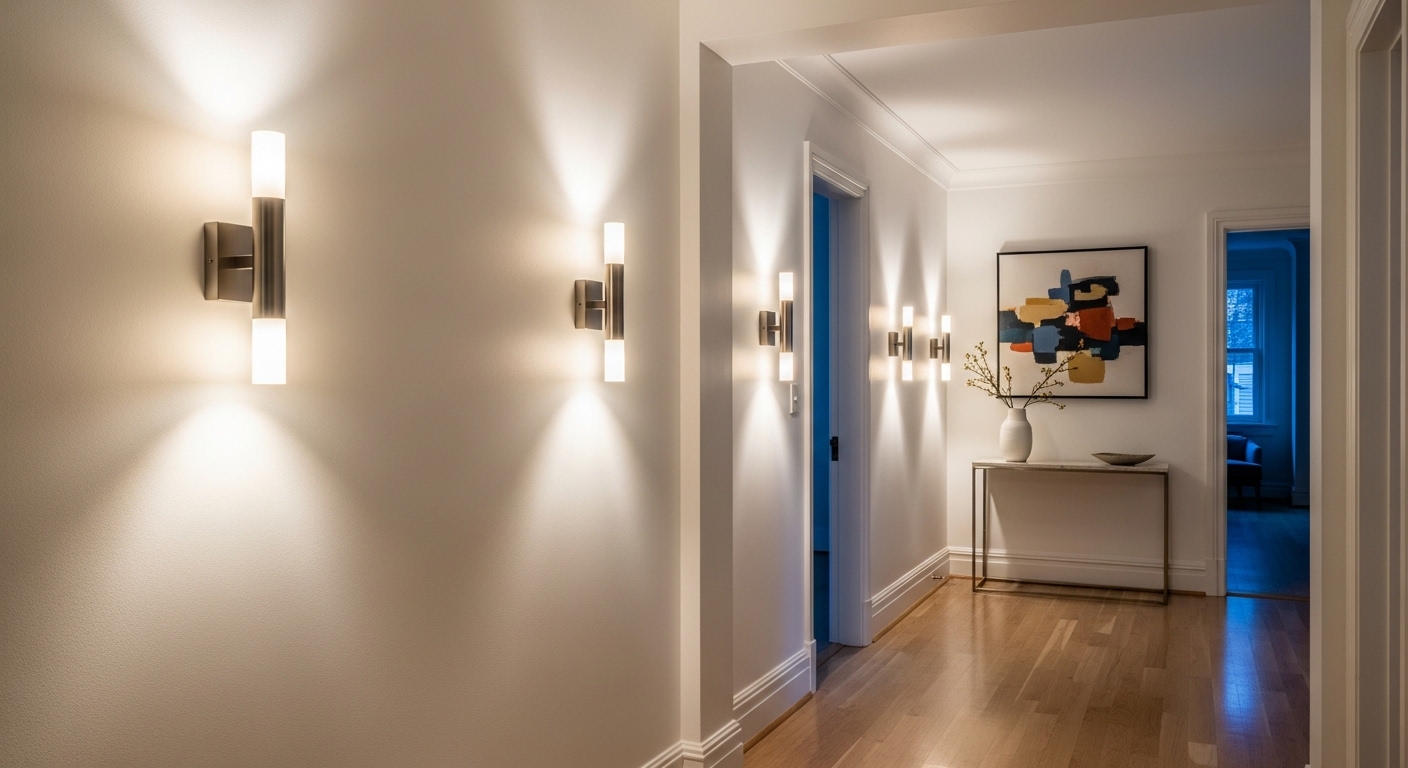
Our main hallway runs 28 feet from the front door to the back bedroom. Before I touched it, it had two bare-bulb ceiling fixtures that left six feet of dark corridor between them. The hallway felt like a space to move through rather than part of the house.
What I Added
Four wall sconces spaced evenly along one wall, all connected to a 3-way dimmer (switch at each end of the hall). The sconces are at 66 inches — eye level for a standing adult, out of reach for anyone under 12. The original ceiling fixtures stayed as backup and occasional use; the sconces handle the daily lighting role.
The Three Settings
Morning (6–8 a.m.): 100%, both overhead and sconces. Daytime: sconces only at 70%. Nighttime: sconces at 15% on a timer from 10 p.m. to 6 a.m. The 15% setting is enough to walk safely without being enough to wake anyone up. My husband stopped using his phone flashlight for late-night kitchen trips the week I installed this.
The Impact
The hallway now feels like a room. It has a mood. It's the first space you see from the front door and the last space you see before the bedrooms. Getting its lighting right made the whole house feel more intentional.
Frequently Asked Questions
How do you light a long hallway?
A series of wall sconces spaced 6–8 feet apart creates the most even and elegant hallway lighting. For a more budget-friendly approach, semi-flush ceiling mounts spaced along the hallway length provide similar even coverage. All hallway fixtures should be on a 3-way dimmer (one switch at each end) so you can control light from either end without walking the length of the hall. A low-dim nighttime setting (10–20%) provides navigation light without waking anyone.
How high should hallway lights be mounted?
Wall sconces in hallways should be mounted at 60–72 inches from the floor — above where someone can reach them casually, but low enough to cast light downward onto the floor rather than just illuminating the ceiling. Ceiling-mounted fixtures in hallways should provide enough downward light to see clearly — enclosed diffusers that direct light downward work better than uplighting fixtures in functional hallways.
Should hallway lights be on a motion sensor?
A motion sensor for the hallway is particularly useful at night — the light comes on when someone gets up for water without requiring them to find and flip a switch in the dark. Pair a motion sensor with a dimmer that holds the last dimmer level so the light comes on at 20% overnight (navigation) rather than 100% (blinding). Some smart switches offer this combination in one unit.