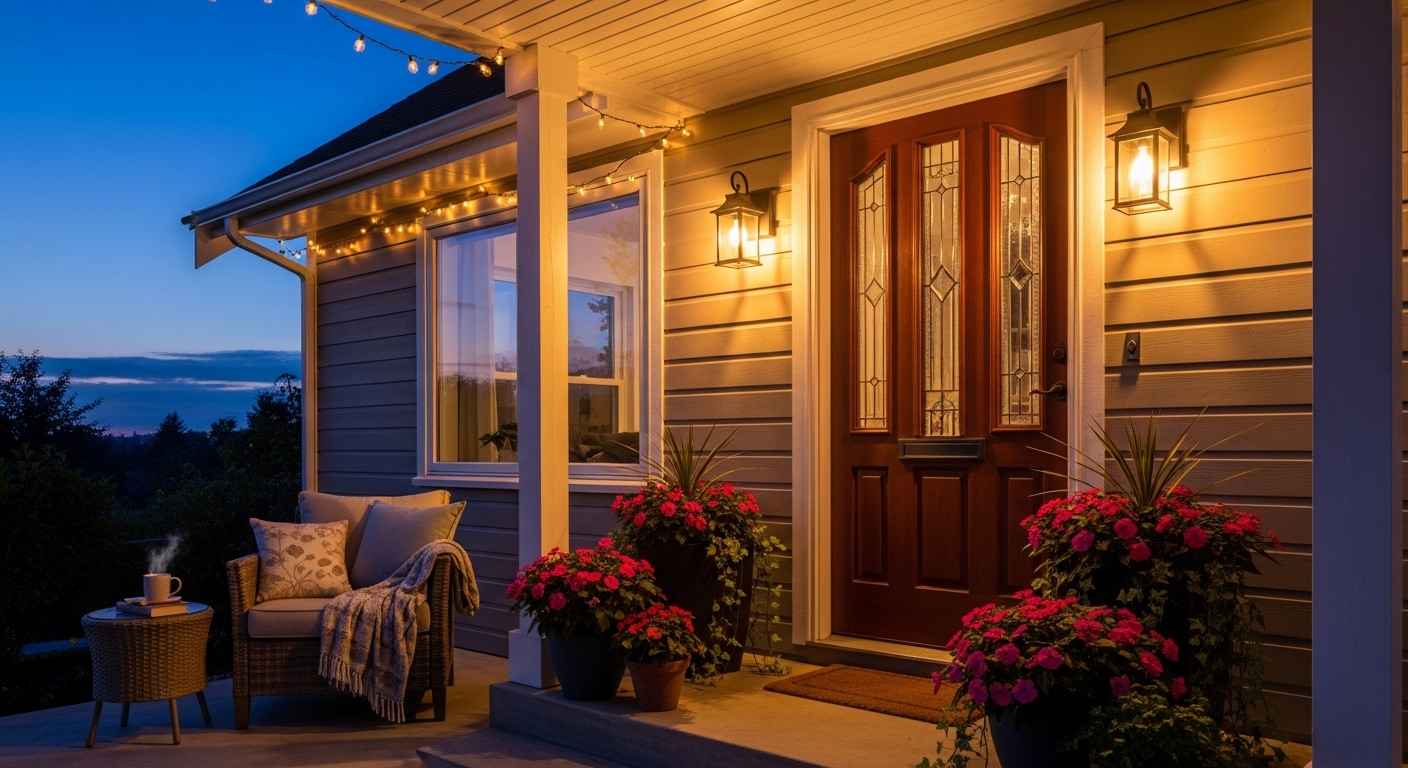
Our front porch light was a bronze coach lantern from the previous owner. The style worked fine; the bulb color didn't — it was a 4000K cool white that made our warm beige house look pallid and institutional after dark. The fix was $8.
The Bulb Swap First
Before buying any new fixture, try replacing just the bulb. A $8 warm white 2700K globe LED transformed what the porch looked and felt like from the street. The lantern style actually worked with the house — the bulb color was the only problem. This saved me the $75 I'd budgeted for a new fixture.
When the Fixture Needed Replacing Too
We did eventually replace both our front porch fixtures — the original was single-mount, and I wanted a pair flanking the door. Two matte black outdoor wall sconces in a lantern style, one on each side of the door. The pair creates symmetry that reads as an intentional design decision from the street.
The Timer
Both fixtures are on a smart switch that comes on at sunset and off at 11 p.m. I haven't manually turned the porch light on or off in 14 months. The porch is lit when it should be, off when it shouldn't. This is the most underrated home automation improvement I've made.
Frequently Asked Questions
What outdoor light fixture is most welcoming?
A warm (2700K) fixture with a lantern or globe style in a finish that matches your door hardware reads as welcoming — it looks like a considered choice rather than a default. The fixture should be sized relative to the door: for a standard 80-inch door, use a fixture 1/4 to 1/3 the door height (20–26 inches tall). Mount at 5.5–6 feet from the ground to the center of the fixture. On a timer so it's on from dusk to a set hour automatically.
How long do outdoor light fixtures last?
Quality fixtures rated UL Wet Location or UL Damp Location should last 10–20 years. Look for powder-coated or marine-grade finishes in regions with freezing winters or humidity. LED bulbs in outdoor fixtures last 10,000–25,000 hours — at 6 hours per day, that's 5–11 years per bulb. The fixture itself should outlast several LED bulbs. Avoid fixtures with exposed sealants that age poorly in UV.
Should outdoor lights be on a timer or motion sensor?
A timer is better for front porch lights that you want on all evening for aesthetics and safety — set to come on at dusk and off at 11 p.m. or midnight. Motion sensors are better for back and side entries that don't need to be on continuously. A combination of both — a timer-based porch light with a motion-sensor floodlight for the driveway — covers all outdoor lighting needs with maximum efficiency.