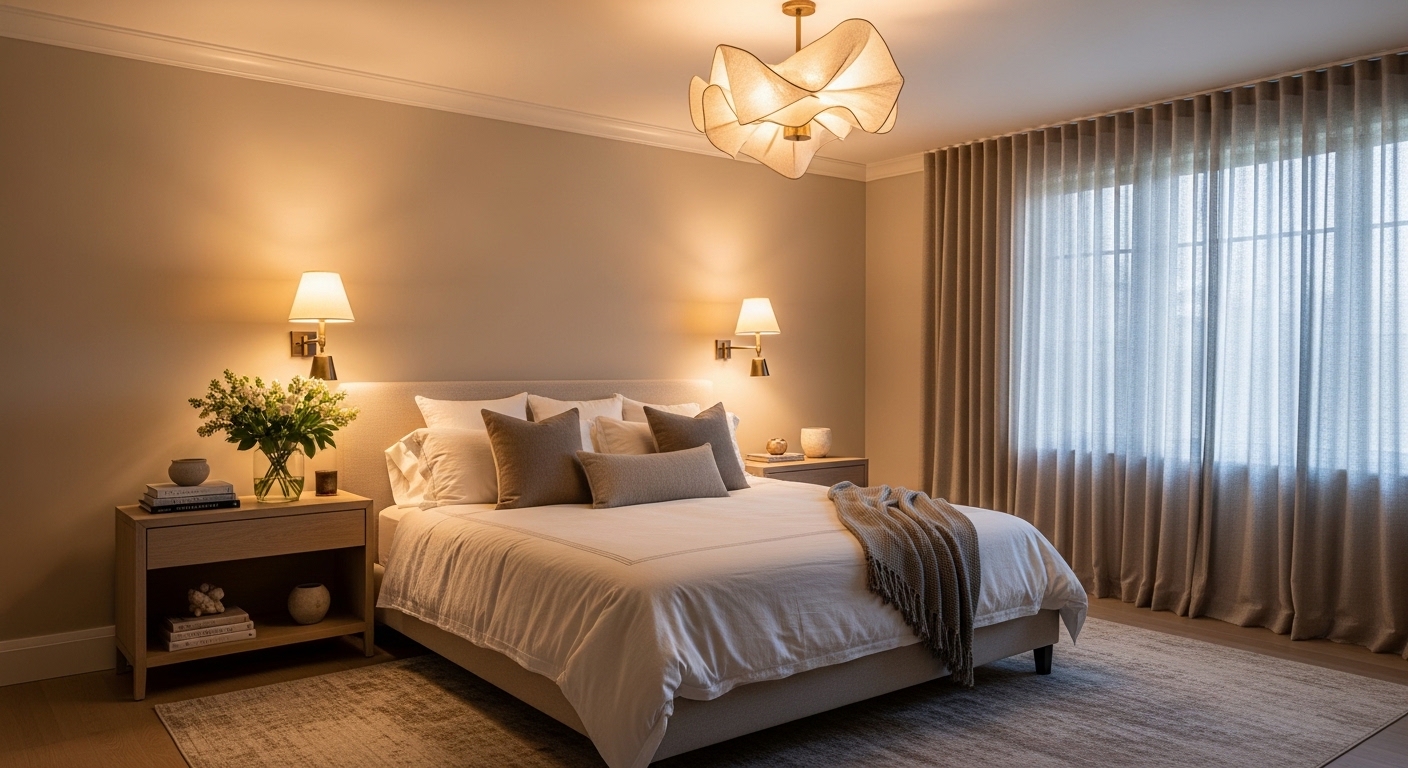
For two years our primary bedroom had a ceiling fan with a four-bulb light kit in the center of the room. The fan worked fine. The light kit made the room feel like a Holiday Inn. We finally replaced it.
The Ceiling Fixture Change
Fan came down. A brushed brass drum semi-flush went up in its center position on a dimmer. The room immediately looked more considered. The fan moved to our closet, which was always too warm — a better use for it than dominating the bedroom ceiling.
The Bedside Sconces
Two plug-in sconces at 62 inches, independently controlled via smart plugs. My husband goes to sleep first; his sconce off doesn't affect mine. I read late; my sconce stays on without bothering him. We've had exactly zero bedtime light arguments since installing them. That's a meaningful quality of life improvement after two years of negotiating lamp timing.
The Overall Result
The bedroom finally feels like a room we chose to be in rather than a room we collapse into. The light is softer, warmer, more controllable. The total change cost $180 — the drum fixture plus two sconces — and it's the best $180 we've spent on the house.
Frequently Asked Questions
Should a primary bedroom have a ceiling fan or a light fixture?
A dedicated light fixture — pendant, chandelier, or semi-flush — makes a primary bedroom feel like a designed room rather than a builder default. Ceiling fans with light kits are a common builder choice because they're dual-function, but they rarely look intentional. If you need airflow, install a fan in one corner of the ceiling rather than centered, and put the statement fixture in the primary position. Or install a DC motor fan with no light kit (controlled by a ceiling fixture separately).
What is the most romantic bedroom lighting?
Warm light (2700K or lower) at low intensity from multiple sources creates the most intimate bedroom atmosphere. Two bedside sconces at 30% on smart dimmers, plus a small decorative lamp in one corner, beats any single overhead fixture at any intensity. The key is multiple sources at low individual brightness rather than one bright source dimmed down — a dimmed bright source still often casts harsher light than multiple smaller sources at their natural levels.
How do you wire bedside sconces without an electrician?
Plug-in bedside sconces are designed for exactly this — no wiring required. They mount to the wall, the cord runs down in a cord cover to a nearby outlet, and you're done. For the cleanest result (no visible cord at all), have an electrician add an outlet behind each nightstand for $75–$100 per outlet. The outlet addition is simple work that takes 45 minutes per side.