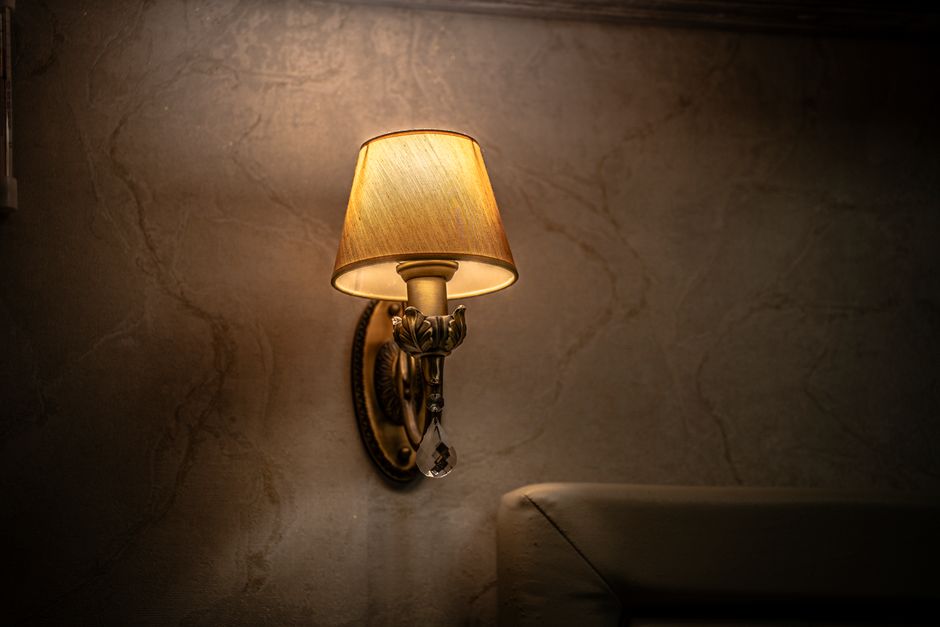
For two years I ran a cord down the parlor wall. Tucked it behind a picture frame. Convinced myself no one noticed. They noticed.
The plug-in sconces in the parlor were fine. They gave the right light, warm and low, flanking the fireplace the way sconces are supposed to. But every time I looked at the wall I saw the cord. And when our neighbor James came to the Fourth of July party and asked, very politely, if we'd "left something plugged in up there," I decided we were finally hardwiring.
A hardwire wall sconce is what I'd wanted from the beginning. But in a house built in 1887, the word "hardwire" carries some weight. Knob-and-tube lurks. Plaster crumbles if you look at it wrong. And the parlor is on the second floor, above a finished ceiling below, which meant the electrician couldn't just drop a wire from above. It was going to be a project. That's why I'd stalled.
What the Electrician Actually Found
We brought in David, the same electrician who did our hallway sconces two years ago. He walked the parlor for about fifteen minutes before saying anything. What he found: the wall with the fireplace had a chase running up from the first floor electrical panel, originally for gas lines that had been converted decades ago. Empty. He could fish a wire up through it with minimal plaster disturbance.
Not every historic wall offers this luck. David said maybe 40% of the old houses he works in have some kind of existing channel he can use. The other 60% require cutting and patching. Our situation was unusually clean. Cost came to $380 for labor and materials, which included a new junction box inside the wall at the correct height and a switched circuit tied to the existing parlor light switch.
I'd budgeted $600, so the $380 was a relief. But I want to be honest: if David had found nothing useful in that wall, we were looking at $700 to $900 for the cut-and-patch approach, and a week of waiting for the plaster repair to cure before painting. That's the real number for a hardwired sconce in a house like ours.
Choosing the Right Hardwire Sconce for an 1887 Interior
The fixture question was actually harder than the installation question. The parlor has 11-foot ceilings, original crown molding, and heart pine floors that cup slightly in summer humidity. It needs something that reads as period without being a costume.
I tried three fixtures before landing on the right one. The first two were too fussy, frosted glass with too much going on. The third was a simple brass arm with a small open shade, more 1920s than 1880s but close enough that the room accepts it. It's from BO-HA's brass sconce collection, the same family as the hallway fixtures, which mattered because I wanted the parlor to feel like it belongs to the same house.
Mounted at 65 inches from the floor, flanking the fireplace at 18 inches from center on each side. That positioning took three rounds of tape marks on the wall before I was happy with it. Don't skip the tape step.
The Difference Between Hardwired and Plug-In
I was not prepared for how much cleaner the wall would look. Not just "no cord" clean. The entire fireplace wall reads differently now. The sconces look like they belong to the house rather than something I added last Tuesday. There's a settledness to a hardwired fixture that a plug-in, however well-disguised, doesn't fully achieve.
That said: for most rooms in this house, plug-in is still the right answer. Our guest bedroom sconces are plug-in and will stay that way. The guest room doesn't have a fireplace wall demanding to look pristine. The parlor did. That's the distinction.
Hardwire when the wall matters. Plug-in when the wall is backdrop.
What I'd Do Differently
I should have hired David for a walk-through before buying fixtures. I assumed both walls flanking the fireplace were equally workable. They weren't. The right wall has a chimney mass running behind it that made the second sconce placement more complicated and added $80 to the job. A fifteen-minute consultation before the fixtures arrived would have caught that. David charges $75 for a walk-through. Worth every dollar in a house this age.
Also: I painted the junction box cover plate to match the wall before David installed the fixture. Took five minutes. Made a visible difference. If you're hardwiring in a plaster wall, paint the plate.
Is a Hardwire Wall Sconce Worth It in a Historic Home
Yes, in the rooms where it matters. The parlor needed it. The result is a fireplace wall that finally looks like I imagined it would look when we bought this house six years ago. The sconces disappear into the room the way good fixtures are supposed to, and all you notice is the light.
$380. Two weeks of planning. One day of work. Completely worth it. I only wish I hadn't spent two years staring at that cord first.