Hallway sconce height in a narrow old hallway is 60 inches from the floor to the center of the backplate, one sconce every 8 to 10 feet centered between doorways, projecting about 6 inches from the wall so the fixture is seen without catching a laundry basket, and in a plaster house the wiring runs through the attic and down so nothing is cut. Our main hallway is 48 inches wide and 32 feet long, the spine of the house, and for the first year it had a single overhead fixture at one end; the far end was always dim, always a little depressing, and getting the sconces right transformed the whole experience of moving through the house. This post is the height and why 60 in a hall people walk through, the spacing and how doorways decide it, the projection rule for a 48-inch hall, matching brass arm sconces and why matched, the wiring through the attic and the three days with zero seams, the plug-in alternative where there was no box, the sequence of pools and what it does, the dimmer and the overnight setting, the ceiling fixture that stayed, the bulbs, the walls between the sconces and what hangs there, the stair end, the mistakes, and the cost.
Sixty inches, and why
Sixty inches to the center of the backplate puts the light at roughly eye level for a standing adult, which feels warmer and more welcoming than overhead placement, and which in a 10-foot hall leaves the upper wall soft and the walking level lit. Higher, at 66 or 68, is the rule some houses use, and in a hall with 8-foot ceilings it is right; in ours, with 10 feet and sconces whose arms angle the shade upward, 60 puts the shade's center at 64 and the light where a face is. We tried 66 on the first pair and lowered them, and the second measurement is the one the other four got.
The spacing
One sconce every 8 to 10 feet, centered between doorways where possible, which in a 32-foot hall with five doors gave four sconces at roughly 68 inches apart from the doorways' centers, and the rhythm reads as placed rather than measured. A sconce beside a door frame is a sconce that lights the frame; one centered between two is a sconce that lights the wall. Where the doors did not allow a center, the sconce went to the side away from the swing, and one door's swing decided one sconce's position by 8 inches.
Projection in a 48-inch hall
Matching brass arm sconces that extend about 6 inches from the wall; in a narrow hall you want projection you can actually see, so the fixture reads as an object and not a plate, and not so much that someone carrying a basket of laundry clips it. Six inches leaves 42 of clear hall, which is two people passing. A flush-to-wall sconce in a narrow hall disappears; a 10-inch arm is a shoulder catch. The arm is the number to check before the finish.
Matched, and brass
Four identical sconces, because a hallway is the one place five different fixtures would look like a shop, and the eye sees all of them at once from either end; brass with a linen shade, unlacquered, darkening at the switch on each fixture where a hand finds it in the dark. The wall sconce collection we used lists backplate sizes, which is worth comparing before you mark a wall, because a 5-inch backplate and a 7-inch one sit differently against a door casing.
The wiring through the attic
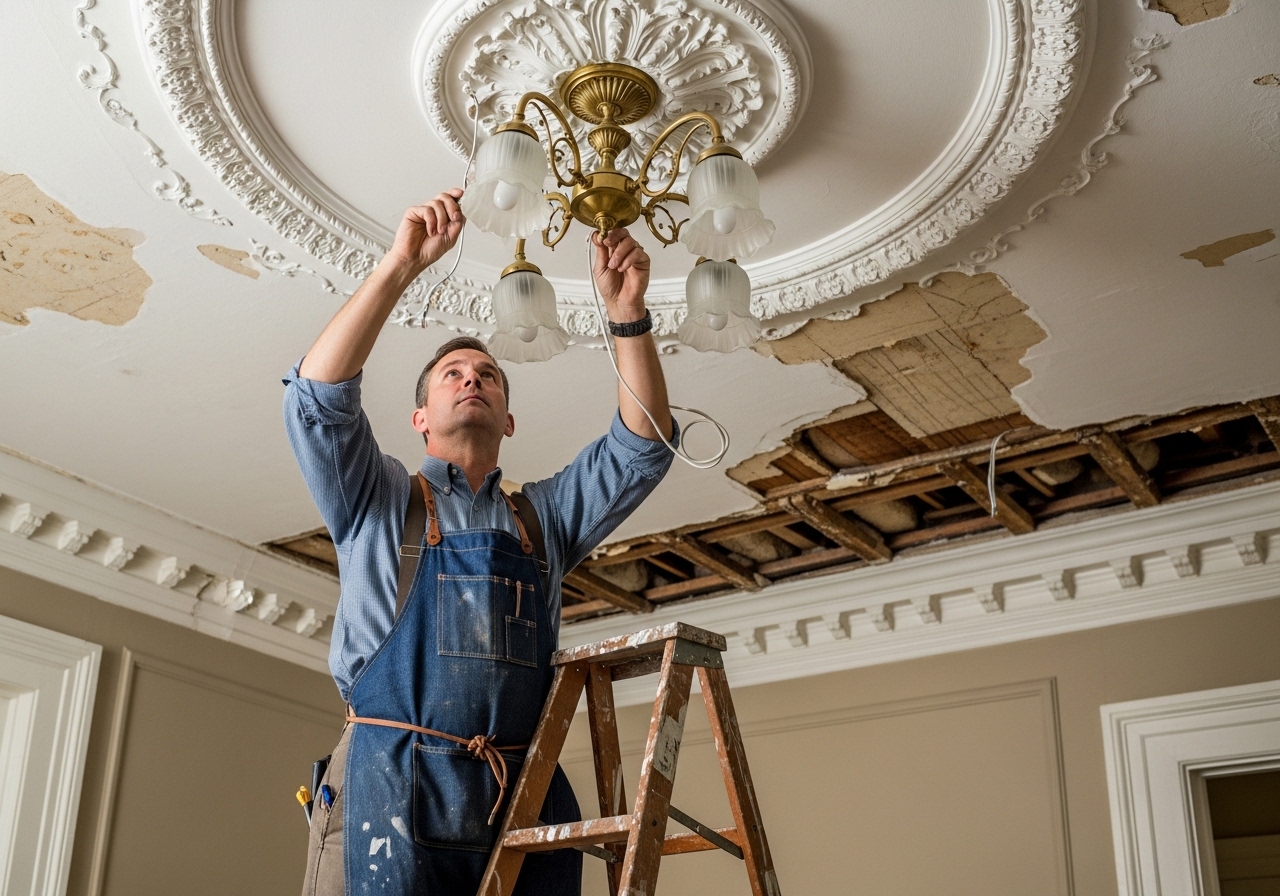
Our plaster walls hide the original knob-and-tube, and we did not want to cut channels we would have to repatch; David ran the new circuit through the attic and dropped it down inside the walls from above, fishing each run to a new box cut only where the sconce's backplate would cover it. Three days of work, zero visible seams, and George the plasterer was not needed. The hardwiring post is the method in detail; the hallway is the room it was learned on.
The plug-in alternative
Where there was no box and the attic could not reach, the upstairs hall's far end, we used plug-in sconces with the cord in a painted cover down to a baseboard outlet, indistinguishable from hardwired at a glance and far less invasive in a historic wall; the same brass, the same height, on a plug-in dimmer. A hallway can be half hardwired and half plug-in and nobody has noticed which is which, and the guest room post is the same trick beside a bed.
A sequence of warm pools
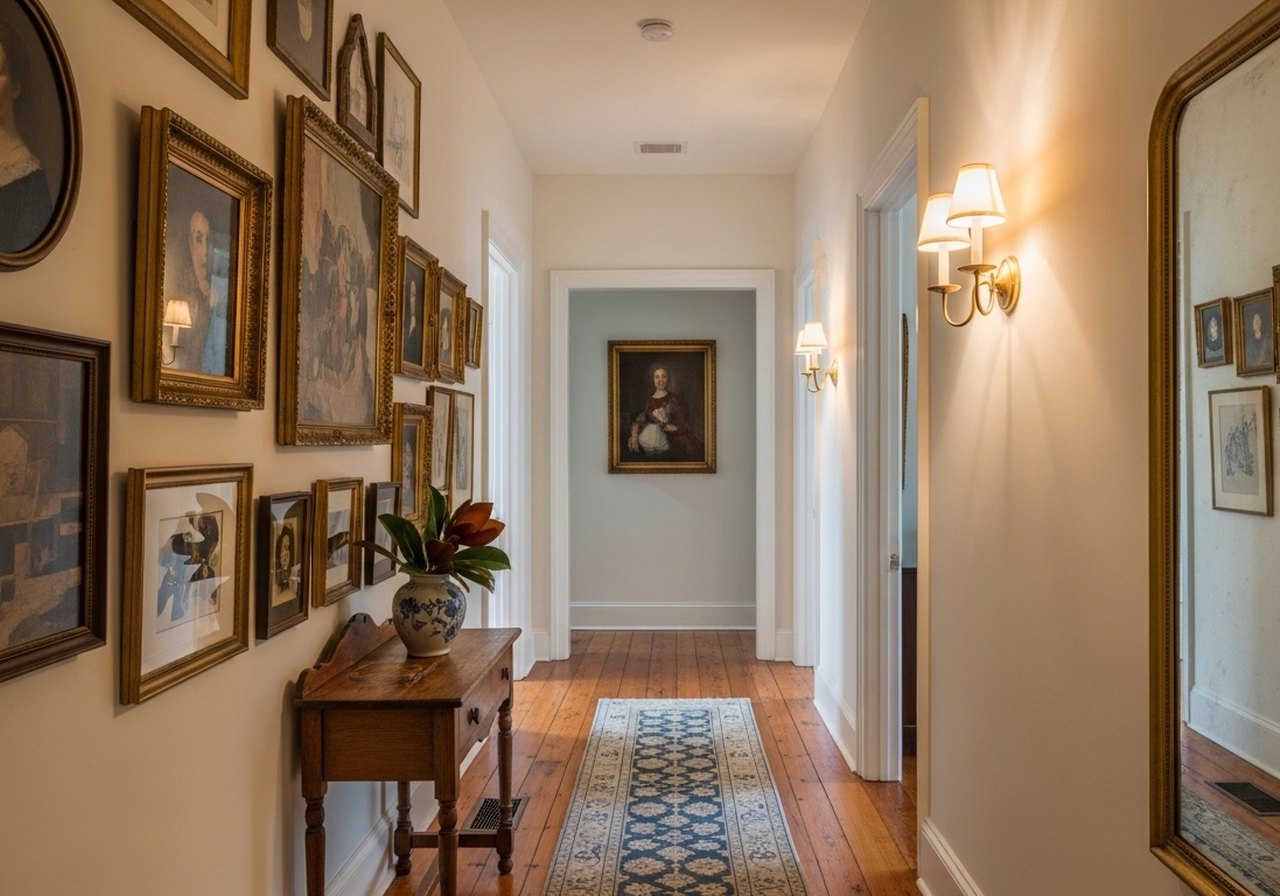
The hall now reads as a sequence of warm pools of light, one every 8 feet, and walking its length is walking from one to the next; it is one of my favorite things about the house. A single ceiling fixture in a narrow hallway flattens it into a tunnel, and sconces at eye level wash the walls, add rhythm and make the passage feel like a considered part of the house rather than dead space between rooms. The far end, which was the dim end, is now the end with the stair's lantern above it and a sconce beside it, and it is the brightest.
The dimmer and the overnight setting
All four hardwired sconces on one dimmer at the kitchen end and a three-way switch at the stair: 40 percent in the evening and 15 overnight, which lights the hall for a trip to the bathroom without waking a guest through a door crack. A hallway at 15 percent from a row of sconces is a hallway that is never dark and never bright, and the ceiling fixture has not been switched on at night in four years.
The ceiling fixture that stayed
The original semi-flush at the kitchen end, with a 2700K bulb and its own switch, for the once a month the hall needs to be at full for a spill or a search; it is backup, and the sconces are the hall. The 10-foot fixtures post is why it is a semi-flush with a 12-inch drop and not a pendant in a 48-inch hall.
The bulbs
2700K, 450 lumens, dimmable, in all four, bought together and changed together, with amber 2200K ones swapped in for December per the Christmas post; a hallway with one bulb a shade off is the room where it shows most, because the four are seen in a row. The shades are linen and the bulbs are frosted, because a hall sconce is passed at 18 inches and a clear bulb through linen is a hot spot.
The walls between
Family photographs and two botanical prints in matching black frames, in the 8-foot gaps at 58 inches to center, lit from the side by the sconce nearest each; the pictures are why the hall is looked at and the sconces are why they can be. Nothing within 12 inches of a sconce, which is where a sconce lights a frame at the wrong angle. The hall is the house's gallery because it is the house's spine, and it was a tunnel with pictures in the dark before.
The stair end
The hall ends at the stair, and the stair's lantern above the landing, on a 6-foot chain from the two-story ceiling, is lit from below by the last sconce so the stair's treads are lit where feet go; a lantern 12 feet up lights the ceiling and the sconce beside it lights the stair. The lantern and the sconces are on the same dimmer, and the stair at 15 percent overnight is the one place in the house that is lit for safety and not for looks, and it looks fine.
The hall by day
A window at the stair end and the transom at the other, and the hall by day is lit by them and nothing else; the sconces come on at dusk on the smart dimmer's schedule and the hall does not have a noon setting. A hall lit by its ends by day and its walls by night is a hall with two characters, and the sconces are only one of them.
Marking the wall
Painter's tape at 60 inches along the whole wall first, then a tape cross at each center between doorways, then a cardboard cutout of the backplate at each cross, and a walk down the hall with a basket to check the arm; an evening, and the boxes were cut exactly where the tape was. Marking before the electrician is the difference between a hall with four sconces where they belong and a hall with four sconces where the wiring was easiest.
Mistakes
The first pair at 66 inches, lowered. A sconce beside a door frame in the first plan, moved to the wall's center before it was cut. A year of the single overhead and the depressing far end. And a 10-inch-arm sconce considered and, at the shop, held against a 48-inch space with a laundry basket, and put back.
What it cost
Four sconces, $520. David's three days through the attic, $1,560. The dimmer and three-way, $58. The two plug-in sconces upstairs, $190, and their dimmer, $14. Bulbs, $30. About $2,370 for the spine of the house lit at eye level, and the three days of fishing wire with no seams is the line that a plaster house makes necessary and a drywall house never sees.
The upstairs hall, done second
The upstairs hall is 40 inches wide and 24 feet long, and it got the same rule a year later with three sconces, one hardwired from the attic and two plug-in where the attic's slope stopped David; the same brass, the same 60 inches, on a dimmer at 15 overnight for the bedrooms' doors. A 40-inch hall took a 5-inch arm instead of 6, and the extra inch of clearance is the one that a laundry basket needs upstairs where the baskets are. Two halls, one rule, and the house is lit from the door to the last bedroom at eye level.
What the sconces did for the rooms off the hall
A room whose door opens onto a lit hall is entered differently from one whose door opens onto a dark one, and the parlor, the dining room and the library all read as warmer after the hall was done, without a fixture in any of them changing. The hall's light through an open door is a room's fourth wall at night, and it was black for a year. The high ceilings post is the rooms; the hall is what connects them and it was the last thing lit and should have been the first.
The hall in a smaller house
A 16-foot hall takes two sconces at 4 and 12 feet; a 24-footer takes three; the rule is length minus 8, over 8, plus one, at 60 inches, between the doors. A hall of any length with one ceiling fixture is a tunnel, and the sconces are the fix at any length, in brass or black or nickel to match the house's metal, on a dimmer that goes to 15 overnight. It is the project I would tell anyone with an old house to do first, and it was our third, after the parlor and the kitchen, which is the wrong order for a house whose spine is its hall.
In one paragraph
Sixty inches to the backplate's center, one sconce every 8 to 10 feet centered between doorways, a 6-inch arm in a 48-inch hall, four matched brass sconces on one dimmer at 40 in the evening and 15 overnight, wired through the attic with no seams, plug-in with a painted cover where the attic could not reach, pictures between them at 58, and the ceiling fixture kept for spills. A tunnel became a sequence of warm pools, and the house's spine became a room.
Shop this post: wall sconces, worth comparing backplate sizes before you mark the wall