Christmas decorating in a historic home is about editing, not adding: greenery, candles and one or two objects per room, nothing that puts a nail or an adhesive into original woodwork or plaster, and every wall sconce in the house swapped to an amber bulb for the season. The temptation in a large old house is to fill every surface, and the problem is that a house with strong architectural character does not need more; it needs the right things, placed with intention, in a building that has seen 130 Christmases and does not require ours to be louder than the last 129. This post is the editing principle and where it came from, the front door's wreath, the stair rail's garland with no lights and why, the parlor mantel of pine and magnolia from the garden, the tree in the front window and the ornaments that mean something, the amber bulb swap and what it does to the sconces, the candles and the rules for them near old wood, protecting the house while decorating, the dimmers as the season's real decoration, the dining room table and the built-ins' shelves, the piazza's lanterns at Christmas, what we do not do and why, the order it goes up and the day it comes down, the mistakes, and the cost, which is mostly nothing.
Editing, not adding
The house has plaster medallions, a carved mantel, turned balusters and heart pine floors, and every one of them is already a decoration; the question for any holiday object is whether it respects those or competes with them, and most holiday objects compete. The principle we settled on after a first Christmas of too much: add nothing that does not respect the character of the house, and take away anything that is not greenery, candles or an object with a history. The house's own Christmas is the one where the architecture is still visible on December 25.
The front door
A wreath, fresh, of mixed pine and magnolia with a plain linen ribbon, hung from the door's existing knocker on a loop of ribbon so nothing touches the paint or the original mortise lock, replaced if it dries out before January; it is the only decoration the street sees by day and, with the lanterns from the lantern post at 2700K on either side of it, the only one it needs. The lanterns' bulbs do not change for the season, because they are already the color of a candle.
The stair rail
Fresh garland on the stair rail, tied with jute at each newel and every third baluster, with no lights, because the rail has original turned balusters that deserve to be visible and a string of lights on a garland turns a stair into a lit garland instead of a stair with greenery on it. The garland goes up the day the tree does and comes down when it drops needles, which in a heated house is about three weeks. It is the decoration guests photograph and it costs $60 from the farm and an hour.
The parlor mantel
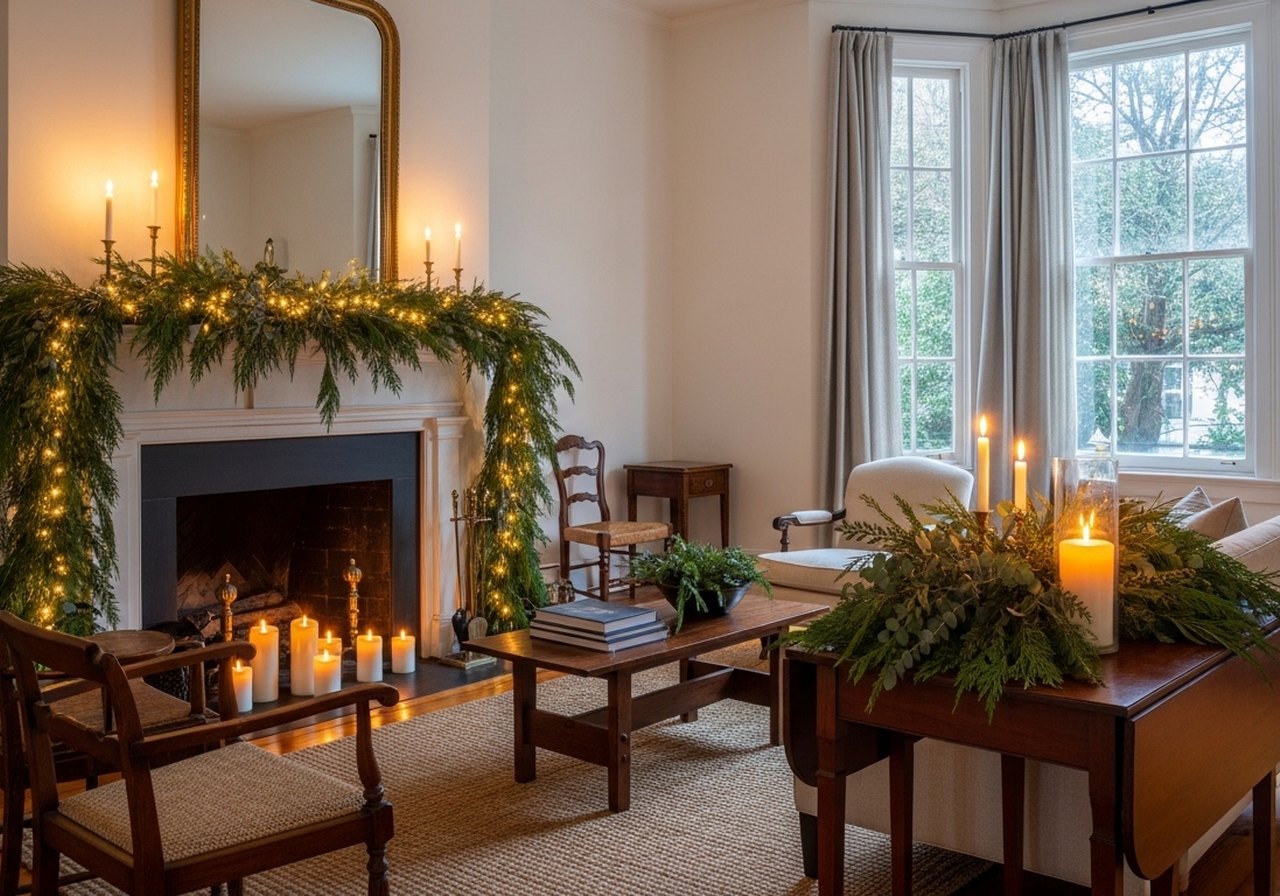
Pine, magnolia and candles, arranged along the mantel with the carved surround left fully visible; no plastic, no foam, no wired picks. The magnolia leaves are from the tree in the back garden and the pine comes from a farm twenty miles north of the city, and the arrangement takes an afternoon and is refreshed once. The candles are real, in brass sticks, and they are lit for dinner and for guests and never left, per the rules below. The mantel is the parlor's Christmas, and the sconces flanking it at amber are what make it read at night.
The tree
In the front parlor window, visible from the street, a real tree, slightly imperfect, that smells like the holidays; ornaments collected over years, not a matching set but objects that mean something, on warm white lights at low density, one string per 2 feet of height rather than the two the packaging suggests. A tree in a room with an 11-foot ceiling is 8 feet, which is the tallest that fits through the piazza door, and it stands on the heart pine on a felt pad and a saucer, because a tree stand's ring on a 130-year-old floor is a permanent decoration.
The amber bulb swap
The thing that makes every decoration better at Christmas is warm, layered light, and the cheapest version of it is swapping the 2700K bulbs in every wall sconce in the house for 2200K amber ones for the season, about $50 for the fourteen sconces from the hallway post and the rooms. At 2200K a sconce is the color of a candle and the greenery beside it looks like greenery by candlelight; the rooms go a shade darker and a shade warmer and the whole house reads as December. The bulbs go back in January into a labeled box, and the swap is twenty minutes each way.
Candles, and the rules near old wood
Real candles on the mantel and the dining table, in weighted brass sticks, lit only when someone is in the room and never within 18 inches of greenery, a curtain or a piece of the house; the mantel's are on the stone shelf and not the wood surround, and the table's are on the runner. A house of this age is a house of dry pine and old wiring, and a candle is a thing we light on purpose and watch. Battery candles in the windows, on timers, are the exception that lets the street see candlelight without a flame near a 9-foot curtain.
Protecting the house
No nails or adhesive into original woodwork or plaster, ever; the wreath hangs from the knocker, the garland ties to the newels, the stockings hang from the mantel's existing brass hooks that a previous owner installed and we inherited. Greenery and candles stay clear of heat. The old wiring is not loaded with too many light strings, and warm lights on a dimmer do the glowing that a dozen strings would; one circuit's worth, on a smart plug, on at 4 and off at 11. The house has survived 130 Decembers and the goal is that it does not notice this one.
The dimmers as the real decoration
Every room's lighting goes lower for the season: the parlor's chandelier at 30 percent, the dining room's at 40, the hall's sconces at 25 in the evening and 15 overnight, the entry's lantern at 40. A house at Christmas is a house lit lower and warmer than in June, and the dimmers, which are in every room for the rest of the year, are what make the greenery and the amber bulbs read. The high ceilings post is the fixtures; December is their lowest setting.
The dining room
The table gets a runner of magnolia and a row of candles, and the built-ins' shelves from the built-ins post get a sprig of pine on each and the family silver moved forward; the shelf strips at 20 percent light the pine from above and the shelves become the room's second mantel. Nothing else changes in the dining room, because the chandelier at 40 over a table of candles and greenery is already Christmas, and the built-ins were made for exactly this week.
The piazza
A wreath on the piazza door's lantern side, a garland along the rail at the sitting end, and the hanging lantern at 50 percent through the season with the wall lanterns at 25, per the piazza post; the piazza is the house's face to the street and at Christmas it is a lit porch with greenery on it and nothing more. No lights on the columns, which is a thing done on this block and which turns a piazza into a pier.
What we do not do
Lights on the exterior beyond the lanterns. Inflatables, obviously. Themed rooms. A second tree. Garland on the crown moldings, which nobody can reach without a ladder against plaster. Anything on the medallions. A matching ornament set. Music from a speaker on the piazza. Each of those is a thing the house's neighbors do beautifully and a thing this house, with its own character already doing the work, would be diminished by. The list of what we do is four lines; the list of what we do not is the rest of the catalog.
The order it goes up, and the day it comes down
The second Saturday of December: the amber bulbs in the morning, the wreath and the garland after lunch, the tree in the afternoon with the family, the mantel on Sunday. Twelfth Night, January 6, everything down in a morning, the bulbs back, the tree to the curb for the city's mulching, the garland to the compost, the box to the attic. Four weeks, which is what a fresh tree and a fresh garland last in a heated house and what the house's calendar has been since it was built.
What a guest sees
From the street, lanterns, a wreath and a tree in the window. Inside, greenery on the rail and the mantel, candles at dinner, and a house that is a shade darker and warmer than usual and otherwise itself. Guests say it feels like an old-fashioned Christmas, which it is not, particularly; it is a house of a certain age at its lowest dimmer setting with pine on the surfaces, and that reads as old-fashioned because most Christmases are lit at full.
Mistakes
The first year: lights on the garland, a second tree in the dining room, a matching ornament set, and a house that looked like a store. A wreath hung from a nail in the door, once. Candles on the wooden mantel shelf before the stone one was cleared. Two light strings on one old circuit that tripped the breaker on Christmas Eve. And leaving the tree up until the needles were on the floor, which on heart pine is a sanding.
What it costs
The tree, $90. The garland and the wreath, $110. Pine and magnolia for the mantel and the table, $30 and the garden. Amber bulbs, $50, once, and reused. Candles, $40. About $320 a year, most of it greenery, and nothing that stays in the house past January 6 but the bulbs in their box.
The kitchen and the bedrooms
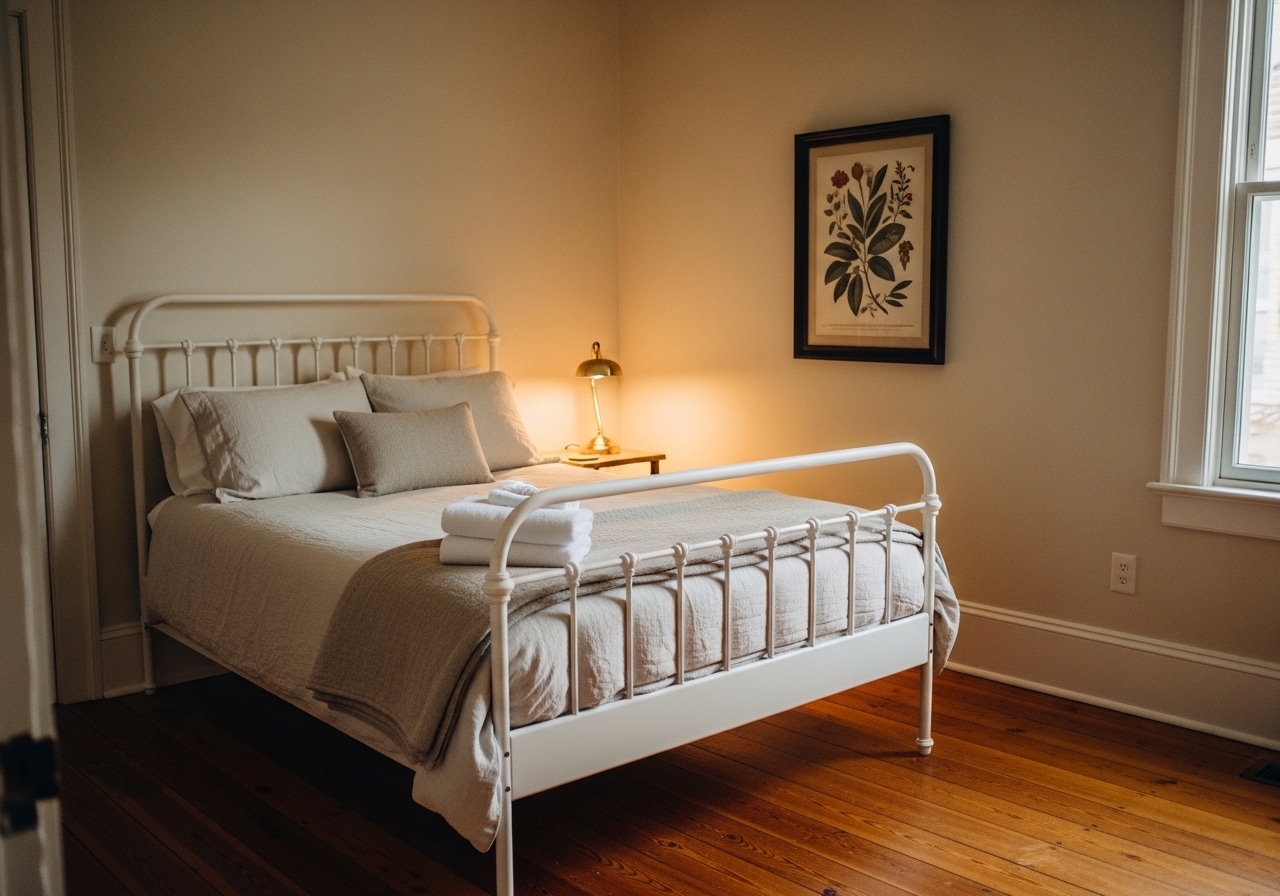
The kitchen gets a bowl of clementines and a sprig of pine on the island under the pendants, and nothing else, because a kitchen at Christmas is a kitchen that is being used; the bedrooms get a single stem of pine in a glass by the bed and the sconces at amber, and a guest's room gets the same, which is a room that smells like December when they arrive. Rooms that are not seen from the street or the parlor get the least, and the least is one green thing and the bulb, which is enough.
Twelfth Night, and the house after
The morning of January 6 the house goes back to itself, and it is the day the architecture is most visible, because four weeks of pine on every surface make a bare mantel look carved again; the amber bulbs are the last thing out and the house goes a shade cooler and brighter, which after four weeks reads as spring. The only thing that stays is the smell of pine in the parlor for a week, which is the house's own decoration and costs nothing.
In one paragraph
Greenery, candles and one or two meaningful objects per room. A wreath from the knocker, garland tied to the newels with no lights, pine and magnolia on the mantel, a real tree in the window with ornaments that mean something. Amber bulbs in every sconce and every dimmer a notch lower. No nails, no adhesive, no overloaded circuits, no flame near old wood. Up the second Saturday of December, down on Twelfth Night, and a house that is still visible under its Christmas.
Shop this post: wall sconces, the fixtures that take the amber bulb for the season