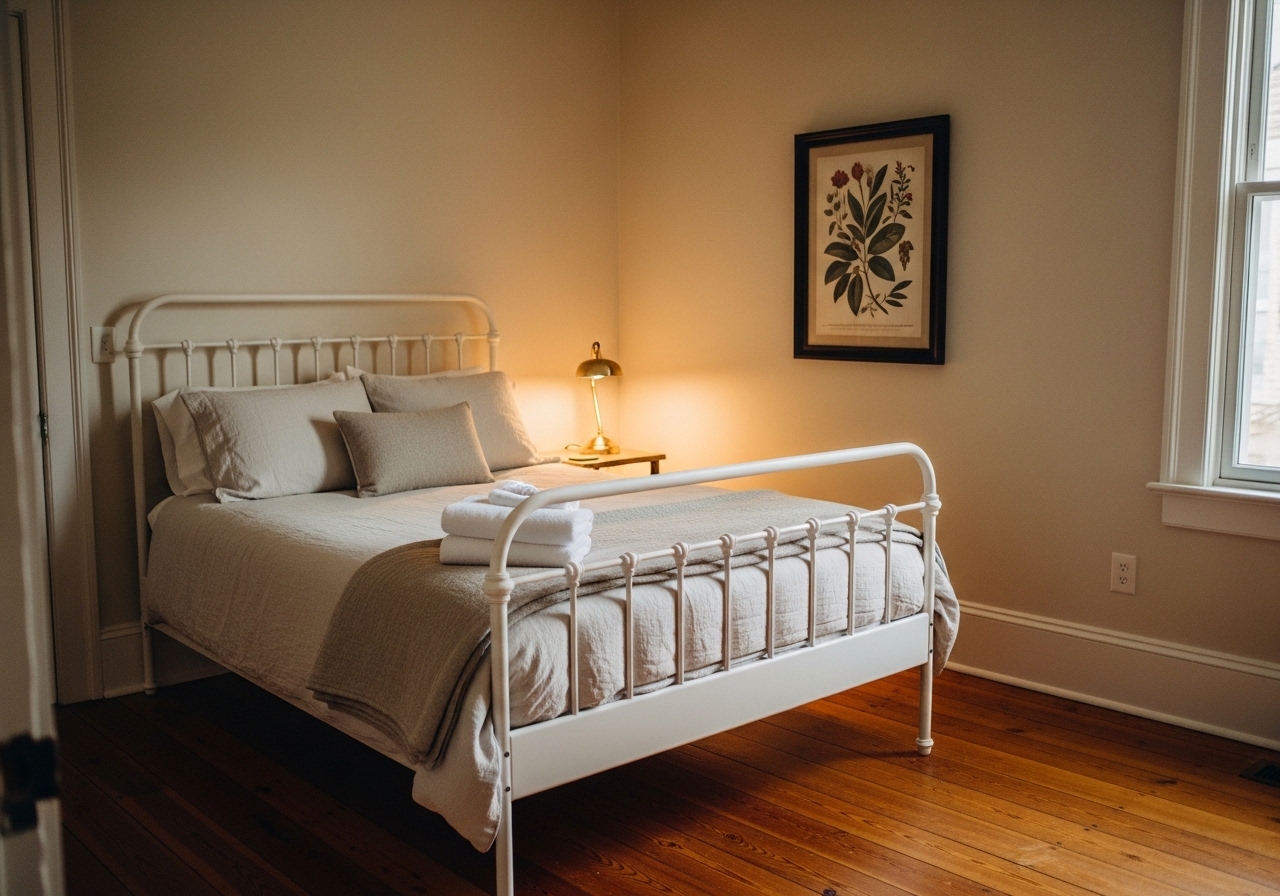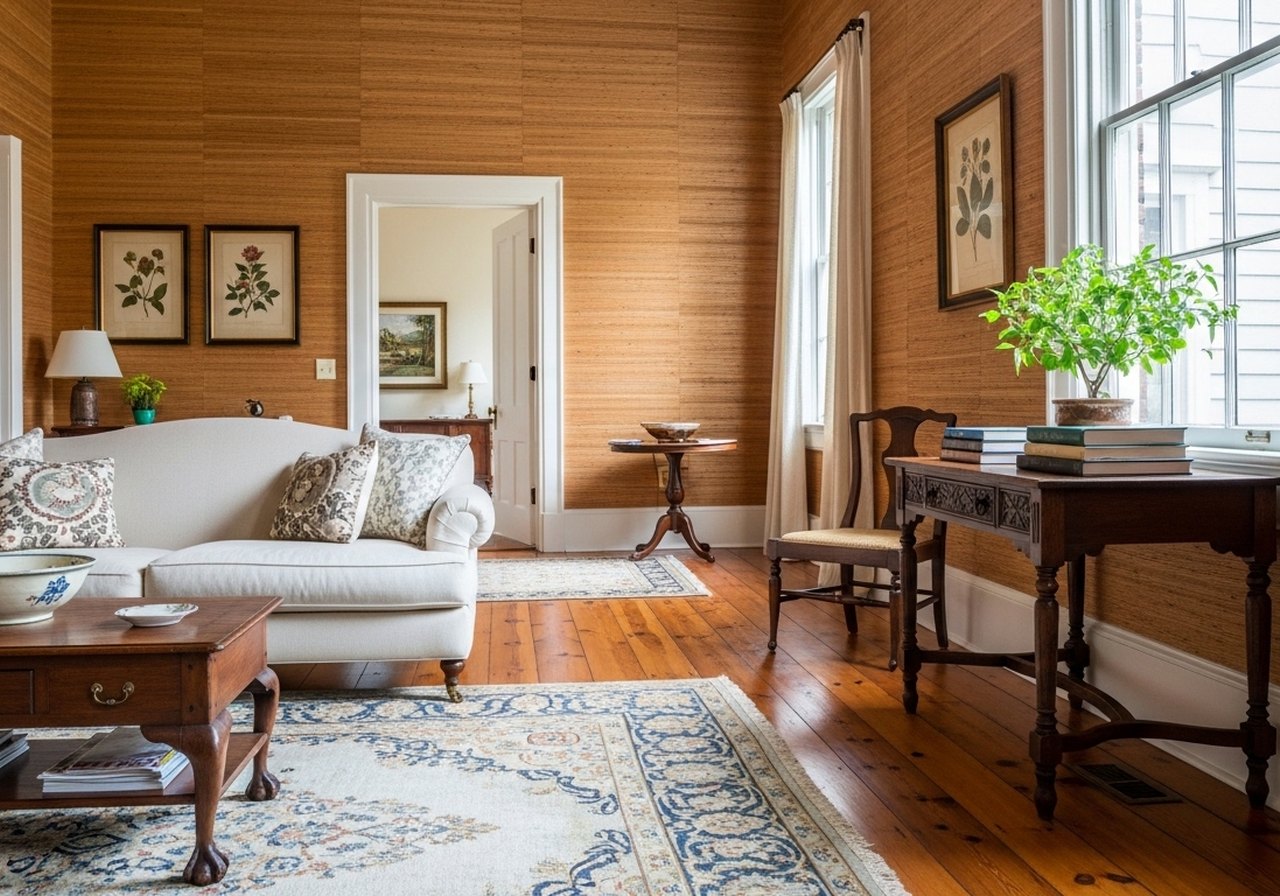
Grasscloth wallpaper is the closest thing to a period-appropriate wallcovering I could find for an 1892 bedroom, because it adds texture without pattern and warmth without committing the room to a specific decorative decade, and in a room with original plaster it reads as an intentional choice rather than an attempt to approximate an era. Wallpaper in a historic house requires more homework than wallpaper anywhere else: get it right and the room feels complete, and get it wrong and the paper looks like it is fighting the house. Ours runs about $4 to $8 a square foot and the master bedroom took twelve rolls plus the extra one this post insists on. This post is why not a print, why grasscloth over paint, the scale mistake people make, the plaster prep and the clay primer, the paste for non-porous walls, the installer question to ask, the one-dye-lot rule and reverse-hanging, buying an extra roll and why old walls need it, the seams and what they show, humidity and where grasscloth cannot go, the sconces the texture demanded, the bed wall versus all four, cleaning what cannot be scrubbed, the mistakes, and the cost.
Why not a print
The mistake most people make is choosing a pattern that is too modern or too quirky for the scale of the room: a small-repeat botanical that works beautifully in a powder room looks infantile in a bedroom with 10-foot ceilings, and a large modern geometric argues with a plaster crown. A period-correct print is the other trap, because a reproduction 1890s paper in an 1890s room is a costume unless the rest of the room is in costume too. I looked at forty prints and every one of them was either the wrong decade or the wrong scale, and grasscloth was the thing that was neither.
Why grasscloth over paint
Grasscloth brings warmth and a natural texture that flat paint cannot, and it forgives the minor imperfections of old plaster better than a smooth finish does: a plaster wall that is never perfectly flat reads as flat under woven grass and as wavy under eggshell paint. It also gives the room a surface that light moves across, and the bedroom's sconces at night make the weave visible in a way that a painted wall has nothing to offer. The bedroom had been painted four times, as the bedroom post records, and the fourth paint was fine and the grasscloth was finished.
The plaster prep
Installation in a plaster house requires extra primer and a paste designed for non-porous surfaces: old plaster with a century of paint on it does not absorb like drywall, and an installer who treats it like drywall gets bubbles and lifting seams within a season. Ours used a clay-based primer, two coats, which gives the paste something to grip and evens the wall's absorption, and then a roman-shade paste, which is a heavy clear paste that does not soak through the grass and stain it. No bubbling, no separation at the seams, four years in.
The installer question
Ask specifically whether they have hung grasscloth on plaster before, and if the answer is a story about a particular house, hire them; if it is a general yes, keep looking. Grasscloth is less forgiving than standard paper, the seams show and the panels vary in tone, and plaster adds the primer and paste problems above; an installer who has done both is a different trade from one who has done either. Ours had, and the difference showed at the seams.
One dye lot, reverse-hung
Every roll from one dye lot, confirmed on the labels before the box was opened, because grasscloth is a natural fiber and two lots are two colors; and the panels reverse-hung, alternating direction, so any tonal variation across a roll's width is mirrored at each seam rather than stepped. Reverse-hanging is standard for grasscloth and the thing an inexperienced installer skips, and it is the reason our seams read as texture and not as stripes.
Buy an extra roll
The biggest lesson: plaster walls in old houses are never perfectly flat or plumb, and your installer will need more material than the square footage calculation suggests, for the panels trimmed to a wall that leans and the one cut around a window that is 2 inches out of square. The room calculated to eleven rolls; we bought twelve and used eleven and a half. A room that runs out mid-wall waits four weeks for a roll from a different dye lot, and that roll is the one everyone sees.
The seams
Grasscloth seams show, by design, and the choice is to accept that or to choose paint; ours are visible as a faint vertical every 36 inches and read as the rhythm of the wall, the way boards read on a paneled one. The installer laid them out from the bed wall's center so the seams are symmetrical about the headboard, which is the detail that makes visible seams look intended. A seam at a random point on the focal wall is a seam; one centered on the bed is a design.
Humidity, and where it cannot go
Natural fiber stains easily and cannot be scrubbed, so grasscloth goes in a lower-humidity room away from splashing: the bedroom, yes; the bathroom, never; the kitchen, never; the piazza-side rooms with windows open all summer, with caution, and ours is on the north side. In Charleston humidity is the enemy of every natural material, and the bedroom is air-conditioned and closed, which is why it is the room that got the grass and not the sunroom.
The sconces the texture demanded
Installing the grasscloth changed how I thought about the bedroom's sconces: the articulating reading sconces from the makeover were a cool brass with white shades, and against the warm weave they looked clinical, so we swapped in a warmer unlacquered finish from the wall sconce collection with linen shades, and the pairing is what made the wall. A textured wall wants a textured shade and a metal that ages, and the antiques and modern post is the reasoning; a sconce is seen against 4 square feet of wall and has to agree with it.
The bed wall versus all four
All four walls, because a single papered wall in a bedroom reads as a headboard that has spread, and because grasscloth is quiet enough to surround a room without closing it in; a patterned paper would have gone on one wall, and the fact that grasscloth could go on four is the reason it was chosen. The ceiling stayed the plaster's warm white, and the crown is the line where the weave stops.
Cleaning what cannot be scrubbed
A soft brush attachment on the vacuum twice a year along the whole wall, downward; a dry eraser sponge for a scuff; and nothing wet, ever. A mark that will not come off is a mark that is lived with or a panel that is replaced from the spare roll, which is the other reason for the spare. Four years, two scuffs, one sponge, and no panel replaced.
Grasscloth and the light
By day the north window rakes across the weave and the wall has a grain; at night the sconces at 20 percent light the wall from 60 inches and the texture is the room's decoration. A painted wall in the same light is a painted wall. The paper cost the same as a good paint job plus the installer, and it is the surface the sconces were bought for.
What I would do differently
Nothing in this room; in the next, hire the same installer for the hanging and do the prep myself, because the prep is two coats of primer and a day and the hanging is a skill. If we did another room we would consider the guest room across the hall, which is dry and north-facing, and we would buy the extra roll again.
Mistakes
Forty prints looked at before the answer was texture. Almost hiring an installer with a general yes. The cool brass sconces for a month against the warm weave. And calculating eleven rolls, which was correct and was the reason the twelfth was bought, because correct is not enough on a plaster wall.
What it cost
Twelve rolls at about $6 a square foot, $2,160. Clay primer and paste, $140. The installer, two days, $1,100. The sconce swap, $190. About $3,590 for four walls of a bedroom that finally stopped being repainted, and the twelfth roll, $180, is the cheapest insurance in the list.
Choosing the color and the weave
A fine weave in a warm oatmeal with a paper backing in a tone slightly darker than the grass, so the backing shows through the weave as a shadow and the wall has depth; a coarse weave reads as a beach house and a very fine one as fabric, and the middle is the one that reads as a wall. Samples of six, 12 inches square, taped to the bed wall for two weeks and looked at at 8 am by the window and at 10 pm under the sconces, and the winner was the one that did not change color between the two, which only one of the six managed.
Grasscloth versus the alternatives we priced
Venetian plaster, which would have been correct and was $14 a square foot and a specialist we could not book; limewash, which is lovely and which cannot be touched up on a wall a headboard leans against; a linen wallcovering, which was $18 a foot; and paint, which was what the room had and had four times. Grasscloth at $6 was the middle of the list and the only one that gave the wall a texture the sconces could work with at a price that left money for the sconces.
The day of the hanging
Furniture to the center under a sheet, the sconces off the wall and the outlets' plates off, the primer's second coat cured for 24 hours, and the installer starting from the bed wall's center line with a plumb bob; twelve panels in two days with the trimming at the crown and the baseboards taking the second afternoon. The room was back together by the second evening and the sconces went back up on the third, which is when the wall was seen lit for the first time and the whole project was justified in a minute.
Living with it
The wall has not been touched in four years except by the vacuum's brush, the seams have not lifted, and the color under the sconces at night is the color it was the first evening; a guest ran a hand along it and asked whether it was original, which for a wallcovering in an 1892 room is the compliment. It has outlasted the four coats of paint that preceded it by a factor I will not calculate, and it is the last thing this bedroom's walls will get for a decade.
The rooms that will not get it
The parlors, whose plaster is the point and whose walls were repaired to be seen; the dining room, whose built-ins are painted the wall color and would fight a texture; and the kitchen and bathrooms, for the humidity. Grasscloth is a bedroom's and a study's material in this house, and the library, which is books to the ceiling on three walls, has one wall that may get it one day. A wallcovering earns a room the way a curtain earns a window, and in a house whose walls are its history, most of the walls stay plaster.
In one paragraph
Texture, not pattern, in a room with plaster and a crown. Clay primer twice, roman-shade paste, an installer who has done grasscloth on plaster, one dye lot reverse-hung, seams laid out from the bed wall's center, and an extra roll for walls that are not plumb. A dry north room, all four walls, warm brass sconces with linen shades against the weave, a vacuum's brush twice a year and nothing wet. About $3,600, and a bedroom that is finished.
Shop this post: wall sconces in a warm finish for a textured wall