Where to put lamps in a living room is answered by one rule I resisted for weeks: a room needs a light source in every corner, at seated eye level, so the eye travels across the room to its edges and the space reads as inhabited all the way out; one $90 table lamp in the far corner did more for our living room than the $1,200 sofa. We had the furniture arranged for six months, correctly by any reasonable standard, and the room felt like a furniture store; a friend said the corner was empty, and she meant a light. This post is the corner rule and the physics of it as far as I understand them, the lamp that did it and why ceramic and linen, the three heights a living room's lamps should sit at, the seated-eye-level rule for shade bottoms, the perimeter versus the center, the two sconces flanking the fireplace that freed the floor, the floor lamp's one job, the overhead's demotion, bulbs and the one temperature rule, dimmers on every lamp, the cords in an old house, the lamp count for a 17-by-22 room, what a lamp does that a ceiling cannot, the mistakes, and the cost.
The corner rule
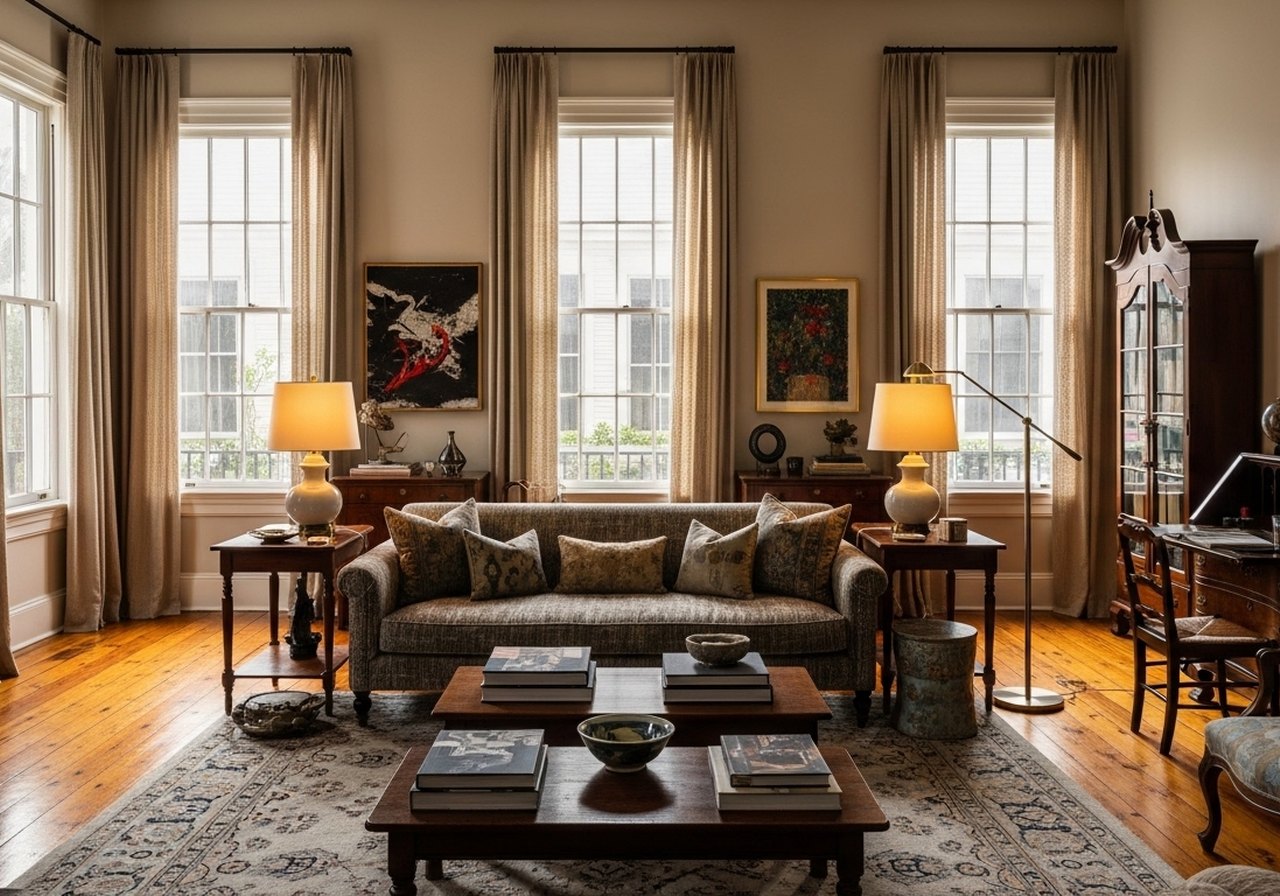
A ceiling fixture lights the middle of a room and leaves the corners in shadow, and a room whose corners are dark is a room whose edges the eye cannot find; it stops at the last lit thing and the room ends there. A lamp in a corner extends the room to the wall, and a lamp in every corner makes the room feel three-dimensional and inhabited to its edges. Our living room is 17 by 22 and had a floor lamp by the sofa and nothing else; the far corner was 20 feet of nothing, and the lamp that went there was the difference between a furniture store and a room. I do not entirely understand the physics, but it works every time.
The lamp
A large ceramic base in an ivory glaze, 26 inches to the socket, with a drum shade in natural linen, 16 inches across, from a shop on King Street, $90 on sale; ceramic because it has weight and warmth and no shine, linen because it diffuses to a glow and the bulb is invisible through it. On a round side table in the far corner beside a chair, so the corner has a reason for a lamp and the lamp has a reason for the chair. When it is on, the corners warm up and the room changes, and it is the lamp I would buy first for any living room.
Three heights
Table lamps at seated eye level, floor lamps a foot above it, and sconces at 60 to 62 inches, so the room's light comes from three altitudes and no single plane; our living room has two table lamps at 40 inches to the shade's bottom, a floor lamp at 52, and two sconces at 60, with the chandelier at 30 percent as the fourth and highest layer. The heights are what make the room glow from several points rather than one flat source, and the layering post is the same three in a room half the size.
Shade bottoms at seated eye level
The bottom of a table lamp's shade should sit at about 40 inches from the floor, which is the eye level of a seated adult, so the bulb is hidden sitting down and the light lands on the lap and the table and not in the face; a lamp on a tall table with the shade bottom at 48 glares at everyone seated and lights the ceiling. Lamp height plus table height equals 40, and it is the arithmetic that decides which lamp goes on which table. Our corner lamp is 26 inches on a 24-inch table with the shade's bottom at 39.
Perimeter, not center
Lamps go around the room's edge, at the corners and the ends of the sofa, and not in the middle, because the middle is where the ceiling fixture already reaches and the edges are where it does not; a lamp on the coffee table is a lamp in the one place the room does not need one. Distributed around the perimeter at varying heights, four lamps make a room glow from four points, and the center is lit by their overlap. It is the opposite of how most rooms are lit, and it is why most rooms feel like the middle is the only place to sit.
The two sconces at the fireplace
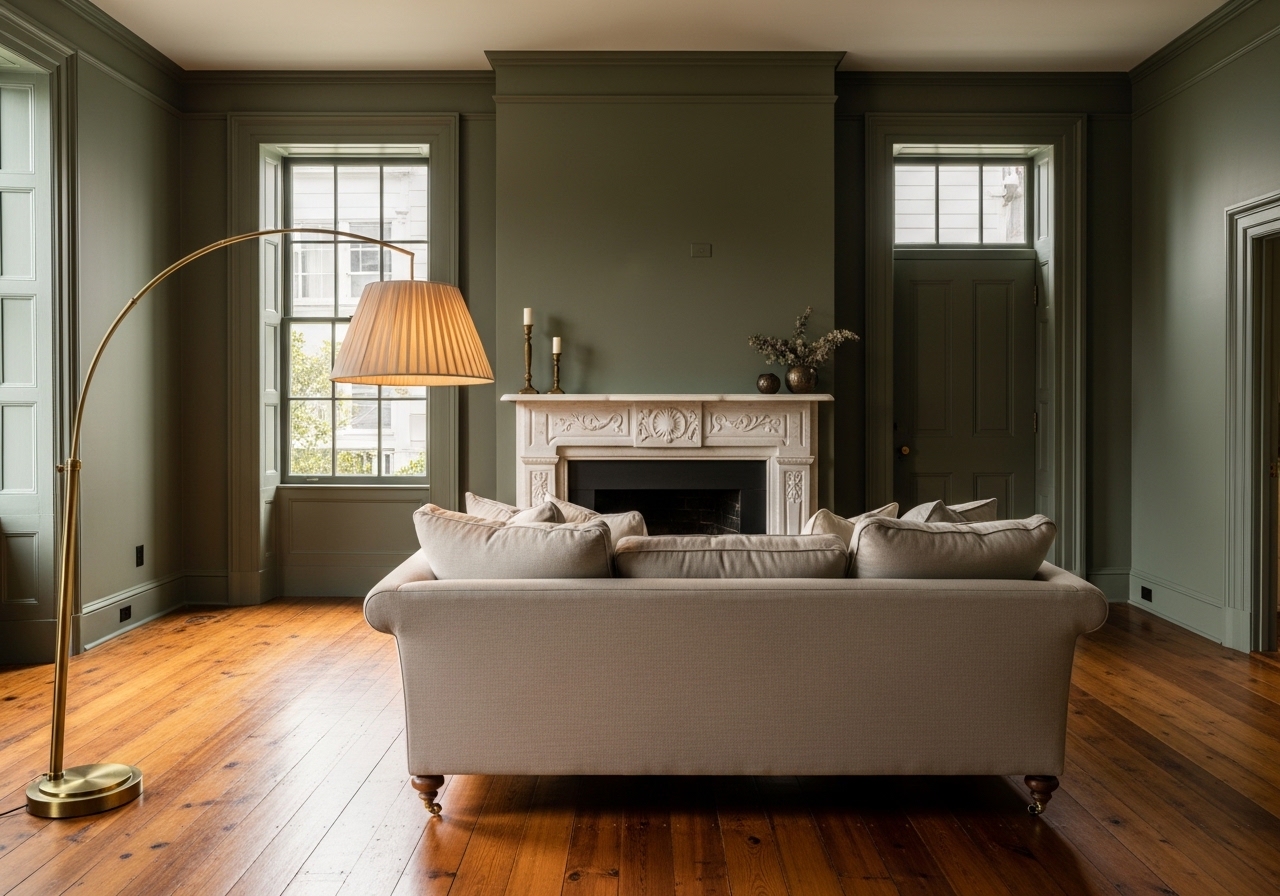
The change that helped most after the corner lamp: a pair of living room wall lamps flanking the fireplace at 60 inches, which freed the floor space two lamps would have taken and gave the room consistent anchor points on its focal wall. They are brass with linen shades, hardwired by David while the wall was open for the paint, and they light the mantel and the art above it and make the fireplace wall the room's center at night the way it is by day. Sconces are lamps that do not need a table, and in a room where the tables are already taken they are the answer.
The floor lamp's one job
A floor lamp lights the person in the chair beside it, and that is all it should do; ours is an arc in raw brass behind the reading chair, aimed at the chair, on a foot dimmer, and it is off when nobody is reading. A floor lamp in a corner as ambient light is a table lamp that is too tall; the corner wants the table lamp, and the floor lamp wants the chair. The antiques post is why that particular lamp is modern in a room of old things.
The overhead, demoted
The chandelier at 30 percent, on a dimmer, for the room's ambient fill and the first impression from the door; at full it flattens everything and makes the lamps pointless. A living room's ceiling fixture is a fixture for cleaning and for arrival, and the lamps are the room after 5 pm. The high ceilings post is the fixture; this is the case for turning it down.
Bulbs, and the one temperature
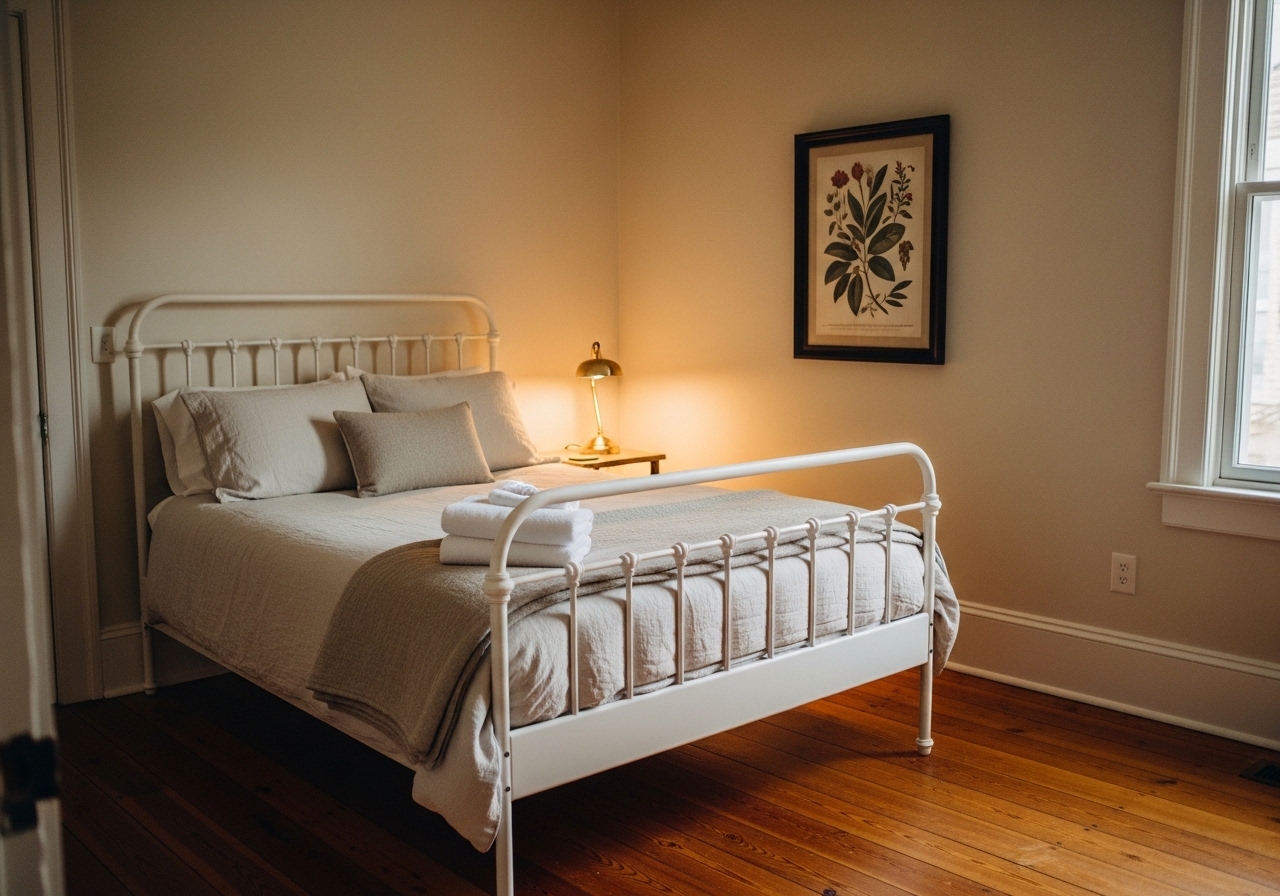
Every bulb in the room 2700K, dimmable, 450 to 800 lumens by the lamp's size, with a warm-dimming bulb in the corner lamp so it goes amber at 20 percent; one color temperature across five sources is the rule, because a room with a 3000K lamp in one corner and 2700K everywhere else has a corner that reads as a different room. The swap is $6 a bulb, and it is the first thing to do before buying a single lamp.
Dimmers on every lamp
A plug-in dimmer on each table lamp's cord, a foot dimmer on the floor lamp, the sconces on a wall dimmer, and the chandelier on its own; the room has five dimmers and no lamp is ever at full after dark. Dimmable bulbs let the lamp layer drop low in the evening, which is exactly when a living room's lamps earn their keep, and a lamp without a dimmer is a lamp with one setting, which after 9 pm is the wrong one.
Cords in an old house
Plaster walls, heart pine floors and outlets where 1930s electricians put them, which is never where the lamp goes: the corner lamp's cord runs under the rug's edge to an outlet 8 feet away, in a flat cord cover along the baseboard painted the trim color; the sconces are hardwired because the wall was open. A lamp placed where the outlet is instead of where the corner is defeats the corner rule, and the cord cover is the $12 that lets the lamp be right.
The lamp count
For a 17-by-22 living room: two table lamps, one at the far corner and one at the sofa's end; one floor lamp at the reading chair; two sconces at the fireplace; and the chandelier. Six sources, four of them at or below eye level, and a room that at 9 pm is lit at about 30 percent from six points and feels like a room in which people live. A smaller room takes four; a larger one takes eight; and the count is always one per corner plus one per chair plus the wall.
What a lamp does that a ceiling cannot
Puts light at the height of a face, a book and a hand; makes a corner a place; gives a room depth by leaving some of it in shadow; and turns off, one at a time, as the evening goes on, which a ceiling fixture cannot do. A ceiling fixture is a room's noon and a lamp is its evening, and a living room is an evening room.
The room before and after, in one evening
Before: the chandelier at full, the floor lamp on, the sofa and chairs correctly placed and the room a showroom, with the far corner dark and the eye stopping at the coffee table. After: the chandelier at 30, the corner lamp on at 40, the sofa lamp at 50, the sconces at 40, the floor lamp on for the reader, and the room three-dimensional, its corners warm and its far wall a place. The furniture did not move. One lamp and two sconces moved the room's edges out to its walls.
Mistakes
Six months of an empty corner, on the grounds that I do not like clutter, which is the mistake this post exists to prevent. A lamp on a tall table with the shade at 48, and a bulb in everyone's eyes. The floor lamp in a corner as ambient light for a year. A 3000K bulb in one lamp for a month before I found it. And a lamp placed by the outlet, twice, before the cord cover.
What it cost
The corner lamp, $90, and its table, $110. The sofa lamp, $140. Two sconces, $190, and David's morning, $260. Plug-in and foot dimmers, $50. Bulbs, $30. Cord cover, $12. About $880 for a room lit from six points, and the $90 corner lamp is the one that showed me what the room was missing.
Lamps by the sofa, specifically
One table lamp at the sofa's end on a 24-inch table, shade bottom at 40, and nothing on the other end, because the other end has the fireplace's sconce above it; a sofa with a lamp at each end is a sofa in a hotel lobby, and a sofa with one lamp and a sconce is a sofa in a room. The lamp is for the person reading at that end, and the sconce lights the other, and the two are at different heights, which is the rule again.
The corner lamp's table
A round table 24 inches across and 24 tall, because a corner lamp needs a surface that puts its shade at 40 and leaves room for a book and a glass; a lamp on a stool is a lamp that gets knocked and a lamp on a console is a lamp that is too high. The table was $110 secondhand and it is the reason the corner has a chair, and the chair is the reason the corner is used, and the lamp is the reason the chair is there; the three arrived in the wrong order and settled into the right one.
In one paragraph
A light in every corner at seated eye level; shade bottoms at 40 inches; lamps around the perimeter and never in the middle; sconces at 60 where the tables are taken; the floor lamp for the chair and nothing else; the overhead at 30; one bulb temperature; a dimmer on everything; cords under the rug and in a painted cover. One $90 lamp in the far corner, and a room that reaches its own walls.
Shop this post: living room wall lamps for the corners without a table