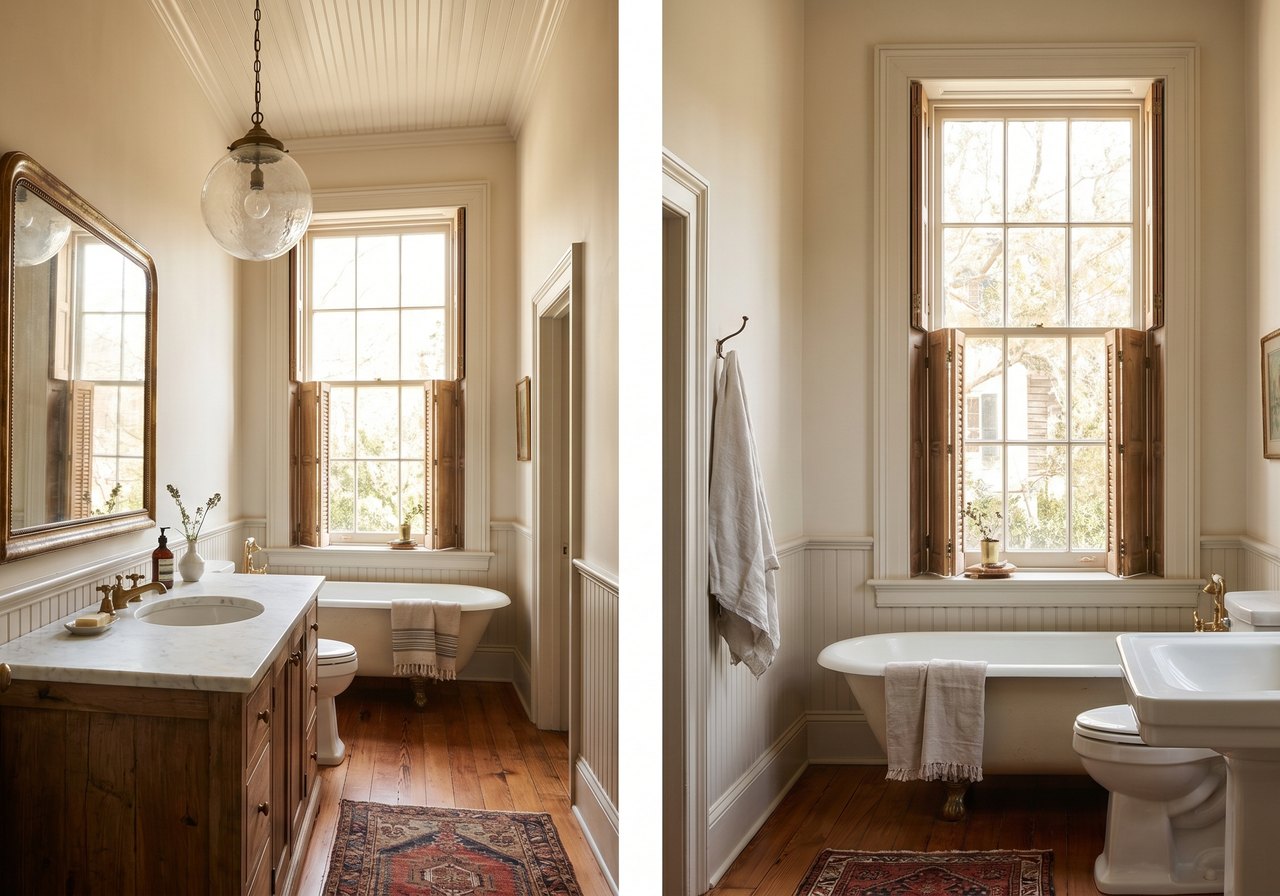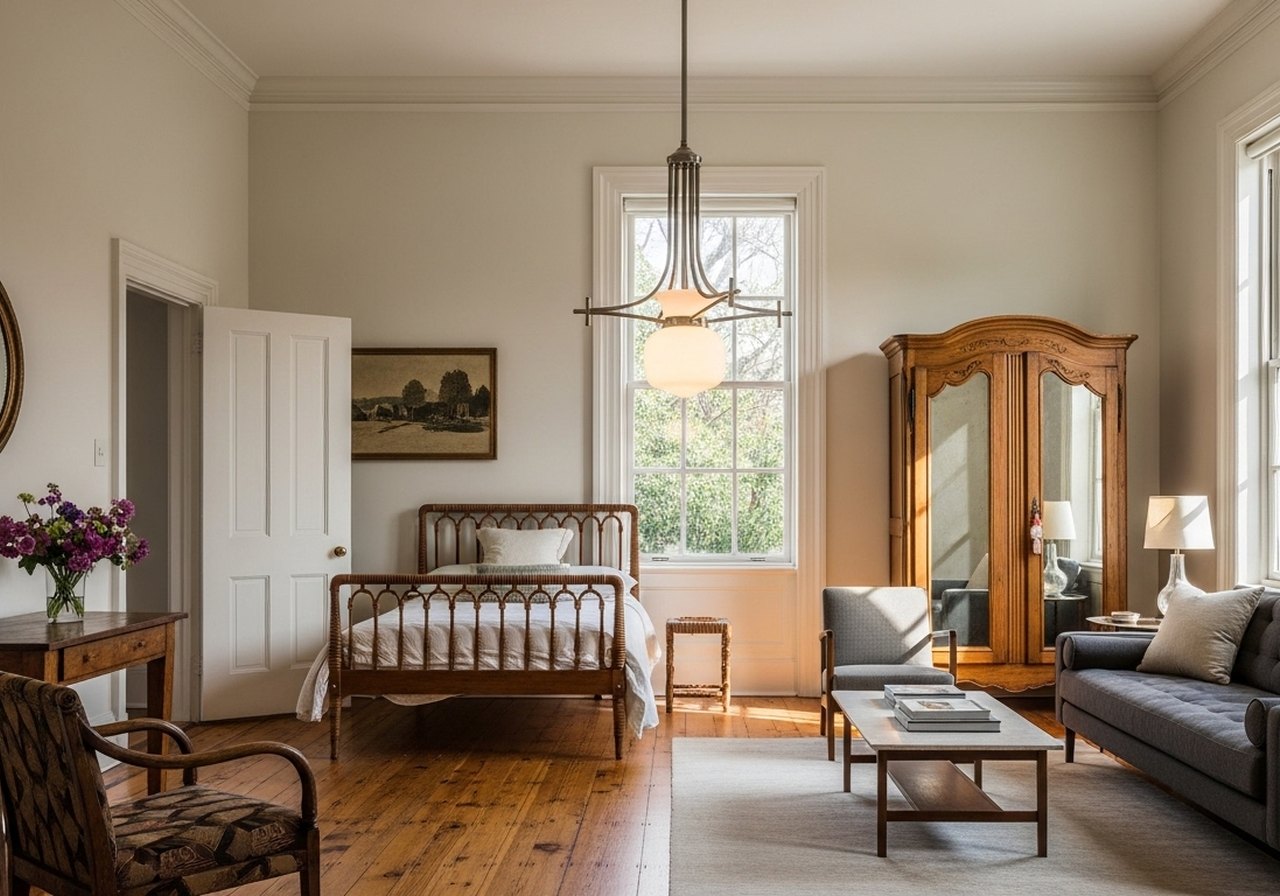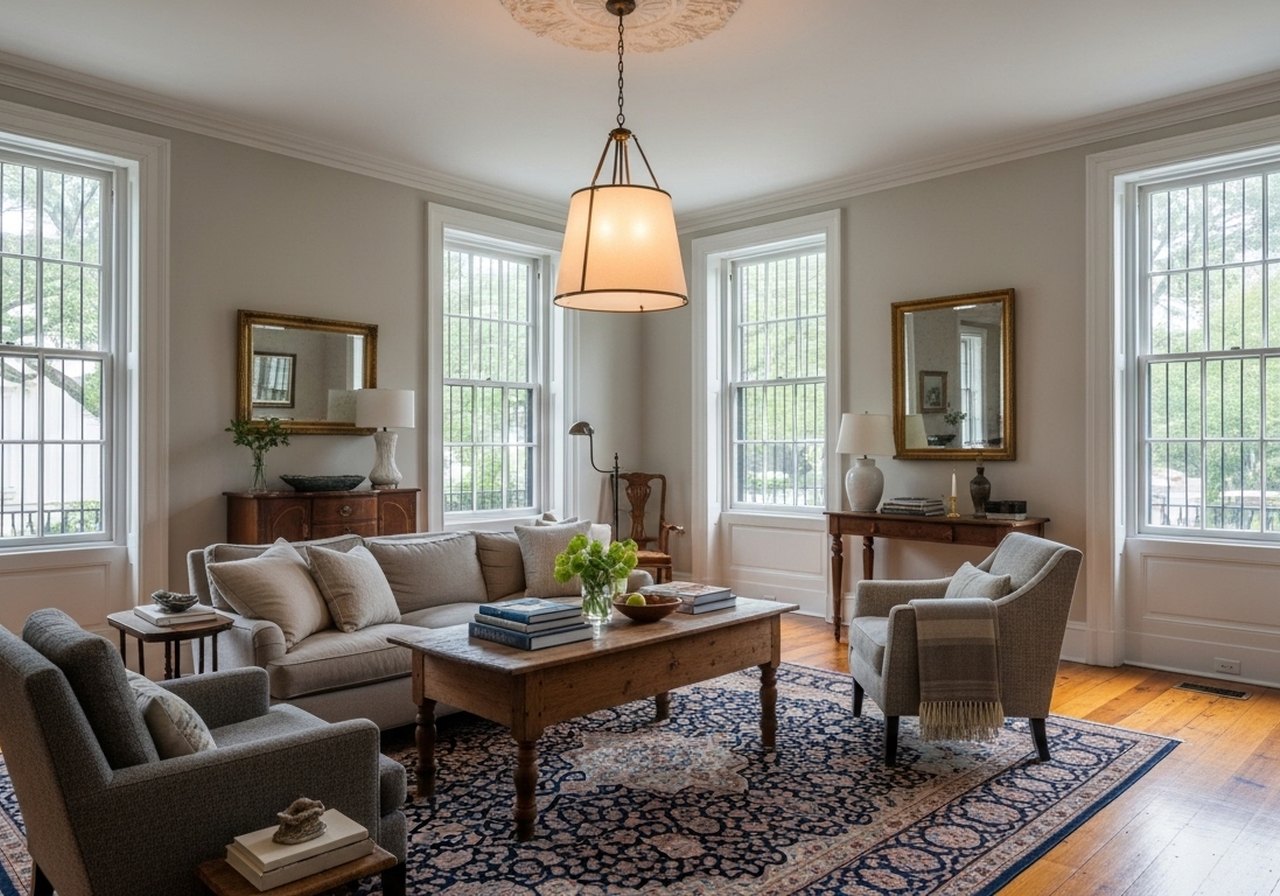
A chandelier for a 10 foot ceiling needs a drop of 2.5 to 4 feet before you even get to the fixture, so that its bottom sits at about 7 feet in a room where people stand and 6 to 6.5 feet over a table, and if your house has 10-foot ceilings and you are buying fixtures designed for 8-foot ceilings, your house is going to look like an afterthought. Scale is everything, and drop length is the metric nobody puts on the box. This is what we have actually bought and used across a house of 10- and 11-foot rooms: the drop-length rule and the arithmetic, the dining chandelier with its custom chain extension, the semi-flush in the hallway and why 12 inches, the direct-wire sconce on the landing that is the best fixture we own, the parlor's chandelier on 48 inches of stem and chain, the foyer's lantern, the kitchen's pendants and their cord length, ordering chain separately and matching the finish, the fixtures that floated uselessly near the plaster before we learned, the lower layer that a tall room needs, sizing up for volume, the medallion as the hanging point, what to filter for when shopping, the mistakes, and the cost across the house.
The drop-length rule
Bottom of the fixture at roughly 7 feet in a room where people are standing, and 6 to 6.5 feet above the surface in a dining or kitchen context; with a 10-foot ceiling that is a 3-foot drop to the fixture's bottom in a standing room and 3.5 over a table, before the fixture's own height, and with 11 feet, a foot more. A fixture sold for an 8-foot room has 6 to 12 inches of drop built in and no way to add more, and in a tall room it hangs near the plaster like a bat. The high ceilings post is the argument; this is the shopping.
The dining chandelier and the chain
A 24-inch brass and seeded-glass chandelier with an 18-inch stem; we added a custom chain extension to bring the total drop to 36 inches, so the bottom lands at 6.5 feet over the table under a 10-foot ceiling. This is not something you can buy pre-configured at most retailers: you order the fixture and the chain separately, in the same finish, and assemble, which took David twenty minutes and a pair of pliers. The chandelier post is the fixture; the chain is the part this post is about, and it was $38.
The hallway's semi-flush
A simple drum shade in antique brass on a 12-inch drop, enough to read as intentional without sacrificing clearance in a 48-inch-wide hall; a tall narrow space is a semi-flush space, because the ceiling's height invites a drop and the hall's width forbids one, and 12 inches is the compromise that reads as a fixture and clears a laundry basket. The hall's real light is the sconces from the hallway post, and the semi-flush is the fixture for a spill.
The landing's sconce
The single best fixture we own is a direct-wire wall sconce on the upstairs landing: no ceiling box needed, no drop-length calculation, just the right amount of light in the right place, at 62 inches on the wall where the stair turns, lighting the treads and the turn. A tall house's stair is its one two-story space and the place a ceiling fixture is furthest from the people, and the sconce is the answer that ignores the ceiling entirely. It was $130 and an hour, and it is the fixture I would keep if I could keep one.
The parlor's chandelier
In the front parlor, 11 feet, a 40-inch chandelier on 48 inches of stem and chain so its bottom is at 7 feet; the fixture came with 24 inches and the rest was ordered in the same antique brass and assembled. At 7 feet in an 18-by-20 room it is the object from the door and the street, and its light is at the seating; at the 9 feet it would have hung at with its own hardware it would have been a ceiling ornament. The parlor's medallion is the hanging point and the reason the canopy's edge does not show.
The foyer's lantern
A 20-inch lantern on a 30-inch chain in a 9-by-12 foyer at 11 feet, bottom at 7 feet, in black iron to match the exterior lanterns through the transom; the foyer post is the fixture. A lantern is the tall-ceiling fixture that comes with a long chain as standard, because lanterns have always hung in tall halls, and it is the one category where the drop did not have to be ordered separately.
The kitchen's pendants
Three brass domes over the island, and the arithmetic is ceiling minus counter minus 32 minus the fixture's height: 120 minus 36 minus 32 minus 10 is 42 inches of cord, and the fixtures shipped with 60 and were cut. A pendant for an 8-foot kitchen ships with 24 inches of cord and cannot be lengthened without a new cord, which is a thing to check before buying for a 10-foot room. The island height post is the 32.
Ordering chain and matching finish
Chain is sold by the foot in a dozen finishes, and the one to buy is the fixture maker's own, in the same finish name, because "antique brass" from two makers is two colors and the seam where the chain meets the stem is at eye level. If the maker does not sell chain, buy a foot of theirs from the fixture's own hardware and match it in a shop by holding them together. A chain extension in the wrong finish is a fixture that looks lengthened, and one in the right finish is a fixture that looks made for the room.
The fixtures that floated
The mistake we made early was hanging fixtures sized and dropped for a normal ceiling, which left them floating uselessly near the plaster: a 20-inch drum in the dining room on its own 8-inch stem for eight months, a builder's pendant in the kitchen on 24 inches of cord that lit the top of everyone's head. Tall rooms want fixtures with real drop and presence, a chandelier, a long-stem pendant, a lantern on a downrod, that bring both the fixture and its light down into the room where people are. Every floating fixture in this house was replaced, and the replacements cost less than the fixtures they replaced plus the time spent disliking them.
The lower layer
A grand overhead fixture alone leaves a tall room dim at living height and a little cold, because warm air and light both rise; every tall room here has sconces at 60 to 62 inches and lamps at seated eye level so the room is lit, not just decorated near the ceiling. The Illuminating Engineering Society makes the same point about layering for rooms of any volume, and it is the point a shopping list for tall-ceiling fixtures has to end with, because the fixtures are the top layer and the room is lived in at the bottom one.
Sizing up for volume
Two inches of diameter per foot of ceiling over 9, per the sizing post, on top of the room's formula; a fixture with the right drop and the wrong diameter is a small thing at the right height, and the parlor's 40 inches is 4 over the formula for its 11 feet. Drop and diameter together are the fixture's presence, and a tall room needs both.
The medallion
A plaster medallion is the hanging point a tall room gives you, and a fixture hung from one looks placed where one hung from a bare box looks dropped; the medallion frames the canopy, hides the box that is an inch off center, and tells the eye where the room's middle is. Every ceiling fixture in this house that hangs from a medallion was sized and dropped to the medallion's diameter, roughly one to one and a half times it, which is a rule of thumb the plasterers knew.
What to filter for
Drop length first, then diameter, then whether chain or cord is sold separately in the same finish, then weight against the box's rating; the ceiling light collection and the pendant collection we use include options with extra drop length and list it, which is worth filtering by before you shop elsewhere. A range of statement pieces designed not to get lost in the height exists, and the filter is how you find them among the fixtures made for the other kind of house.
The rooms in this house, in numbers
Dining, 10 feet: 24-inch chandelier, 36-inch total drop, bottom at 6.5 over the table. Parlor, 11 feet: 40-inch chandelier, 48-inch drop, bottom at 7. Foyer, 11 feet: 20-inch lantern, 30-inch chain, bottom at 7. Kitchen, 10 feet: three 10-inch domes, 42-inch cords, bottoms at 32 over the counter. Hall, 10 feet: 12-inch semi-flush drums. Landing: a sconce. Library, 10 feet: 26-inch drum on a 20-inch stem. Bedroom, 10 feet: 22-inch fixture at 8 feet, a size under and higher on purpose. Written out, every fixture's drop was decided by its room's height and its use, and none by what came in the box.
Mistakes
The floating dining drum, eight months. The kitchen's builder pendant. Chain from a hardware store in "brass" that was the wrong brass, returned. Hanging the foyer lantern at 8 feet because 7 felt low, and lowering it. And not filtering by drop the first time we shopped, which is how a fixture for an 8-foot room ended up in a 10-foot one.
What it cost, across the house
Chain extensions and cord, about $120 across four fixtures. The fixtures themselves are in their own posts; the drop is the part that cost $120 and that made $3,000 of fixtures look like they were bought for this house. The landing's sconce, $130, is the fixture with no drop at all and the best one.
The bedroom's exception, again
The one tall room where the fixture hangs higher on purpose is the bedroom, at 8 feet under 10, a size under the formula, because the fixture is seen from the pillow and a chandelier's bottom 3 feet over a lying face is a threat; the bedroom post is the pendant that taught it. The drop rule is for rooms people stand and sit in, and the bedroom is the room where the rule bends up.
Fixtures for 12 feet and above
We have none, but a friend's 1850s house has 13-foot parlors, and the arithmetic scales: 5 to 6 feet of drop, chain ordered by the yard, a fixture 6 inches over the room's formula, and a medallion 30 inches across as the frame. The lower layer becomes more important with every foot, because the ceiling fixture is further from the people; at 13 feet the sconces are the room and the chandelier is the view.
The one thing to measure before shopping
The distance from the floor to the ceiling at the box, with a tape and a ladder, because an old house's ceilings are not the height the listing says and ours vary by 3 inches between rooms; then the table's height if there is one, and the tallest person's. Three numbers, and the drop is arithmetic. Every fixture in this house that floated was bought without the first number.
In one paragraph
Bottom at 7 feet standing and 6.5 over a table; 3 to 4 feet of drop under 10 and 11 feet; chain or cord ordered separately in the maker's own finish; semi-flush where the room is narrow; a sconce where the ceiling is too far away to matter; diameter up 2 inches per foot over 9; the medallion as the frame; sconces and lamps below so the room is lit where it is lived in; and drop length as the first filter, because it is the one the box leaves off.
Shop this post: ceiling lights and pendant lights with extra drop, filtered by drop first