Every time we pulled out the inspiration folder for our dining room lighting, the bauhaus fixtures kept rising to the top. Not because we specifically set out to find bauhaus pendant lights. We didn't even frame it that way when we started the search. But when we'd narrow down to the fixtures that felt right for the room, there was always a common thread: clean geometry, honest materials, nothing extraneous. That's bauhaus, whether you call it that or not.
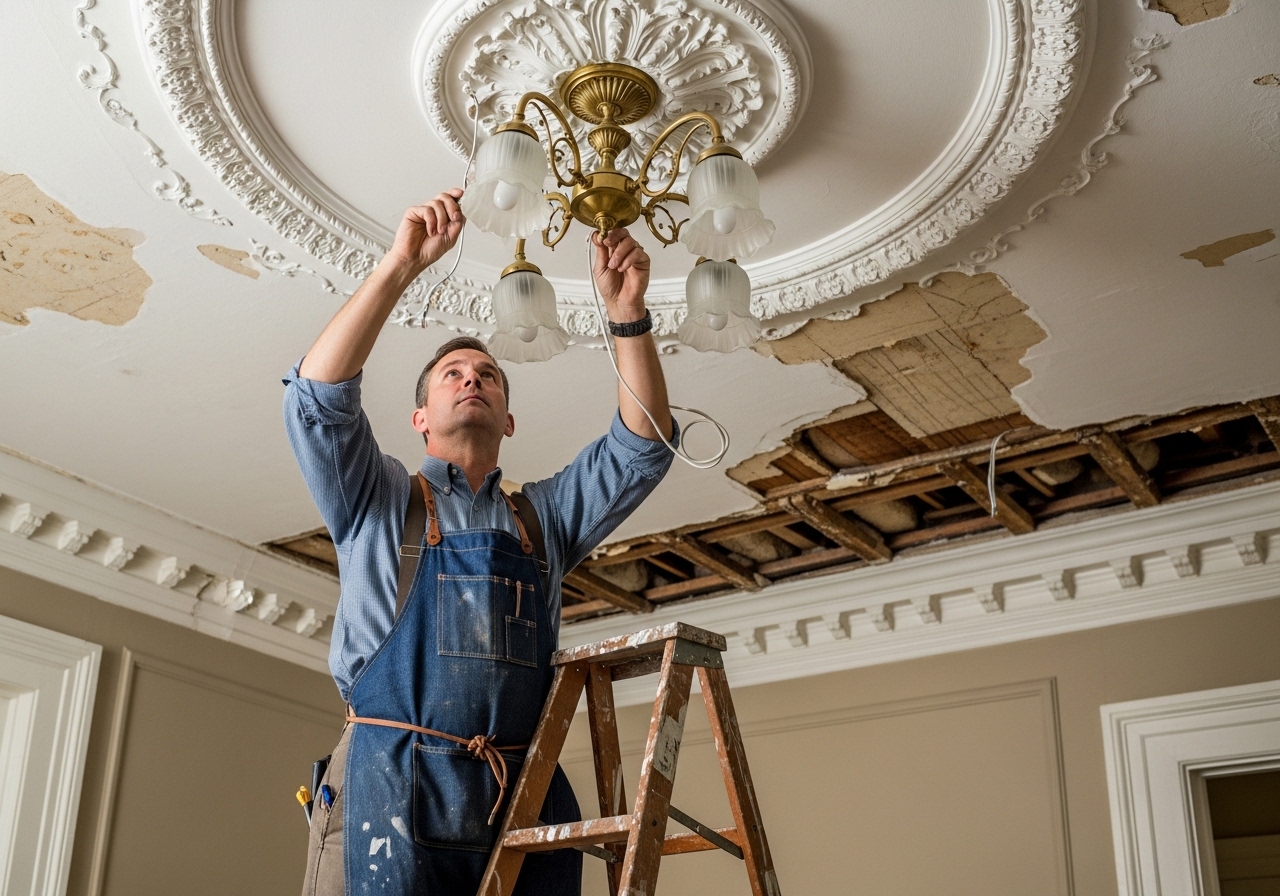
I want to talk about why this style keeps winning in historic homes specifically, because the answer isn't obvious. The received wisdom is that old houses need old-looking fixtures, period reproduction sconces, colonial candelabra, that sort of thing. We tried that approach in our first year here and it didn't work. Our 1890s Charleston single house doesn't need another layer of Victorian detail. It has enough detail built in. What it needs is lighting that complements rather than competes with what's already there.
Bauhaus, as it turns out, is exactly that.
What Bauhaus Design Actually Is (The Short Version)
The Bauhaus school operated in Germany from 1919 to 1933, overlapping almost exactly with the period when most American historic homes were being built or updated. Its central idea was that form follows function: the shape of an object should emerge from what it needs to do, not from applied decoration. Beauty, in the Bauhaus view, is a byproduct of functional excellence, not a layer on top of it.
In lighting, this means: clean geometric forms (spheres, cylinders, cones), materials used (metal looks like metal, glass looks like glass, no paint-to-mimic-other-materials). And visible hardware treated as part of the design rather than hidden. A Bauhaus lamp looks exactly like what it is. Nothing is hidden. There's a rigor to it that I find relaxing to be around, especially in rooms with a lot of architectural complexity.
What it doesn't mean: cold, harsh, or clinical. Good bauhaus-influenced fixtures have warmth, not from ornament, but from proportion, from material choice, from the quality of light they produce. This is a distinction that gets lost when people dismiss the style as "too modern" for a historic house.
Why Bauhaus Works in a House Like Ours
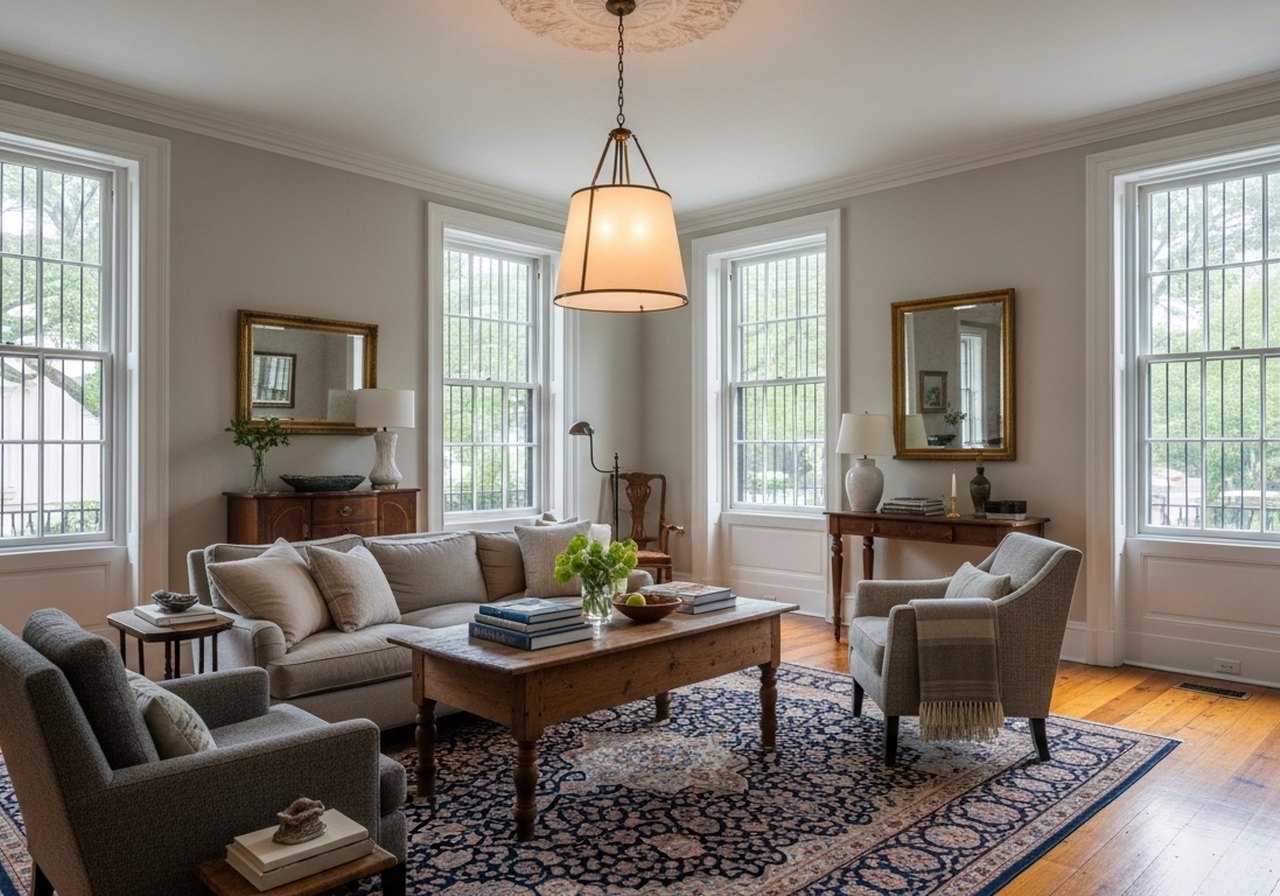
Our dining room has ten-foot ceilings, original plaster walls, and crown molding that required actual skill to install. It's a visually busy room by modern standards. When we hung period reproduction brass chandeliers. The kind designed to look vaguely Victorian. The room felt cluttered. Two competing visual languages fighting each other.
When we switched to something simpler, something that didn't demand attention, the architectural details could breathe again. The crown molding read as what it is, exceptional craftsmanship, instead of as background noise behind a fussy fixture.
We wrote about the experience of lighting 10-foot ceilings in the historic home ceiling fixtures post, which goes into more detail on the scale and proportion considerations. The short version: in a room with high ceilings and strong architectural character, a quiet fixture almost always wins over a dramatic one. Bauhaus fixtures tend to be quiet.
"The crown molding read as exceptional craftsmanship instead of as background noise behind a fussy fixture."
The Fixtures We Considered and What We Chose
Our dining room is 14 by 16 feet. We needed a pendant with enough presence to anchor the space over the table without overwhelming the ceiling height. For bauhaus lamp options, we looked at three categories: globe pendants, dome pendants, and articulated pendants.
Globe Pendants (The Bauhaus Lamp Classic)
The globe is the most recognizable bauhaus lighting form. László Moholy-Nagy's light-space modulator, Marianne Brandt's brass hemisphere. These are the reference points. A clear or frosted glass sphere on a minimal stem is the most direct descendant of Bauhaus school lighting experiments.
For our dining room, a single large globe (12-14 inch diameter) over the center of the table was tempting. We tried it, and the problem was scale, a single globe, even a large one, felt sparse in a 14-by-16 room. A cluster of three smaller globes worked better, but the installation complexity increased and the result started to look more like a trendy restaurant than a historic home dining room.
Dome Pendants
The dome form, a hemisphere shade that directs light downward, is the most practical bauhaus lighting shape for dining rooms. It concentrates light on the table surface, which is where you want it, and the shade itself recedes visually. This is the form that influenced most mid-century modern pendant design.
The Tara industrial pendant from BO-HA ($99.95) is the one we ended up testing in our dining room first. It's a matte black dome with a clean stem, about as direct a bauhaus lamp as you can find at that price point. The form is honest: it does exactly what a pendant light needs to do, and the visual weight is appropriate without being heavy. Over a table, it reads as intentional and correct rather than as a statement.
Articulated Pendants (Our Final Choice)
What we landed on was the Rota rotating pendant ($179.95). The Rota is a dome-and-arm design where the shade can be repositioned. It rotates on its mount, which lets you direct light either straight down onto the table or angled slightly toward the room. This adjustability was what finally sold us: historic rooms don't always have dining tables perfectly centered under the original ceiling medallion. And being able to correct for that without re-running wiring was appealing.
The Rota's finish is warm brass, which was a deliberate choice. I wanted something that would develop a relationship with the room's other warm tones. The heart pine floors, the painted wood trim, without being explicitly ornamental. Brass in a minimal form reads very differently from brass in a Victorian fixture. The Rota threads that needle effectively.
We've had it up for four months and it still reads as exactly right for the room. Our contractor, who has worked in Charleston historic homes for twenty years and tends to be skeptical of "modern" choices in old houses, said it was the best lighting decision we'd made in the renovation. I consider that a meaningful endorsement.
Bauhaus Lighting in Other Rooms: What We Tried
The dining room success led us to revisit other lighting decisions with bauhaus principles in mind.
The study: We replaced a fussy table lamp with a simple arc floor lamp, bare stem, minimal shade, no ornamentation. The room immediately felt more focused. A bauhaus lamp on a desk doesn't compete with the books on the shelves. It just lights the room.
The kitchen: Our kitchen renovation involved choosing pendants over the island. We wrote about that in the dining room lighting cost post, which covers the budget version of some of these same decisions. For the island, we went with two simple dome pendants, similar in spirit to the Tara, though sourced elsewhere. The principle was the same: clean form, honest material, directed light.
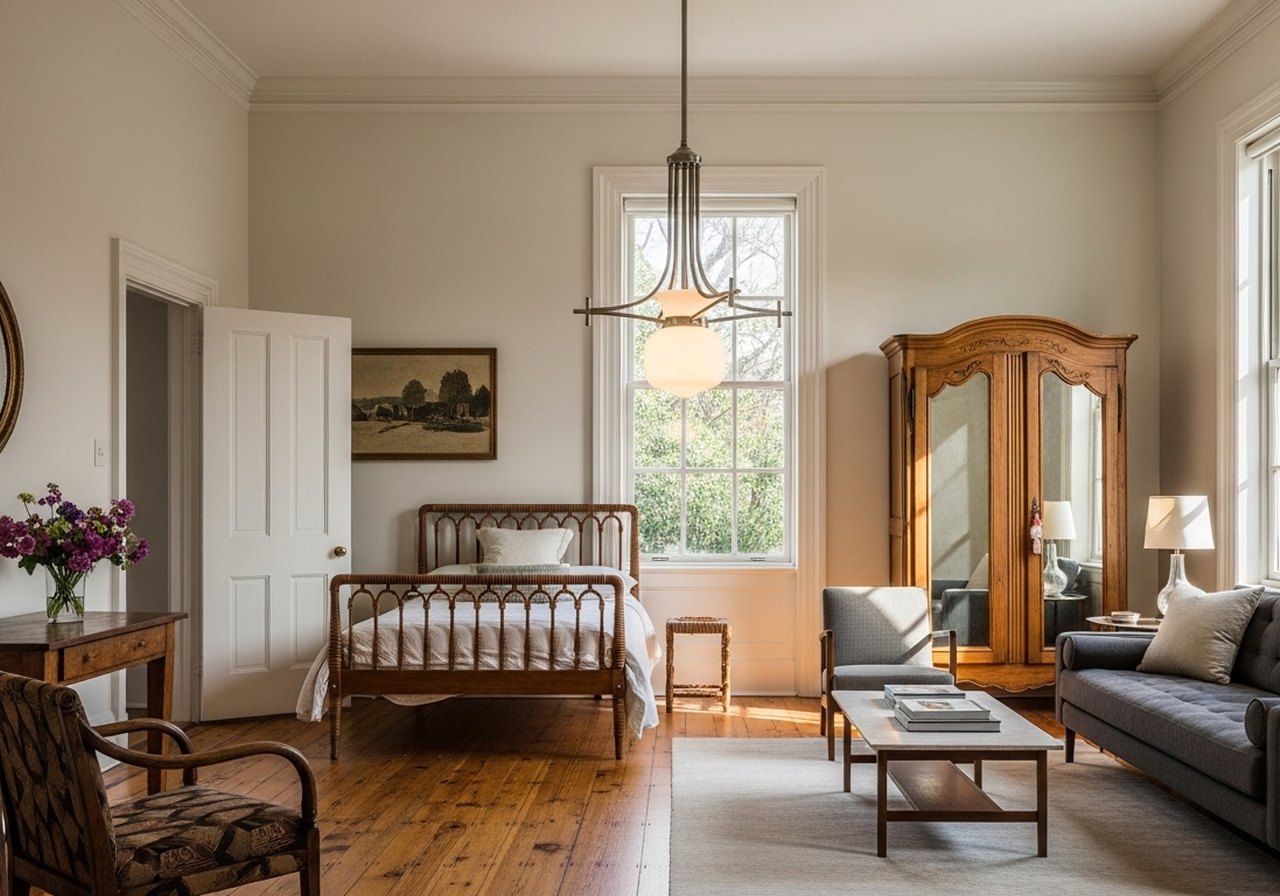
The bedroom: We tried a bauhaus table lamp on the nightstand and it worked immediately. The previous lamp had a pleated shade and turned finials, lovely on its own, but competing with the plaster ceiling medallion above the bed. The simple lamp let the ceiling detail be the thing you notice when you walk into the room.
The through-line: in every room with strong architectural features, simplifying the lighting let the architecture win. This is, at its core, what bauhaus design offers. Not a style statement. A way of stepping back.
Practical Considerations for Bauhaus-Style Pendant Lighting
A few things I wish someone had told me at the start of this:
Scale matters more than style. A bauhaus pendant that's too small for the room just looks cheap, regardless of how correct the design is. For dining rooms, pendant diameter should be roughly half the table width. So a 36-inch table wants an 18-inch fixture. We undersized our first attempt and it looked timid.
Cord length is a real design decision. Bauhaus fixtures often have longer cords or canopy mounts that expose the cord/stem as part of the design. In a ten-foot room, you have more vertical play than in an eight-foot room. The Rota's stem is adjustable, which made installation much easier than a fixed-length pendant would have been.
Bulb choice changes everything. A bauhaus globe pendant with a clear globe shade and a visible filament LED at 2200K looks like a completely different fixture than the same pendant with a frosted globe and a standard 2700K LED. Decide what quality of light you want before you commit to the shade type. We cover this in the bedroom lighting upgrade post. The bulb is at least half the equation.
Bauhaus lighting and dimmer switches are natural partners. The restrained form of a bauhaus pendant reads best at 60-70% brightness in most dining contexts, enough to light the room without harshness. See the dimmer switch installation post for our weekend project installing dimmers throughout the first floor. It's simple and transforms how these fixtures perform.
Shop This Post
The question I get most often about bauhaus-style lighting in a historic home is: won't it look anachronistic? My answer, four years into this renovation, is the opposite. Period reproduction fixtures look anachronistic. They look like someone trying too hard to recreate a past that's already expressed in the architecture itself. Bauhaus lighting looks timeless because it's based on principle rather than period. It worked in 1925. It works now. And in a house with exceptional architectural bones, it gets out of the way and lets those bones speak.
That's the only endorsement a fixture really needs.
Where It Works in the House
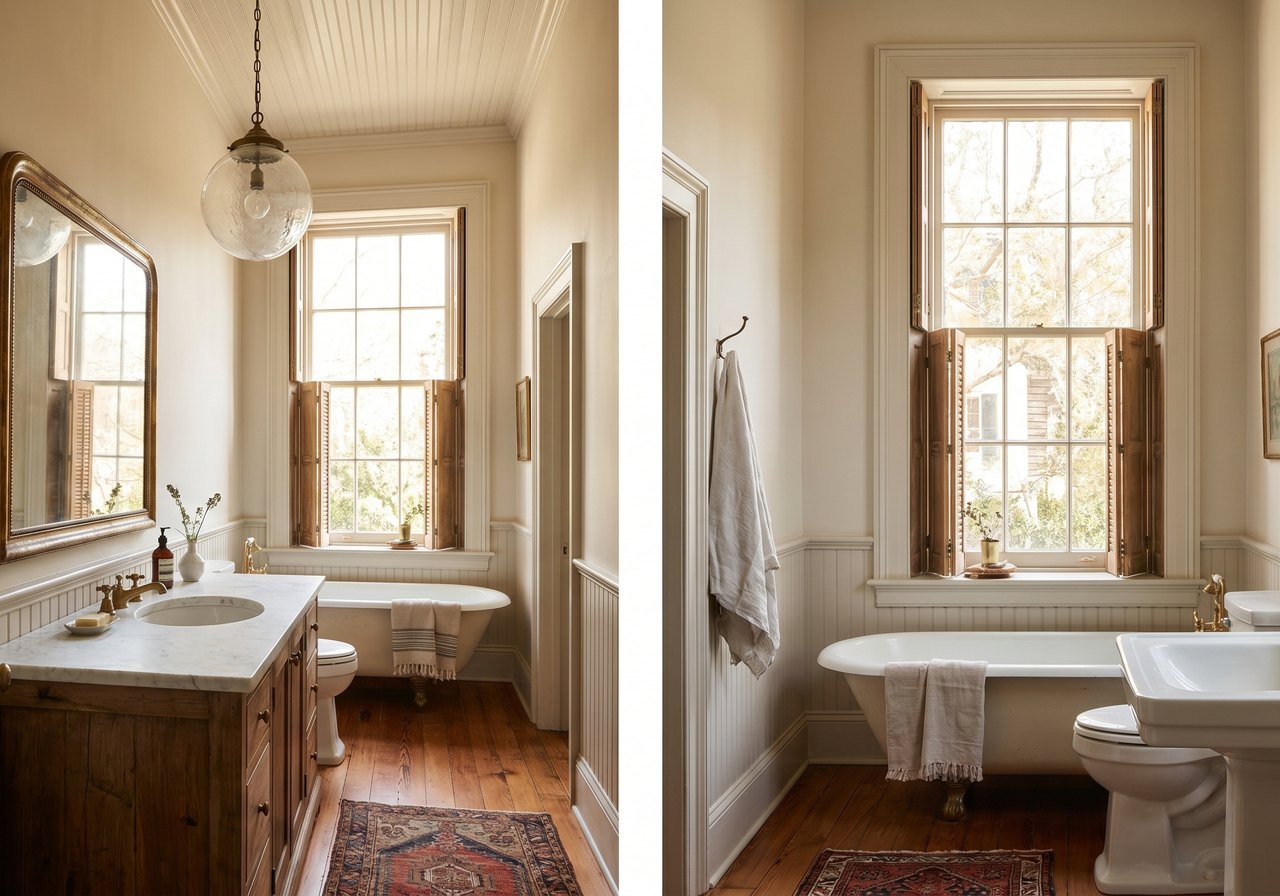
We ended up using clean Bauhaus-style fixtures in the rooms where the architecture is already doing a lot. The parlor, the entry, because a simple metal-and-glass form gives the eye somewhere to rest. In plainer rooms we reached for something more sculptural or antique instead. The lesson was that the fixture's job changes with the room: relief in an ornate space, character in a plain one.
Buying for the Long Run
A principled, well-made fixture outlasts trends, which matters in a house meant to be lived in for decades. We looked for solid materials and simple geometry over novelty, the same logic behind choosing modern pendants that won't look dated in five years. Timeless beats fashionable when the fixture is staying for good.
Shop this post: Tara industrial pendant and Rota rotating pendant