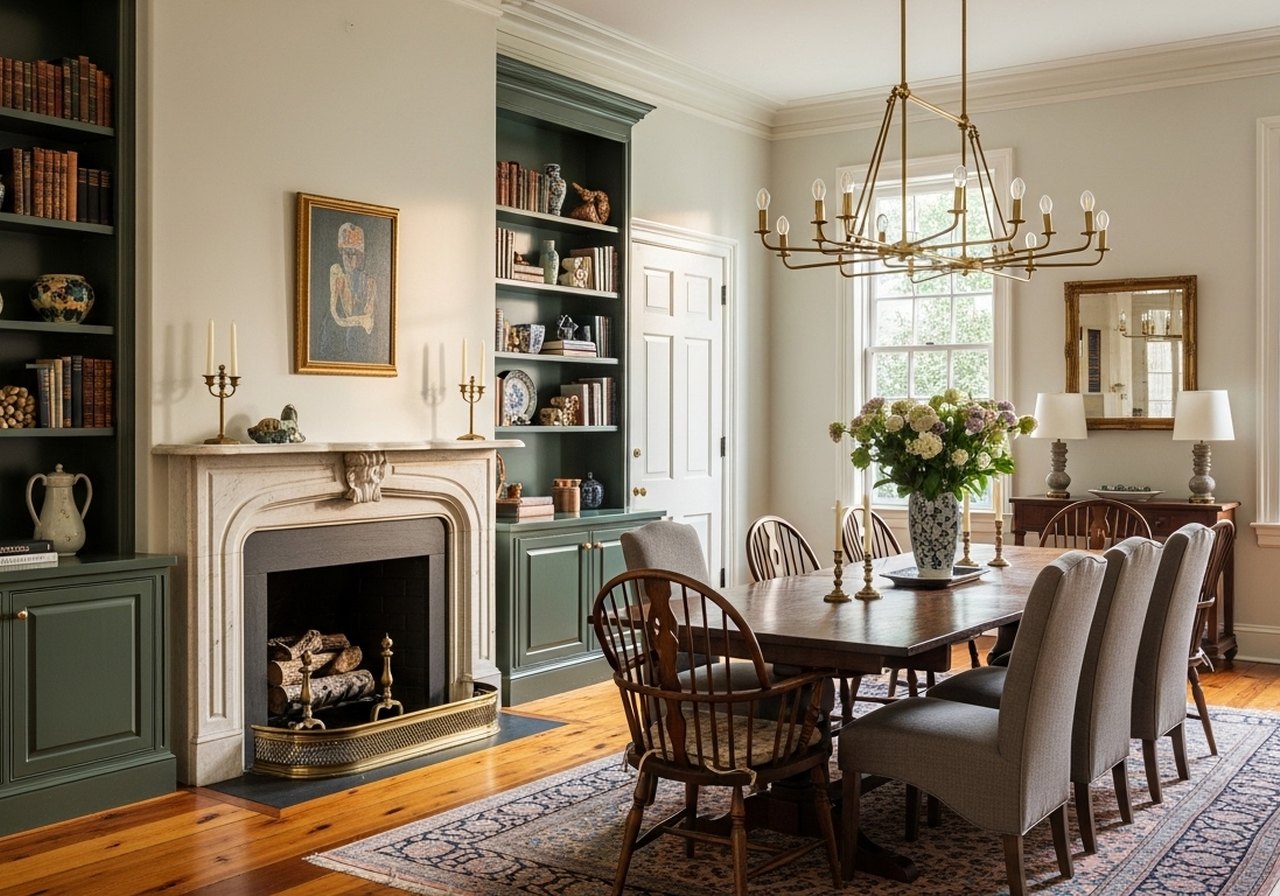
Built in cabinets around a fireplace are the one addition to a historic dining room that reads as original even when it is not, provided the profiles match the existing baseboard and crown, the paint matches the walls, and the proportions are taken from the room three times before a saw is touched; ours ran about $4,000 from a local millworker and they are the highest-impact thing we have added to a historic room. The original dining room had no built-in storage, which is common in single-house construction, where room function was flexible and furniture did the work; it needed storage and presence, and flanking cabinets on either side of the fireplace solved both. This post is why flanking cabinets and not a sideboard, the three site measurements and what each caught, the profile matching and the trim it copied, open above and closed below, piano hinges, painting them the wall color, the shelf lighting and the hidden source, the two sconces the built-ins demanded, the dimmer the room suddenly needed, what goes on the shelves and the restraint, the fireplace wall as the room's focal point, the chandelier that came after, what a millworker costs and what to ask, the mistakes, and the whole cost.
Why flanking cabinets
A sideboard is furniture and reads as furniture; flanking cabinets are architecture and read as the house. A dining room in an 1892 single house with a fireplace on the long wall has two alcoves either side of the chimney breast that were always meant to hold something, and a cabinet built into each alcove is the thing the room was drawn for even if it never got it. The classic configuration is symmetrical, floor to just below the crown, with the fireplace and its mantel as the center, and it is a configuration that has been built into old houses for two hundred years, which is why it reads as original.
Three site measurements
The first found that the alcoves differ by three-quarters of an inch, because 1892 masonry is not plumb; the second found that the floor drops an inch toward the exterior wall; the third, with the cabinet carcasses dry-fitted, found that the crown's return at the chimney breast needed a scribed filler that the drawings had not allowed for. Three visits, three corrections, and the finished cabinets sit as if the room grew them. A built-in that is measured once is a built-in with a gap, and in an old house the gap is always where the eye lands.
Profile matching
The cabinets' base matches the room's baseboard, 9 inches with the same ogee; the top has a crown that dies into the room's plaster crown at the chimney breast; the face frames are the width of the door casings; the shelf edges have the same quarter-round as the window stools. The millworker took a section of loose baseboard from the attic and had a knife ground for it, $180, which is the line in the estimate that makes the difference between built-ins and bookcases. Anyone building into a historic room should ask for that line by name.
Open above, closed below
Open shelves from 36 inches to 8 feet for display and the things a dining room uses, the good glasses, the platters that are looked at; closed cabinets below, on doors, for the things that are not, the table linens, the extra leaves, the candles. The proportion is roughly two-thirds open to one-third closed, which is the proportion of a Georgian bookcase and the one the eye expects. Solid doors below, not glass, because glass doors below a counter show the linens and the mess.
Piano hinges
The lower doors hang on brass piano hinges the full height of the door, which is what a cabinet door in a house of this age would have had, and which will not sag in a humid city the way two butt hinges on a 30-inch door will; they were $22 a door against $8 for the pair of butts, and they are the detail a carpenter notices. The knobs are unlacquered brass, matching the kitchen's hardware, and they are darkening at the same pace.
Painted the wall color
Everything, the cabinets, the shelves, the face frames, in the same warm off-white as the walls, in a satin finish where the walls are matte, so the built-ins read as architecture rather than furniture; a built-in painted a contrasting color is a piece of furniture that cannot be moved. The one exception considered was the shelf backs in a deeper tone, and it was rejected because it would have made the shelves a display and the room a shop. One color, and the room got bigger.
The shelf lighting
A warm LED strip, 2700K, under the front edge of each shelf, tucked behind a small lip so the source is hidden and the light washes down the shelf below it; on a driver inside the lower cabinet, on its own dimmer, $140 for the two sides. The strips are at 20 percent in the evening and the built-ins glow rather than disappear into the shadow the chandelier leaves at the room's edges. Lit shelves are the difference between built-ins that are a feature and built-ins that are storage, and the lip that hides the strip is the detail that keeps them from looking like a store.
The two sconces the built-ins demanded
The thing I did not anticipate: once the built-ins were in, the room felt more formal in a way that required the lighting to step up, and two wall sconces went up flanking the mirror over the mantel at 62 inches, brass with linen shades, which light the fireplace wall from its center while the shelf strips light its edges. The fireplace wall now has three sources and the rest of the room has the chandelier, and the wall is where the eye goes. The room teaches you what it wants, and this one wanted more light the week the cabinets were finished.
The dimmer the room needed
A dimmer on the overhead fixture that we had not needed before, because the room with lit shelves and mantel sconces at night wanted the chandelier at 40 percent and it had only ever been on or off; the chandelier post is the fixture that replaced the flush mount a few months later, and the dimmer went in first. Every fixture added to a room changes the setting the others want, and the built-ins changed all of them.
What goes on the shelves
Restraint: a mix of books on their sides and standing, ceramics in white and cream, three pieces of the family silver, a pair of brass candlesticks, and a third of each shelf left empty. The rule was that nothing on the shelves would be colored, so the shelves read as texture and not as a collection, and that no shelf would be full. The library post is the built-ins that are full of books; the dining room's are the ones that are not.
The fireplace wall as focal point
The mantel with the mirror above it, the two sconces, the two cabinets with their glowing shelves, symmetrical about the chimney; it is the composed wall that the room had been missing for the six years we have owned it and that it had been drawn for in 1892. The table faces it and the chandelier is centered on it, and a guest sitting down looks at the fireplace wall and not at the window, which in a dining room is the right direction. It is the result I imagined when we bought the house, and it took the built-ins to get there.
What a millworker costs, and what to ask
About $4,000 for two cabinets, each 42 inches wide, 14 deep, floor to 8 feet, in poplar, primed and painted, installed, with the custom knife and three site visits; a cabinet shop quoted $2,800 for the same in stock profiles, and the $1,200 difference is the trim matching. Ask whether they will match the existing profiles and have a knife ground; ask for three site visits; ask for piano hinges and a scribed fit at the crown; ask to see a built-in they did in an old house. The one who could answer all four got the job.
Mistakes
Almost specifying a contrasting shelf-back color. Not planning the shelf lighting until the cabinets were built, which meant the driver went into a cabinet instead of the wall. Two butt hinges on the first door as a test, which sagged in a month. And waiting six years, because the room worked without them and I did not know what it was missing until it had them.
The whole cost
The built-ins, $4,000. The shelf strips and driver, $140, and their dimmer, $22. The two sconces, $190, and David's morning to box them, $260. The chandelier's dimmer, $22. About $4,630 for the wall that made the dining room the room I had imagined, and $4,000 of it is the one thing on this list that cannot be bought off a shelf.
The build, week by week
Week one, the first site visit and the drawings. Week two, the second visit with the profiles and the baseboard section for the knife. Weeks three to six, the shop. Week seven, the dry fit and the third visit, and the scribed filler. Week eight, installation, two days, and the painter's three coats over a week. Nine weeks from the first conversation, most of it the shop's, and the room was used throughout because the work was at the wall and not in the middle. A good millworker's schedule is slow and the slowness is in the shop, where it does not bother anyone.
Styling the shelves for the first time
Everything off, then the books in first in loose groups, then the ceramics, then the silver, then step back to the doorway and take a third of it off; the third that comes off is the thing that makes the shelves read as a room's and not a shop's. It took an evening and it is redone twice a year, at Christmas when the greenery goes on and in spring when it comes off. The shelf strips at 20 percent are the light it is judged under, because that is the light the shelves are seen in at dinner.
What the built-ins changed about the table
The table moved 8 inches toward the window to center on the fireplace wall instead of the room, because the fireplace wall is now the room's center; the chandelier moved with it, which is the reason the chandelier's box was relocated when it replaced the flush mount. A built-in changes where a room's middle is, and everything hanging from the ceiling has to agree. It is the consequence nobody mentions and the one that cost an extra electrician's hour.
Where built-ins do not belong in an old house
The front parlor, where the alcoves are for the pier mirrors that the room's height demands; the bedrooms, where a built-in wardrobe in a house that had armoires reads as a hotel; and any room whose fireplace wall is not the room's natural center. The dining room and the library are the two rooms in this house where built-ins read as architecture, and the library post is the other; everywhere else, the furniture does the work the way it was meant to.
In one paragraph
Flanking cabinets in the fireplace alcoves, floor to just under the crown, measured three times, with a knife ground to the house's own trim, open above and closed below on piano hinges, painted the wall color, lit under each shelf from a hidden strip, with two sconces at the mantel and a dimmer on the chandelier that the room asked for the week they went in. Four thousand dollars, and a room that reads as it was drawn.
Shop this post: wall sconces for the mantel and brass sconces to match the knobs