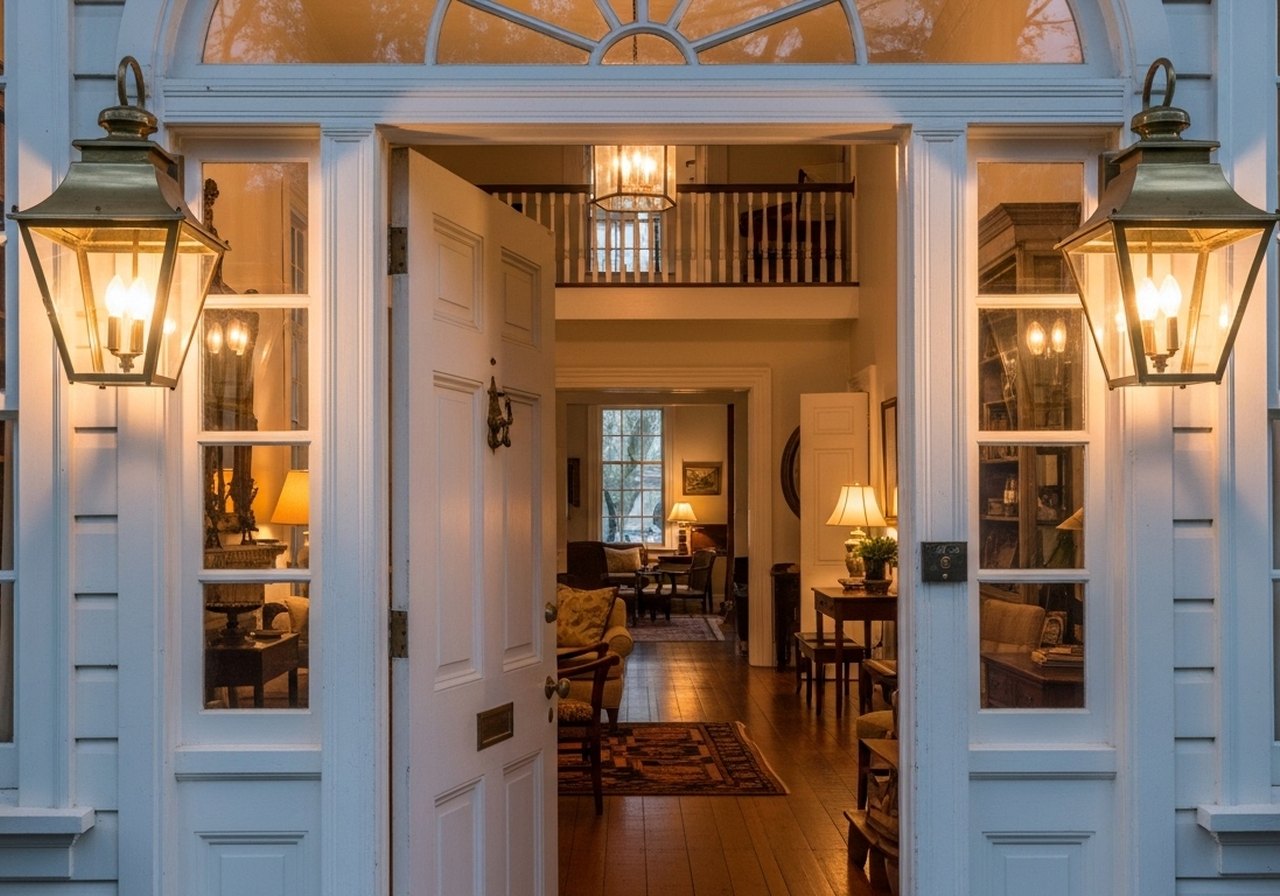
Exterior lantern lights for a historic home should be sized to a quarter to a third of the door's height, cast in iron or heavy brass in black, wet-rated whatever the overhang, wired in copper, and bulbed at 2700K, and the ones that came with our 1892 facade were none of those things. The originals were 1980s coach lanterns that had nothing to do with the period of the house or the character of the street, and they were underpowered, two 40-watt equivalents on a 40-foot facade. We replaced them with cast-iron traditional lanterns from a maker who still casts them the old way, and the front of the house at night is now something I am proud of from the sidewalk. This post is the size rule and the arithmetic, the style question and how to answer it without a reproduction, the wiring surprise and why it was mandatory, the bulbs and the change in light, the wet rating and the salt air, mounting height and the latch side, the piazza's lanterns and the family rule, the front door versus the side door, the dusk-to-dawn question, what we rejected and why, the street at night, the maintenance a cast fixture wants, the mistakes, and the cost.
The size rule
A lantern's height should be a quarter to a third of the door's, so an 8-foot door takes a 24- to 32-inch lantern, and the fixtures the house came with were 14 inches and read as a builder's afterthought from the street. Ours are 26 inches, which on an 8-foot door with a transom and a 40-foot facade sit at the low end of the range and read as generous because the fixture is dense. A lantern is looked at from 40 feet away, and the rule that governs a pendant indoors, when in doubt go bigger, governs it twice as hard outdoors, because distance shrinks everything.
The style question
Not a reproduction, which in a house with its original details reads as the one thing that is trying too hard, and not a modern fixture, which on an 1892 facade is a wristwatch on a portrait. The answer is a fixture of a type that has existed continuously since the house was built: a cast-iron lantern with a flat top, clear glass and a simple frame, the kind that has been made by the same handful of foundries since gas. It is not a copy of anything; it is the thing itself, still being made. That category exists for lanterns, for hardware and for very little else, and it is why the front of the house was the easiest lighting decision we made.
The wiring surprise
The old fixtures had been wired with aluminum conductor at some point, which is technically compliant and which no electrician I trust is comfortable with; David rewired both boxes to copper in two hours, $180, and I would call it mandatory for any exterior fixture on a house of this age. An exterior box is the one that gets wet, and aluminum at a wet connection is the failure that shows up as a lantern that flickers and then does not. Open the box before buying the fixture; what is inside decides whether the job is an afternoon or a day.
The bulbs and the change in light
From two 40-watt equivalents to two 60-watt LED candelabra bulbs at 2700K, clear, which is 800 lumens a side instead of 450, and the distribution is what changed: the front path is fully lit to the sidewalk, the porch is warm and not harsh, and the door's brass is lit from both sides. Warm, always, because a cool bulb on a Southern facade reads as a parking lot; clear rather than frosted, because a lantern's glass is the diffuser and a frosted bulb inside it is a light with two shades. We tried 3000K for a week and the house looked like an office.
Wet-rated, whatever the overhang
We are three blocks from the water, and a damp-rated fixture under a roof overhang rusted through at its base in a year on the piazza; the front lanterns are wet-rated cast iron with a powder coat over the casting, and after four years they show nothing. Wet-rated is not a formality in a coastal city; it is the difference between a fixture and a two-year fixture. The piazza post is where we learned it, and the front door got the lesson second-hand.
Mounting height and the latch side
Center of the fixture at 66 inches, which on a lantern 26 inches tall puts the top at 79 and the bottom at 53, framing the door without crowding the transom; one each side of the door, because a single lantern on the latch side is correct for a cottage and mean on a facade of this width. If only one is possible, it goes on the latch side so the hand on the knob is lit. Height is measured from the porch floor, not the ground, and our porch is 30 inches up, which the first electrician's estimate did not account for.
The piazza's lanterns, and the family rule
The 42-foot piazza has its own lanterns every 10 to 12 feet from the outdoor wall sconce collection, smaller than the front door's and in the same black cast finish, because one lantern family around the house ties the exterior together while letting the front door have the most presence. Different sizes, one family, one finish, one bulb color. A house with a brass lantern at the front, a black one at the side and a nickel one at the back is a house that bought its lights at three different times, which is what ours was.
The front door versus the side door
The front door is the facade's and gets the largest lanterns and the most light; the side door onto the piazza is the family's and gets a single piazza lantern on the latch side at the same height; the garden door at the back gets the smallest of the family on a photocell. Three doors, three sizes of one lantern, and the size tells a visitor which door is which, which on a single house, where the "front" door opens onto the piazza and the street door opens onto the porch, is a real question.
The dusk-to-dawn question
The front lanterns are on a photocell and come on at dusk and go off at dawn, because a historic facade with dark lanterns at 9 pm is a house that looks empty, and because the street is the reason the lanterns are the size they are. The piazza's are on a dimmer inside and a timer that takes them off after midnight, which is the family's schedule and not the street's. The two systems cost $24 together and the front lanterns have not been switched by hand in four years.
What we rejected
Coach lanterns, which are what the house had and which are a 1980s idea of Colonial. Gas lanterns, which are correct for Charleston and which cost $900 a fixture plus a gas line, and which we may do at the piazza one day. Mission-style and craftsman fixtures, which belong to a different decade and a different coast. Anything with a seeded-glass "vintage" bulb showing, which is a fixture wearing a costume. And the reproduction lantern with the fake patina, for the reason above: the real thing is still being cast, and it patinas on its own.
The street at night
From the sidewalk across the street the house reads as two warm points at the door, a line of smaller warm points down the piazza, and the parlor's chandelier through the front window; before, it read as a dark facade with two dim dots. Exterior lighting is the only lighting in a house that strangers see, and it is the one that tells the street whether the house is cared for. I have started noticing it on every house I walk past, and once you see it you cannot stop.
Maintenance
Twice a year, the glass out and washed, the frame wiped with a damp cloth, and any chip in the powder coat touched with a black enamel pen before the salt finds it; the bulbs have not been changed in four years. A cast-iron lantern wants almost nothing, which is why the ones on the houses around us have lasted a century; the maintenance is the touch-up, and it is ten minutes.
Installing them
A cast lantern at 26 inches weighs about 12 pounds, and the box has to be sound and the mounting screws into blocking, not just the box's ears; David added a wood block behind each box while the wall was open for the rewiring. The fixture's backplate covers a 4-inch round box; ours were 3.5-inch octagonal and needed adapters, $6. Two lanterns, the rewiring and the blocking took the morning, and the photocell took ten minutes at the switch.
Mistakes
Four years of the coach lanterns, because they worked and the inside of the house was louder. Not opening the box before ordering, and a rewiring job discovered on installation day. A damp-rated fixture on the piazza first. A 3000K trial week. And measuring the mounting height from the ground instead of the porch floor on the first estimate, which would have put the lanterns at a visitor's knees.
What it cost
Two cast-iron lanterns, $680 the pair. The rewiring and blocking, $180. Adapters and the photocell, $30. Bulbs, $16. About $900 for the front of a house that is looked at by everyone who walks down the street, and it is the lighting money in this house that the most people have seen.
The house numbers, the bell and the things beside the lanterns
A lantern lights whatever is beside it, and the things beside ours are the brass house numbers, the doorbell and the mail slot, all of which were chosen after the lanterns so they would be lit and not shadowed: the numbers at 60 inches on the latch side under the lantern's throw, the bell at 48, the slot in the door. A facade with good lanterns and a plastic bell button is a facade that stopped one decision short. The numbers were $40 and the bell $60, and both are in the same black as the lanterns, for the family rule.
The neighbors' lanterns, and the block
Three houses on our block have gas lanterns, two have cast iron like ours, and four still have the coach lanterns that every house here got in the 1980s; the block reads at night as a row of warm points where the owners have thought about it and dim dots where they have not, and the difference is entirely the fixture and the bulb. A historic street is a shared facade, and the lanterns are the one improvement to a house that improves the block, which is a thing I did not understand until ours went up and a neighbor across the street asked about them the next week.
What the lanterns did to the inside
An unexpected thing: with the front lit properly, the foyer's lantern through the transom and the parlor's chandelier through the window became part of the facade's composition, and both got dimmers set to match the exterior's warmth at night. The front of a house at night is the lanterns plus whatever shows through the glass, and the two have to agree; the foyer post is the lantern inside the door that answers the two outside it.
In one paragraph
A quarter to a third of the door's height, in cast iron or heavy brass, black, wet-rated, still being made the old way. Copper in the box, blocking behind it, 66 inches to center on both sides of the door. 2700K clear candelabra bulbs on a photocell. Smaller members of the same family at the side and back. Rejected: coach lanterns, reproductions, anything modern, anything cool. The front of the house, lit the way the street expects an 1892 house to be lit.
Shop this post: outdoor wall lights in the right proportions for an old facade