Clawfoot tub bathroom ideas for a historic house start with the tub, which is non-negotiable, and then with the four decisions around it that we got half right: keep the tub and reglaze it rather than replace it, spend on the plumbing fixtures and the tile rather than the vanity, light the face from the sides at the mirror with damp-rated sconces, and do not choose a 1-inch marble hex floor unless you are prepared to seal it weekly. The master bathroom was the most expensive room in the renovation and the one where we made the most recoverable mistakes, and I am writing from hard-won experience. This post is the tub and where it came from, the 400 pounds and the four people, reglazing versus replacing, the floor tile mistake in detail and what I would do instead, the salvage window with wavy glass, the budget rule about vanities and faucets, the sconces beside the mirror and their height and rating, the tub's own light, the finish that matched the tub's hardware, the ceiling fixture and the fan, waterproofing before anything pretty, the layout in a 9-by-11 room, what surprised us, the order of the work, the mistakes, and the cost.
The tub
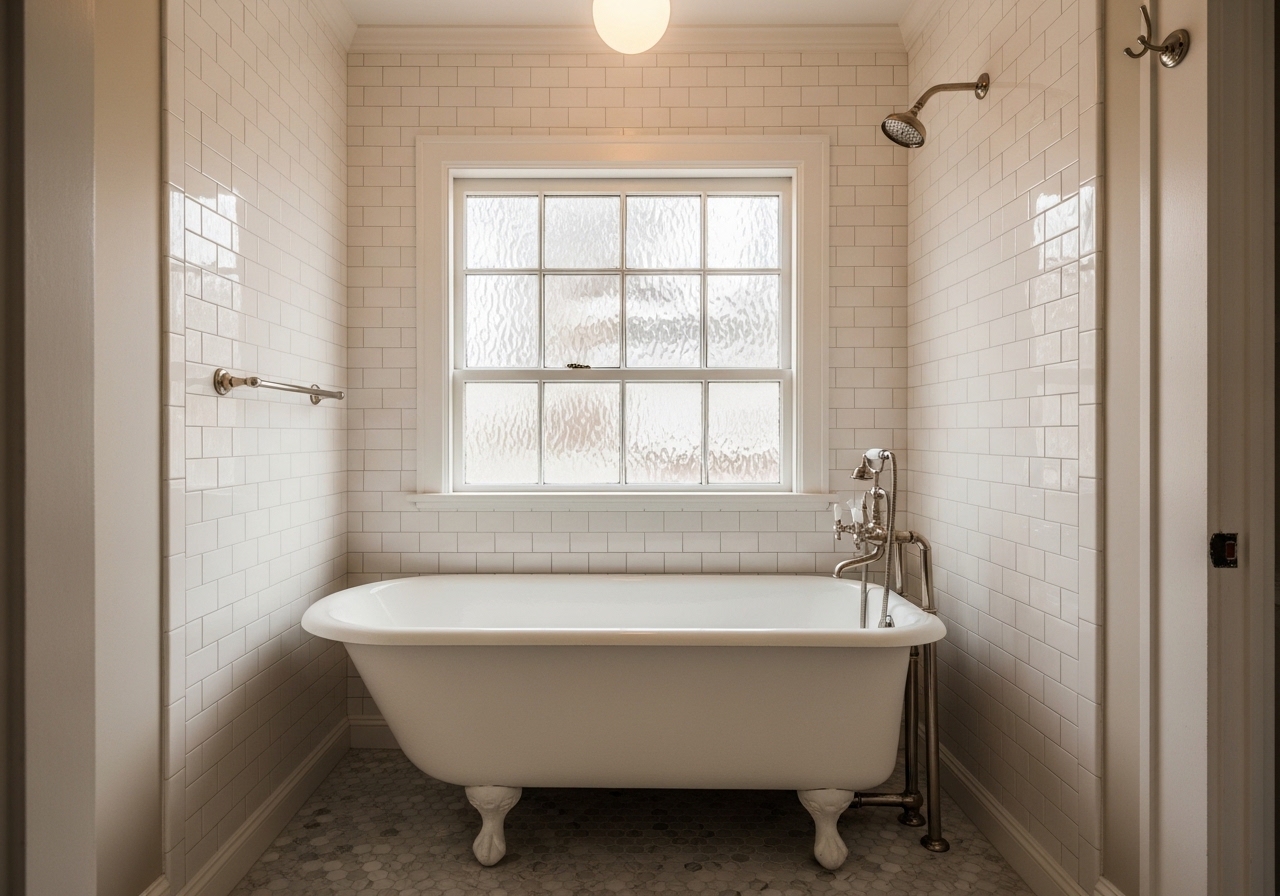
A 66-inch cast-iron slipper tub from an architectural salvage dealer in North Charleston, where it had been sitting in a warehouse for twelve years; $650 as found, 400 pounds, four people to get it up the stairs, and zero regrets. A clawfoot tub is the soul of an old bathroom, and a new acrylic reproduction is a shape without the weight; the cast iron holds heat for an hour and rings when you tap it. It sits on its original feet, which were stripped and painted black, in the window alcove where the light falls on it.
Reglazing versus replacing
The interior was chipped and yellowed, and a professional reglaze in white was $480 and two days, against $2,800 for a new cast-iron tub of the same size and $900 for acrylic; reglazing was the answer for anyone with a sound tub and a cosmetic problem, and it has held for four years with the care the reglazer specified, which is no abrasive cleaners and no bath mats with suction cups. The exterior was primed and painted in the wall color, which is a matte warm white, so the tub reads as a fixture and not as a sculpture.
The floor tile mistake
We chose a 1-inch hex in white marble that looked striking in the showroom and turned out to be nearly impossible to keep clean: marble is porous, the grout lines are a nightmare, and the floor that looked like a 1900 bathroom in the showroom looks like a 1900 bathroom that has been used, in a way I did not intend. If I were doing it again, a larger-format tile with fewer grout lines, a 2-inch hex in porcelain that reads the same from standing height, or the marble with a weekly sealing schedule I would have to actually keep. The tile was $1,400 installed and the lesson was included.
The window
The unexpected triumph: the original window had been replaced at some point with a vinyl single-hung that did not open properly, and we found a period-appropriate double-hung at salvage with its original wavy glass intact, $300, and had it retrofitted for $700. The light through wavy glass in a white bathroom is extraordinary, and the window is the reason the tub is where it is. A bathroom's daylight is its best light and its rarest, and a salvage window is the cheapest way to get the right kind.
Where the money goes
Spend on the plumbing fixtures and the tile, not on the vanity: a vanity can be painted, refaced or replaced in a weekend, and a cheap faucet is a cheap faucet forever. Ours is a salvaged dresser with a marble top and an undermount sink, $600 all in, under a faucet that was $700, and the proportion is right. The tub filler, a floor-mounted telephone style in nickel, was $1,100 and is the single most-touched object in the room, and it feels like it.
The sconces beside the mirror
Two damp-rated bathroom sconces flanking the mirror at 64 inches to center, 36 inches apart on a 30-inch mirror, with frosted glass shades that hide the bulb from every angle, on a dimmer; they were the last thing we installed and they made the biggest difference, because a face lit from the sides at eye level is a face, and a face lit from above by the old bar was a skull. Warm high-CRI bulbs, 2700K at 90 CRI, so skin and color read true. They are kept clear of the tub's splash zone, which is the rule for anything not wet-rated.
The tub's own light
A wet-rated recessed fixture over the tub, the one recessed light in the house, because a tub in an alcove under a window is dark after 5 pm and a bath is an evening thing; 2700K, 600 lumens, on its own dimmer at 20 percent, which is the bath setting. A pendant over a tub is a code question and a cleaning question, and the recessed fixture is invisible in the alcove's ceiling, which is the only place in a plaster house I would put one.
The finish
Polished nickel on every fixture, because the tub's original feet and the salvaged filler are nickel and a bathroom with the tub's hardware in one metal and the sconces in another is a bathroom that bought its parts separately; the sconces' finish matched the clawfoot tub's hardware almost exactly, which is the reason they were chosen. Nickel in a bathroom, brass in the kitchen from the brass post, and a reason for each: the bathroom's metal was decided by a tub that was made in 1905.
The ceiling fixture and the fan
A small semi-flush with a frosted bowl at the room's center, 1,200 lumens, on a dimmer and rarely above 40 percent; and a quiet fan on a timer switch in the alcove's ceiling beside the tub light, because a bathroom with a cast-iron tub and a salvage window is a bathroom where steam meets old wood. The fan's timer runs 20 minutes after every bath, and it is the fixture that protects the window.
Waterproofing before anything pretty
The subfloor was sistered and a waterproof membrane laid under the tile, the walls behind the tub were backed with cement board and a liquid membrane, and the tub's drain got a new overflow and trap before the tub went in; $2,200 of things nobody sees, and the reason the marble floor's grout is the only thing in the room that has been a problem. A bathroom renovation in an old house is a waterproofing project with a pretty layer on top, and the order is non-negotiable.
The layout
Nine by 11: the tub in the window alcove on the long wall, the vanity opposite the door with the mirror and sconces, the toilet in the corner behind a half-height wall, and 36 inches of floor between everything, which is the minimum that lets two people be in the room. The tub had to be where the window was, and everything else was arranged around that; a clawfoot tub in the middle of a room is a magazine idea and a mopping problem.
What surprised us
That the window mattered more than the tile. That the sconces mattered more than the vanity. That the reglazing held. That 400 pounds is heavier than four people think. And that a bathroom lit from the sides, with the ceiling fixture at 30 percent and the tub light at 20, is a room people linger in, which nobody has ever said about a bathroom under a light bar.
The order of the work
Demo, then the subfloor and the waterproofing, then the plumbing rough-in for the filler's floor mount, then the window, then the electrical for the sconces and the tub light, then the tile, then the tub up the stairs and set, then the vanity, then the fixtures, then the sconces last. Nine weeks with a two-week wait for the window's retrofit, and the sconces on the last afternoon, which is when the room became a room.
Mistakes
The marble hex, in detail above. Not measuring the stair's turn before the tub was bought, and a morning of geometry with four people and a 400-pound object. The first mirror, too wide for the sconces' spacing, returned. A frosted bulb trial in the tub light that made the bath a fog. And installing the sconces last, which was correct for the schedule and meant eight weeks of a finished room with a bad light on my face every morning.
What it cost
The tub, $650, and its reglazing, $480. The window and its retrofit, $1,000. Waterproofing and the subfloor, $2,200. The tile, $1,400. The vanity, $600, and its faucet, $700. The tub filler, $1,100. Two sconces, $260, the tub light, $140, the semi-flush and fan, $220, and David's two days, $1,040. Plumbing labor, $3,400. About $13,200 for the most expensive room in the house, and the $260 of sconces is the line that changed it most per dollar.
The toilet, the towel bars and the small metal
A two-piece toilet with a high-efficiency tank in a traditional shape, because a tankless modern one in this room would be a spaceship; towel bars, a robe hook and a paper holder in the same polished nickel, from one maker, mounted into blocking David set while the wall was open. The small metal is where a bathroom's finish rule is tested, because there are eight pieces of it and any one in the wrong finish is the one the eye finds. All nickel, matched to a tub foot, and a room that bought its parts as a set.
The mirror
A 30-inch round mirror in a nickel frame, centered over the vanity at 66 inches to its center, chosen after the sconces so the sconces' 36-inch spacing framed it with 3 inches of wall each side; the first mirror was 40 inches wide and touched both sconces and went back. A mirror is sized to the sconces and not to the vanity, because the sconces are fixed and the mirror is not.
The bath itself, which is the point
The tub light at 20 percent, the sconces off, the semi-flush off, the window's last light on the water, and 400 pounds of cast iron holding the heat for an hour; it is the reason the room exists and the reason the lighting was designed for it and not for the mirror alone. A bathroom lit for a bath is a bathroom with a fixture over the tub on its own dimmer, and it is the one recessed light I have ever specified.
The guest bathroom, done cheaper by the same rules
The hall bath got the same sconce-beside-mirror rule at 64 inches in nickel, a reglazed original tub, a porcelain hex floor in 2 inches, and no salvage window, for about a quarter of the master's cost; the bathroom pendant post is that room's ceiling. The rules do not change with the budget; the tile and the window do, and the sconces are the line that stays in both rooms because it is the one that changes a face.
In one paragraph
Keep the cast-iron tub and reglaze it; put it in the window's light; salvage a window with wavy glass; waterproof before anything pretty; spend on the filler and the faucet and not the vanity; skip the 1-inch marble hex; light the face from the sides with damp-rated sconces at 64 inches in the tub's metal, and the tub with one wet-rated recessed light on a dimmer; a fan on a timer; and the sconces last, which is the right order and the wrong wait.
Shop this post: bathroom sconces and vanity mirror lights in a finish to match old hardware