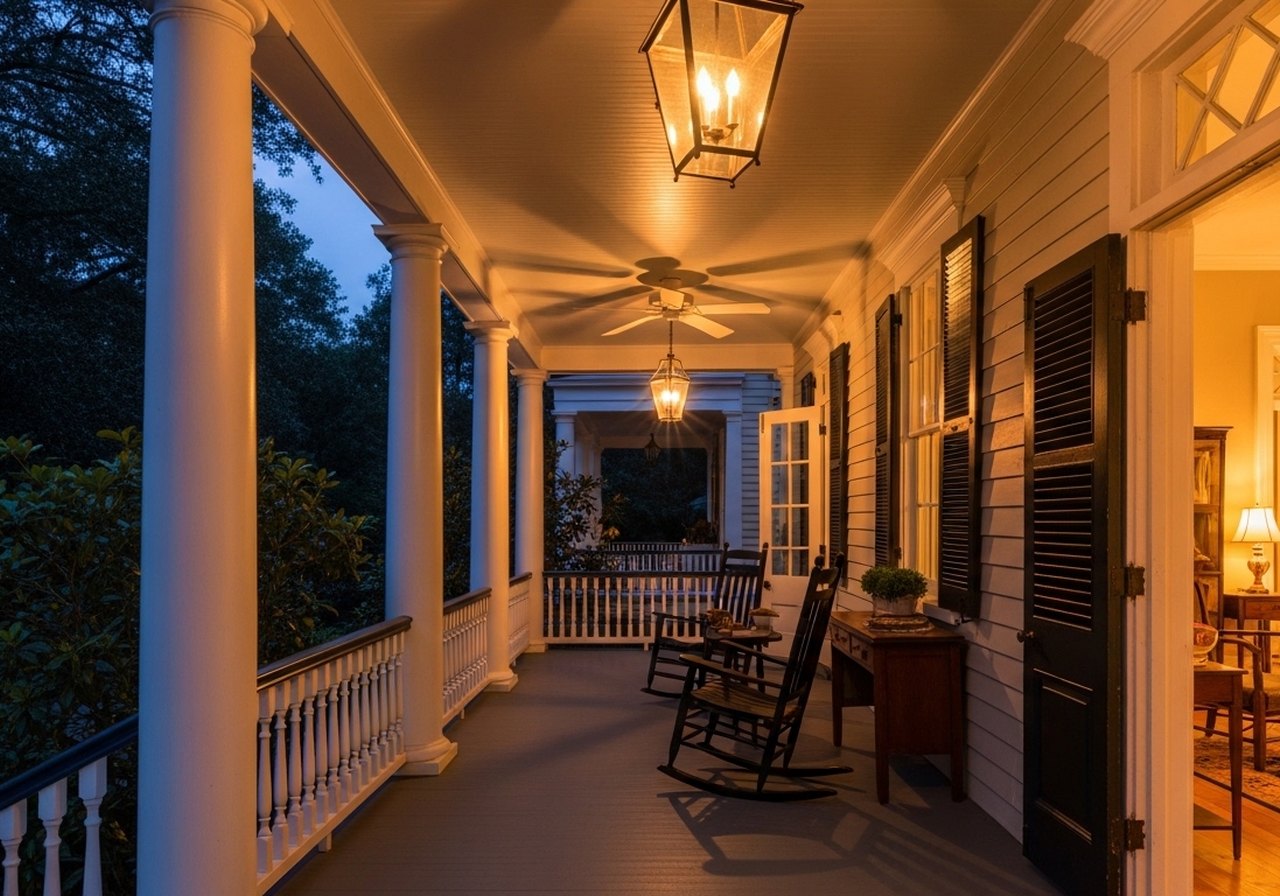
Porch lighting ideas for a Charleston piazza start with two facts that make it harder than an ordinary porch: it is 42 feet long, so a single fixture at one end lights almost nothing, and it is three blocks from the water, so a damp-rated fixture rusts in a year and only wet-rated will do. In Charleston the side porch is called a piazza, a long narrow porch that runs the full length of the single house along one side, oriented to catch the prevailing breeze, and it is the room we live in from April to November. We lit it like a living room that happens to be outside: a wall lantern every 10 to 12 feet, a hanging lantern at the sitting end, all on a dimmer switched from inside, on from dusk and off after midnight. This post is the wet-rating lesson and what it cost to learn, the spacing arithmetic for 42 feet, the fixture and why cast iron, the hanging lantern over the sitting end, the dimmer and the two settings, 2700K and the parking-lot problem, angling fixtures to glow and not glare at the street, the ceiling and its color, the piazza door and its own light, mosquitoes and bulbs, the hurricane-season routine, the view from the street, the piazza in winter, the mistakes, and the cost.
The wet-rating lesson
Our first set of sconces was damp-rated, the rating for a covered porch, and they started rusting within a year under a roof overhang, because salt air does not care about overhangs; the second set is wet-rated, sealed at the socket and the backplate, and four years later shows nothing. In a coastal city, wet-rated is the minimum for any exterior fixture, covered or not, and the $40 premium per fixture is the cheapest insurance in this post. The first set was $320 for four and went to the metal recycler, which is the tuition.
The spacing arithmetic
A wall lantern at 60 to 70 lumens of useful throw lights about 5 to 6 feet of porch either side of it, so a fixture every 10 to 12 feet gives even coverage with no dark bands: 42 feet, starting 5 feet from the street end, gives four wall lanterns at 5, 16, 27 and 38 feet, with the last one beside the sitting end's hanging lantern. Three would have left two dark patches; five would have been a runway. The columns set the exact positions, because a lantern between columns reads as placed and one on a column reads as a mistake, and the 10-to-12-foot rule bent by up to 18 inches to land between them.
The fixture
Traditional black cast-iron lanterns, wall-mounted, fully enclosed, wet-rated, from the outdoor wall sconce collection, a size down from the front door's from the lantern post so the family holds; 18 inches tall, mounted at 66 inches to center between the columns. Cast iron because it is what a piazza had in 1892 and is still made, black because the house's trim is white and the shutters are dark green, enclosed because an open-bottom lantern here is a bug lantern. The scale is for the columns, not the door: a lantern on a piazza is seen in a row, and a row of large fixtures is a row of large fixtures.
The hanging lantern
At the sitting end, where the chairs and the table are, a hanging lantern from the ceiling on a 24-inch chain, wet-rated, the same black cast iron, over the table, which is the piazza's chandelier and the thing that turns 12 feet of porch into a room. It is on the same dimmer as the wall lanterns and it is the fixture that is on when the wall ones are off, for the two of us with a drink at 10 pm. The ceiling box took David an hour, through the porch ceiling from the attic side, and it is the one fixture on the piazza I would fight for.
The dimmer and the two settings
All five fixtures on one dimmer inside the piazza door, on a timer that brings them on at dusk and off at 12:30. Two settings: 70 percent for guests and a table set for six, and 25 percent for a quiet evening, which is the setting that is on nine nights of ten. A piazza at full brightness is a stage, and the neighbors across the street are the audience; at 25 percent it is a room with the lights low, and the street sees a glow through the columns and nothing else. The dimmer is the reason the piazza is used, because a porch you can only light fully is a porch you light rarely.
2700K, and the parking-lot problem
Warm bulbs, 2700K, in every fixture, because cool light on a Southern porch reads like a parking lot; we tried a 4000K bug bulb for a month and the piazza looked like a gas station. LED, clear, candelabra base, 450 lumens in the wall lanterns and 800 in the hanging one. The whole piazza at full is about 2,600 lumens over 42 feet, which is dim by indoor standards and exactly right for a porch, where the point is to see faces and the garden and not the floorboards.
Angling to glow, not glare
Every wall lantern has its glass angled so the light goes down and back toward the house, and the hanging lantern's shade is closed on the street side; the street sees the piazza lit and does not see a bulb, which is the difference between a house that glows and one that shines in your eyes as you walk past. It took an evening on the sidewalk with my husband inside turning fixtures, and it is the step nobody does. A piazza faces the street on one side and the neighbor on the other, and both of them are looking.
The ceiling
Haint blue, the pale blue-green that Charleston porch ceilings have been painted for two centuries, which is on ours because it was on ours, and which does something for the light nobody warns you about: a warm lantern under a cool ceiling reads as warmer, by contrast, and the ceiling at night is a soft sky. A white porch ceiling under warm lanterns goes yellow; the haint blue stays blue. If a piazza ceiling is being painted anyway, the blue is the color, and not for the superstition.
The piazza door
A single house's "front" door opens onto the piazza, not the street, and it has its own lantern on the latch side at 66 inches, the same family, on the house's photocell circuit rather than the piazza's dimmer, so the door is lit even when the porch is dark. A guest who has never been to Charleston walks to the street door, finds it is a false door onto the porch, and is led by the lit door to the real one; the lantern is the instruction. The foyer post is what is inside that door.
Mosquitoes and bulbs
A yellow bug bulb attracts fewer insects and looks like a bug bulb; we run 2700K and a fan, which is the real mosquito answer on a piazza, two ceiling fans on the dimmer's neighboring switch that move the air the length of the porch. The enclosed lanterns keep the insects out of the fixtures, which was the open-bottom set's other failing. A porch in Charleston is lit for people and fanned for mosquitoes, and the two systems are next to each other on the wall inside the door.
The hurricane-season routine
The hanging lantern comes down in June if a storm is named for us and goes back up after, twenty minutes each way; the wall lanterns stay, because cast iron on four screws into a column does not move. The bulbs are LED and survive the power flickering back on. The dimmer's timer resets after an outage and has to be re-set, which is the one annual chore. Four seasons and two named storms, and the lanterns have needed the touch-up pen once.
From the street at night
A row of five warm points through the columns at 25 percent, the door's lantern brighter, the haint blue ceiling faintly lit, and the parlor's window beside it; the house glows in the right way, and it is one of the things I am most proud of in six years here. Before, the piazza was a dark side of the house with two rusting dots, and the street read it as a house nobody sat outside. A piazza lit is a piazza used, and a piazza used is what a single house is for.
The piazza in winter
December to March the dimmer's timer moves to off at 10 and the setting stays at 25 percent, because a lit porch in winter is a lit house from the street even if nobody is on it; the hanging lantern is the only one raised to 50, for the two evenings a month it is warm enough to sit. The lanterns' glass is washed in March with the front door's. A piazza's lights are the facade's for a third of the year and the room's for the rest, and the timer knows which.
Sizing a piazza's lighting for a shorter porch
A 20-foot piazza takes two wall lanterns at 5 and 15 feet and the hanging one at the sitting end; a 30-footer takes three. The rule is 10 to 12 feet apart, between the columns, starting 5 from the street, and a hanging fixture wherever the chairs are. The dimmer, the wet rating, the 2700K and the angling do not change with length; the count does, and it is porch length minus 10, divided by 11, plus one.
Mistakes
Damp-rated fixtures, $320 and a year. A 4000K month. Open-bottom lanterns full of moths. The wall lanterns on the columns in the first plan, before the electrician pointed at the spaces between. No dimmer for the first season, and a porch that was a stage or dark. And not standing on the sidewalk to angle the glass until a neighbor mentioned, kindly, the light in her window.
What it cost
Four wall lanterns, $520. The hanging lantern, $260. The door's lantern, $130. The dimmer and timer, $58. David's day for the ceiling box and the four wall boxes, $520. Bulbs, $30. About $1,520 for a 42-foot room that is lit from April to November and glows from the street all year, plus the $320 of damp-rated tuition, which is why this post has a wet-rating section first.
The piazza as a dining room
From May to October we eat outside four nights a week under the hanging lantern at the sitting end, at a table for six, and the lantern at 50 percent with two candles on the table is the setting; the wall lanterns at 25 do the rest of the porch so the table is a lit room with a dim corridor beside it, which is how a dining room should sit in a house. Guests eat longer on the piazza than in the dining room, and the difference is the breeze and the fact that the porch's lights are lower than any room inside. A porch lit as a room gets used as one, and this one is used more than the dining room from the first warm night.
In one paragraph
Wet-rated, always, three blocks from the water. A black cast-iron wall lantern every 10 to 12 feet between the columns at 66 inches, four on 42 feet, and a hanging lantern over the sitting end. One dimmer inside the door: 70 for guests, 25 for the evening, on at dusk and off after midnight. 2700K clear bulbs, glass angled to glow toward the house and not the street, a haint blue ceiling, fans for the mosquitoes, and the door's own lantern on the house's photocell.
Shop this post: outdoor wall lights in the right scale for a column