Dining room chandelier height is 30 to 34 inches from the table top to the bottom of the fixture, which under our 10-foot ceiling puts a 24-inch brass and seeded-glass chandelier on an 18-inch stem plus a chain extension at roughly 6.5 feet above the floor, and the rule I use is the fixture's bottom at 6 to 7 feet over a standard-height table. We had a builder-grade flush mount in the dining room for eight months; it worked, technically, and every time I sat down for dinner I felt like I was eating in a doctor's waiting room, and the ceiling deserved better. This post is the height and the week we lived with it 2 inches too high, the size and the 28 inches I now wish I had bought, why brass and seeded glass in an 1892 room, the dimmer and the 40 percent that made the room a place to linger, the light the seeded glass gives, the patina on the canopy, the chain extension for a tall ceiling, the box and its brace, the two sconces that came later with the built-ins, the table it is centered on, what the flush mount was doing wrong for eight months, the bulbs, sizing to a table that will grow, the mistakes, and the cost.
The height
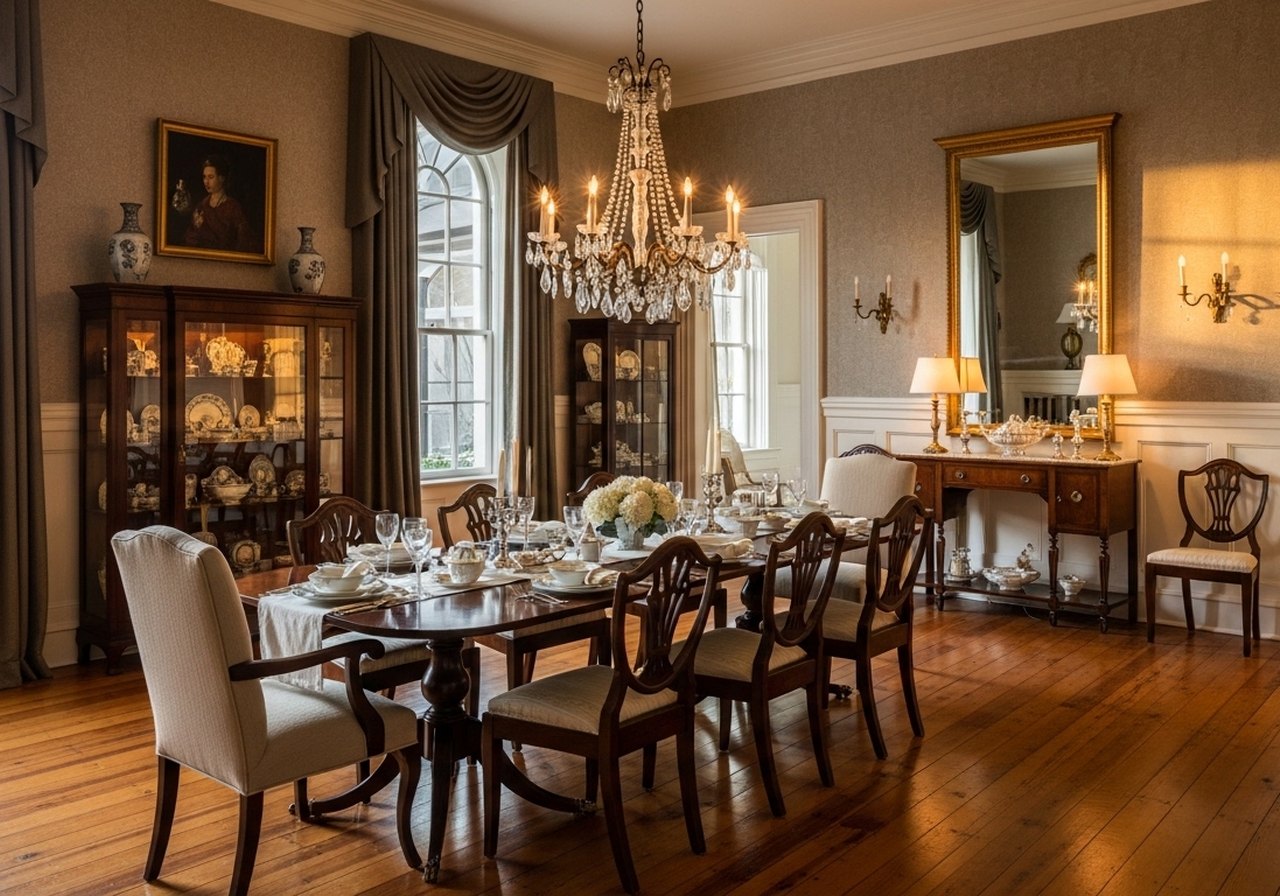
Bottom of the fixture 30 to 34 inches above the table top, and because nobody walks under a dining fixture you can hang it lower than instinct says; we lived with the chandelier an inch or two too high for a week before dropping it, and the lower setting completely changed the room, because the light pooled warmly on the table and on faces instead of washing the whole space evenly. Ours is at 32 over a 30-inch table, 6 feet 2 inches from the floor to its bottom, and at 34 it was a light for the room; at 32 it is a light for dinner. Test the range with someone seated and the fixture held on its chain, and cut the chain after.
The size
Twenty-four inches wide, sized to about two-thirds of a 42-inch table's width, so it anchors the room; if I were doing it again I would go even larger, and 28 inches might have been the right call, but I am not going back up that ladder. The sizing post says between two sizes buy the bigger, and this chandelier is the post's own example of the regret the smaller one leaves. It is not wrong at 24; it is right at 28, and the difference is the kind only the person who hung it sees.
Brass and seeded glass
Nothing radical: a six-arm chandelier in unlacquered brass with seeded-glass shades, proportioned for the room and of a type that has hung in dining rooms since gas; brass because it patinas with the rest of the house's metal and seeded glass because it scatters the light. A crystal chandelier would be correct and would be a cleaning schedule; a modern fixture would be a correction the room did not ask for, per the antiques post; and a reproduction with a factory patina would be a costume. This one is the thing itself, still made, and it is aging in the room.
The dimmer
A $22 dimmer at the wall, and what surprised me most was the change in how the room felt at night: dimmed to about 40 percent, the room became a place you would want to linger, and at full it is a homework light on a Saturday. The same chandelier serves a long dinner and a school project, and a warm bulb dimmed low is what makes the room feel like an occasion. A dining chandelier without a dimmer is a fixture at one brightness, and that brightness is wrong for dinner.
The seeded glass
Seeded glass scatters the light in a way a clear globe does not: instead of a single bright point from each bulb you get a warm, textured glow, the bubbles in the glass breaking the filament into a soft pattern on the ceiling and the walls. It is the reason the fixture can hang at 32 inches without glaring at a seated face, and the reason the medallion above it is lit with a pattern at night. Clear glass would have needed frosted bulbs and lost the filament; seeded glass keeps the filament and softens it.
The patina
The brass has already started developing a small patina around the canopy where hands touch it adjusting the chain, and I expected to be bothered and am not; it is the kitchen hardware's finish on the ceiling, and in five years the chandelier will look like it came with the house. A lacquered brass would have stayed bright and looked newer every year the rest of the house aged.
The chain extension
An 18-inch stem plus an 18-inch chain in the same brass, ordered separately and assembled, because the fixture's own hardware would have left its bottom at 7 feet 8 under a 10-foot ceiling; the 10-foot fixtures post is the arithmetic. The chain's links are the same finish as the stem, and the seam is invisible, which is the difference between a fixture lengthened and a fixture made for the room.
The box and the brace
The chandelier weighs 22 pounds and the builder's box was rated for 15; David added a brace bar between the joists from below, through the medallion's center hole, which took an hour and $140 and which I had not checked before buying. Any chandelier over about 15 pounds needs the box's rating checked first, and an old house's box is whoever last wired it, which is rarely someone who expected 22 pounds of brass.
The two sconces
A year after the chandelier, the built-ins went in and the room felt more formal, and two sconces flanking the mirror over the mantel at 62 inches were the answer, on their own dimmer; the built-ins post records the room asking for them. A chandelier at 40 percent lights the table and leaves the walls dark, and the sconces are what light the fireplace wall so the room at dinner is a room and not a table in a void.
The table it is centered on
Centered on the table, not the room, which are 8 inches apart because the built-ins moved the room's center to the fireplace wall and the table followed; the box was relocated when the flush mount came down, which added an hour to David's day and is the reason the chandelier hangs over the table's center and not over its edge. A chandelier centered on a room whose table is off center is a chandelier that looks like it missed.
What the flush mount was doing wrong
Lighting the ceiling and the upper walls evenly from a frosted disc 4 inches from the plaster, at one brightness, with no way to put light on the table or the faces; it was a fixture for a hallway installed in a room for dinner, and it made every meal feel like a waiting room because it lit the room like one. Eight months of it, because it worked, which is the sentence that recurs in every one of these posts.
The bulbs
Six clear candelabra LEDs, 2700K, 400 lumens each, dimmable, with the filament visible through the seeded glass because the bulb is the ornament; 2,400 lumens at full for an 18-by-20 room is a work light and at 40 percent is dinner. Frosted bulbs in seeded glass are a fixture with a headache, and the trial week of them was two days.
Sizing for a table that will grow
The table seats eight and with its leaf ten, and the chandelier is sized to the table's width, which does not change with the leaf, so one fixture serves both; a linear fixture sized to the length would have to grow with it. It is the argument for a single round chandelier over a family table, and the argument for 28 inches is that the leaf makes the table longer and a slightly larger fixture would hold the longer table's center better.
Mistakes
Eight months of the flush mount. Twenty-four inches, when 28 was right. A week at 34. Not checking the box's rating, and a second visit for the brace. Frosted bulbs for two days. And centering the first box on the room before the built-ins moved the table, which is the hour of relocation.
What it cost
The chandelier, $580. The chain extension, $38. The brace and the box's relocation, $260. The dimmer, $22. Six bulbs, $36. About $940 for the fixture that changed the whole room, and the $22 dimmer is the part that changed it at dinner.
The chandelier at three times of day
Off by day, when the west window does the room; at 40 percent at dinner, with the sconces at 30 on the mantel wall and the candles on the table, which is the setting the room was bought for; and at full on a Saturday morning for a project on the table, when it is a work light and a good one. One fixture, three jobs, and the dimmer is the only thing that changes. The high ceilings post is the argument for the lower layer that makes 40 percent enough.
Installing it
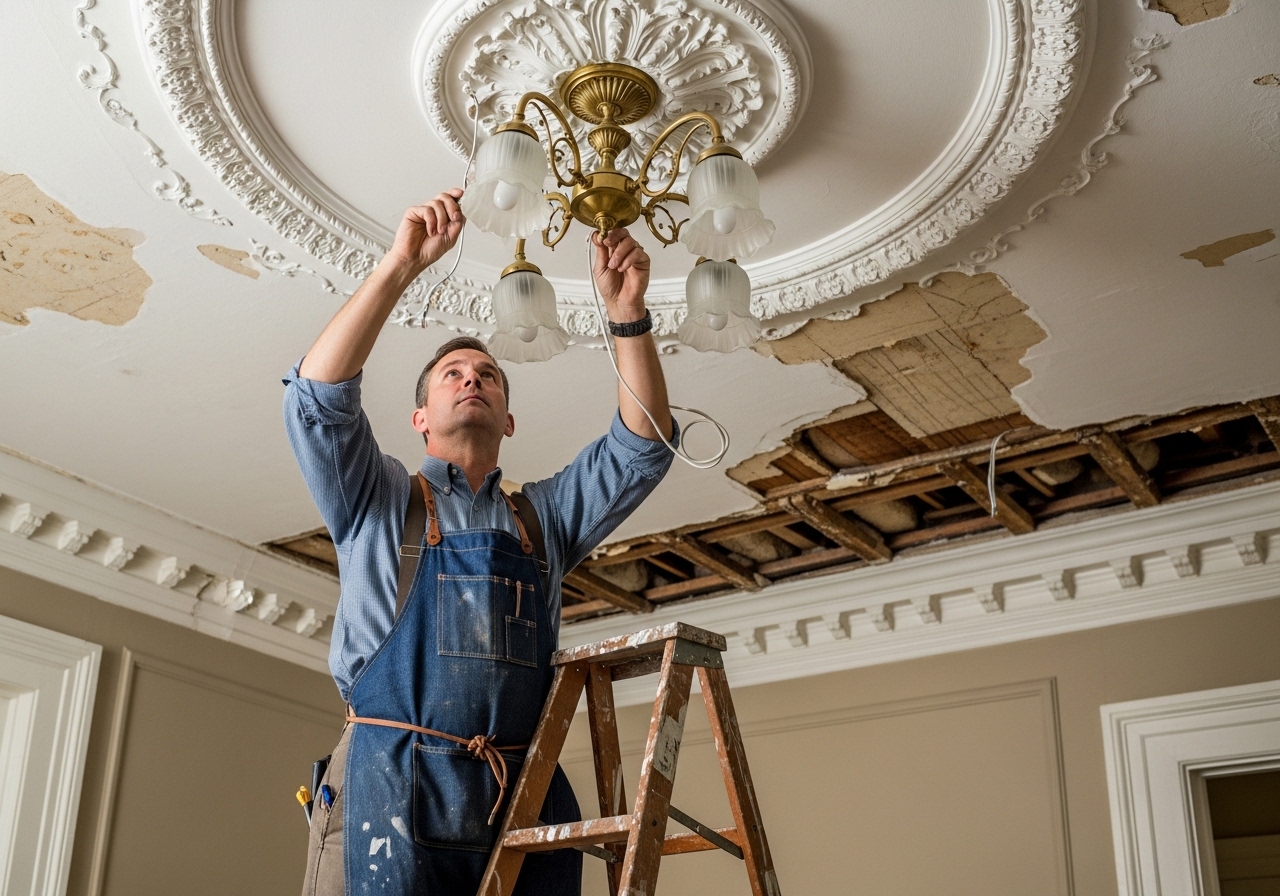
The brace first, through the medallion's hole; the canopy's bracket onto the brace's box; the chain assembled to the stem and its length set with the table in place and someone seated; the fixture lifted by two people while a third connected the wires; the canopy up; the chain's last link cut. Two hours with David and my husband, and the medallion untouched but for the hole it already had, which in a plaster house is the measure of a clean job.
Cleaning seeded glass and brass
Twice a year the six shades come off and are washed in the sink, the arms wiped with a dry cloth so the patina is not disturbed, and the bulbs dusted; ten minutes on a stool. Unlacquered brass is never polished on this fixture, because the point is that it darkens, and seeded glass hides a fingerprint that clear glass would show at dinner. It is the lowest-maintenance chandelier I have owned and the one I would own again.
The room from the doorway
From the hall, at dinner, the chandelier at 40 is a warm object over a lit table with the sconces glowing on the wall behind it and the built-ins' shelves lit at their edges, and the room reads as a place from 20 feet away; from the doorway with the flush mount it read as a bright box with a table in it. A dining room is seen from its door as often as from its chairs, and a chandelier at the right height is the thing that makes the doorway view a room.
The flush mount is in the attic, in case a hallway ever needs one, which is the room it was made for, and the room it will look right in.
Eight months under it were eight months of a room not being used for what it was drawn for, and the chandelier's first dinner was the first dinner that lasted past the plates.
In one paragraph
Thirty to 34 inches over the table, tested at 34 and dropped to 32; two-thirds of the table's width, and between sizes the bigger; unlacquered brass and seeded glass, still made the old way; a chain extension in the same finish for a 10-foot ceiling; the box's rating checked and braced; centered on the table; on a dimmer at 40 percent for dinner; clear candelabra bulbs; and two sconces on the mantel wall when the room asks. A doctor's waiting room became a place to linger, and the ladder is not going back up for 4 inches.
Shop this post: pendant lights and ceiling lights with room context in the photos, which makes scale easier to judge