Entry hall ideas for an 1890s house begin with taking things away: when we bought the house, the entry hall had been painted the same shade of greige approximately six times, not six coats of one color but six separate people across six decades all landing on the exact same safe, slightly warm beige, and underneath it were original heart pine floors, wainscoting and plaster walls that just needed to be seen. The whole entry redo came in around $2,800, most of it labor I did myself and floor refinishing I did not, and it is the highest-impact small project we have done. This post is the before and why it was hard to look at, stripping four layers from the wainscoting and what came out, the floors and why matte, the deep cream above the wainscot and the samples that lost, the lantern that was the last piece, the console lamp and the mirror, the brass umbrella stand from an estate sale, the place for keys, the greenery, the transom and the light through it, the front door's hardware, the dimmer, what an entry hall is for in a single house, the order of the work, the mistakes, and the cost.
The before
Hard to look at, not because it was bad exactly but because it had no opinion: greige walls, greige wainscot, a satin-finish floor that had been refinished at least twice with something too shiny, a 1990s flush mount with a frosted bowl, and nothing on any surface. An entry with no opinion is an entry that tells a visitor the house has none, and this house has 130 years of opinions. The first thing I did was take a photograph, and the second was to scrape a test square on the wainscot.
Stripping the wainscoting
Four layers came off, greige over cream over green over the original shellac, with a heat gun and a pull scraper and a chemical stripper for the beading, over three weekends, which is a job I would describe as deeply unpleasant and, in the end, worth it. The wood underneath is heart pine, tighter-grained than anything you can buy today, with a warm honey color that no amount of staining could replicate, and it took two coats of a wax finish and nothing else. Lead paint was present in the lower layers, as our inspector had noted, and the work was done with a respirator, a wet method and a HEPA vacuum, and the children of friends were not in the house that month.
The floors, and why matte
Refinished by the same crew that did the rest of the house, per the floor post, in a matte finish, satin at most; high-gloss floors in a period home look wrong, too reflective, too uniform, and matte lets the grain read properly and hides the century of dents that are the floor's point. The entry's 108 square feet cost about $750 as part of the whole-house job, and the matte finish is the decision guests comment on without knowing what they are commenting on.
Deep cream, not white and not beige
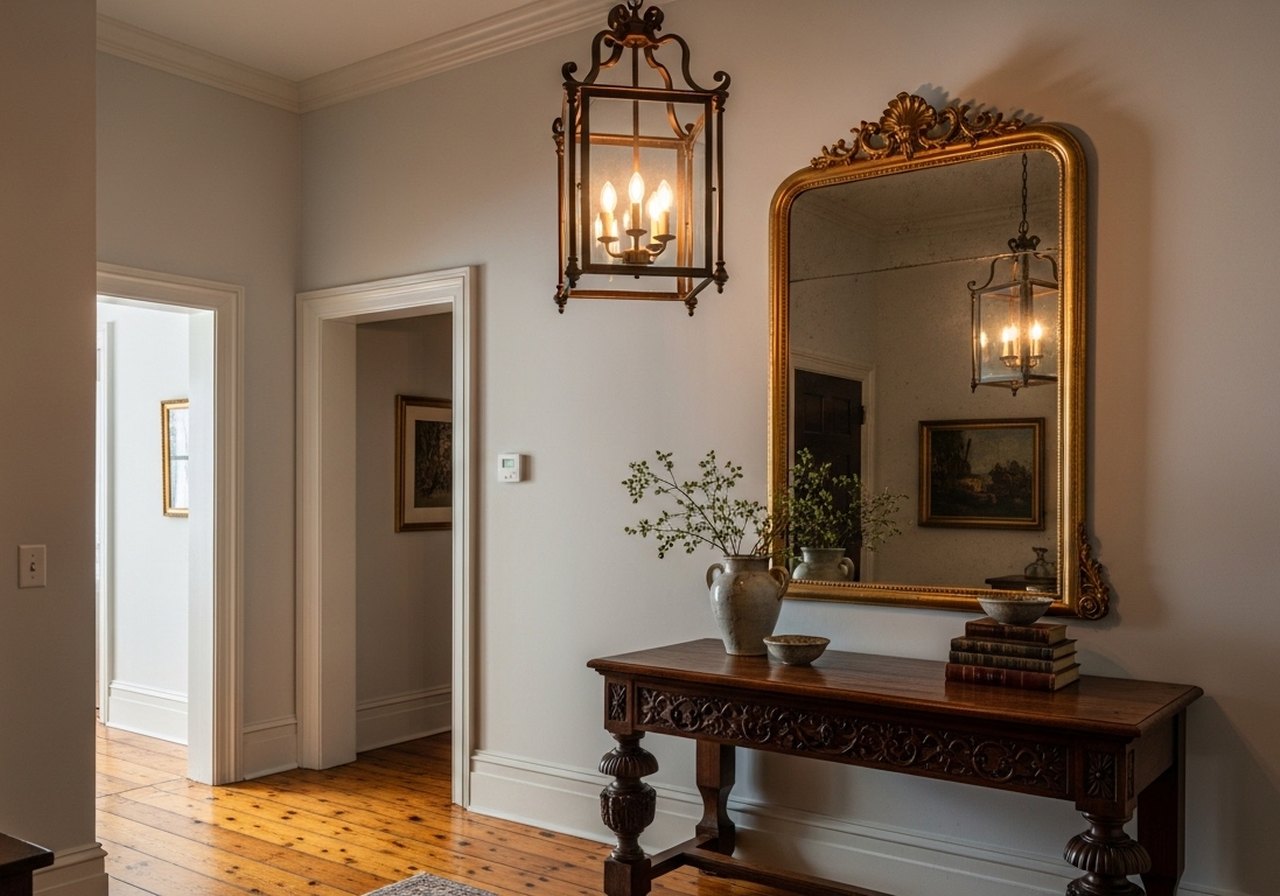
The walls above the wainscot in a deep cream, something with real warmth, chosen from five samples painted in 2-foot squares and looked at for a week at 8 am, noon and 9 pm under the lantern; white read cold against the honey wood and beige read like the greige it was replacing. The winner pulls toward yellow in the morning light through the transom and toward a warm grey at night, and against the natural wood and the brass it finally looks like a house with a history. The paint post is the same method in a harder room.
The lantern
The last piece to fall into place: a hanging lantern from the entryway light fixtures collection, 20 inches, black iron and clear glass, centered in the hall on a 30-inch chain so the bottom sits at 7 feet under the 11-foot ceiling, on a dimmer. A lantern is the fixture an entry of this age would have had, gas once and electric since, and it is dense enough to read at 20 inches in a space the sizing formula says wants 25. The foyer post is the lantern's own story; here it is the piece that made the rest look finished.
The console lamp and the mirror
A narrow console against the wainscot, 12 inches deep, with a brass table lamp at seated eye level, because a lantern overhead is the entry's light and a lamp at eye level is its welcome; a mirror above the console, 30 inches, in a plain black frame, which bounces the lantern and the transom's light and is the last check before the door. The lamp is on a smart plug that brings it on at dusk, and it is the light that is on when we come home. A lantern and a lamp is two heights, which is the minimum for any room that is meant to feel inhabited.
The brass umbrella stand
From an estate sale on Tradd Street, $40, dented, unlacquered, and darkening in the corner by the door where it holds three umbrellas and a walking stick that came with it. It is the object in the entry that makes the entry look like a house that has been lived in, and it cost less than the paint. One old object with a use, in a corner, does more than a decorated console, and the rule since has been one such object per room.
A place for keys
A small pewter dish on the console, and nothing else on the console but the lamp and, in season, a vase; the entry's job is to receive what comes in the door and the dish is where it goes. Before, keys lived on the stair's newel post and the mail on the floor. Order is the cheapest thing in an entry and the first thing a visitor reads, and the dish was $18.
The greenery
A vase of whatever the garden has, magnolia in winter, camellia in February, hydrangea in June, on the console beside the lamp, changed weekly; it is the one thing in the entry that is alive and the thing that makes the honey wood and the cream walls look like a room and not a restoration. It is free, and it is the last step of the entry's Sunday, with the dish emptied and the floor swept.
The transom
The front door has an original transom with wavy glass, and the morning sun through it lays a bar of light on the floor that moves across the hall by noon; the cream was chosen for that light and the lantern is hung so it does not block it. At night the transom shows the lantern to the street, which is the reason its dimmer is set to match the exterior lanterns from the lantern post. A transom is an entry's second fixture, and ours was painted shut when we bought the house and freed with a razor.
The front door's hardware
The original mortise lock and brass knob, stripped of paint and left unlacquered, with a new deadbolt in an antique brass that matches at a glance; the door itself was stripped with the wainscot and waxed. A visitor's hand is on the knob before their eye is on anything else, and a painted-over knob on a restored entry is the tell that the restoration stopped at the wall.
The dimmer
On the lantern, $22: full for the arrival with bags and the step-in, 40 percent for the evening, 15 percent overnight so the hall reads as a warm passage from the street and the stair is lit for the 2 am trip. An entry with one brightness is an entry that is either a stage or dark, and ours had been the latter for a decade under the flush mount's single bulb.
What an entry hall is for, in a single house
In a Charleston single house the street door opens onto the piazza and the real front door is on the porch, so the entry hall is entered from the side and runs to the stair; it is a passage more than a room, 9 by 12, and it is the first interior a visitor sees after the porch. Its job is to say what the house is, and for a decade it said "beige." Now it says heart pine, plaster, brass and a lantern, which is what the house is, and the rest of the rooms are the same sentence continued.
The order of the work
Strip the wainscot first, because it is the dirtiest job and everything else has to wait for it. Then the floors, with the rest of the house. Then the paint, after the floors have cured and been covered. Then the lantern, because it needs the ceiling repaired and painted. Then the furniture and the objects, in one afternoon. Three months across a spring, most of it weekends with a heat gun, and the lantern's afternoon at the end was the reward.
Mistakes
A chemical stripper on the flat wainscot panels that raised the grain, before switching to heat; the panels needed a light sanding they should not have. The first paint sample, a white, on the wall for two weeks before I admitted it was cold. The console bought before the lamp, and 4 inches too deep for the passage; returned. And leaving the flush mount for a year after the paint, which meant a year of a finished entry under a fixture that did not belong to it.
What it cost
Stripper, heat gun, scrapers, respirator and wax, $260. The floor's share of the refinishing, $750. Paint and samples, $140. The lantern, $320, and its dimmer, $22. The console, $340, the lamp, $85, the mirror, $110. The umbrella stand, $40, the dish, $18. About $2,100 in things and about $700 in the floor crew's labor, $2,800 for the entry, and three weekends of stripping that I would not do again and am glad I did.
What the entry does for the rest of the house
A visitor's opinion of the house is formed in the entry and revised in the parlor, and the entry's restoration is the reason the parlor's is believed; before, guests walked through beige into a parlor with a medallion and read the parlor as an exception, and now they walk through heart pine into it and read it as the rule. The parlor post was the bigger project and the entry was the one that made it make sense, which is why an entry is the room to do first even when the money says otherwise.
The entry by season
Magnolia in the vase in December with the lantern at 40, camellias in February, the transom's bar of light longest in June when the lamp is off until 8, and a wreath on the door from the Christmas post for four weeks a year. The entry is the room that changes most with the calendar because it is the room with a live thing in it and the room with the door, and the lantern's dimmer follows the season with the street's lanterns outside it.
The stair, which the entry leads to
The entry ends at the stair's newel, and the newel got the same stripping as the wainscot, four layers to the same heart pine, and the balusters after it, one weekend each of the following spring; the entry was not finished until the stair agreed with it, and a visitor's eye runs from the door to the newel without stopping. The stair's own lantern above the landing is the entry's second fixture, and its dimmer is set to match.
In one paragraph
Strip six decades of greige off the wainscot and find heart pine. Matte on the floors. Deep cream above, chosen under the lantern. A hanging lantern at 7 feet on a dimmer, a lamp at eye level on the console, a mirror above it, an estate-sale umbrella stand in the corner, a dish for the keys, and whatever the garden has in a vase. Free the transom. Strip the knob. About $2,800, and an entry that makes a statement the moment you walk in.
Shop this post: entryway light fixtures, the lantern that finished the hall