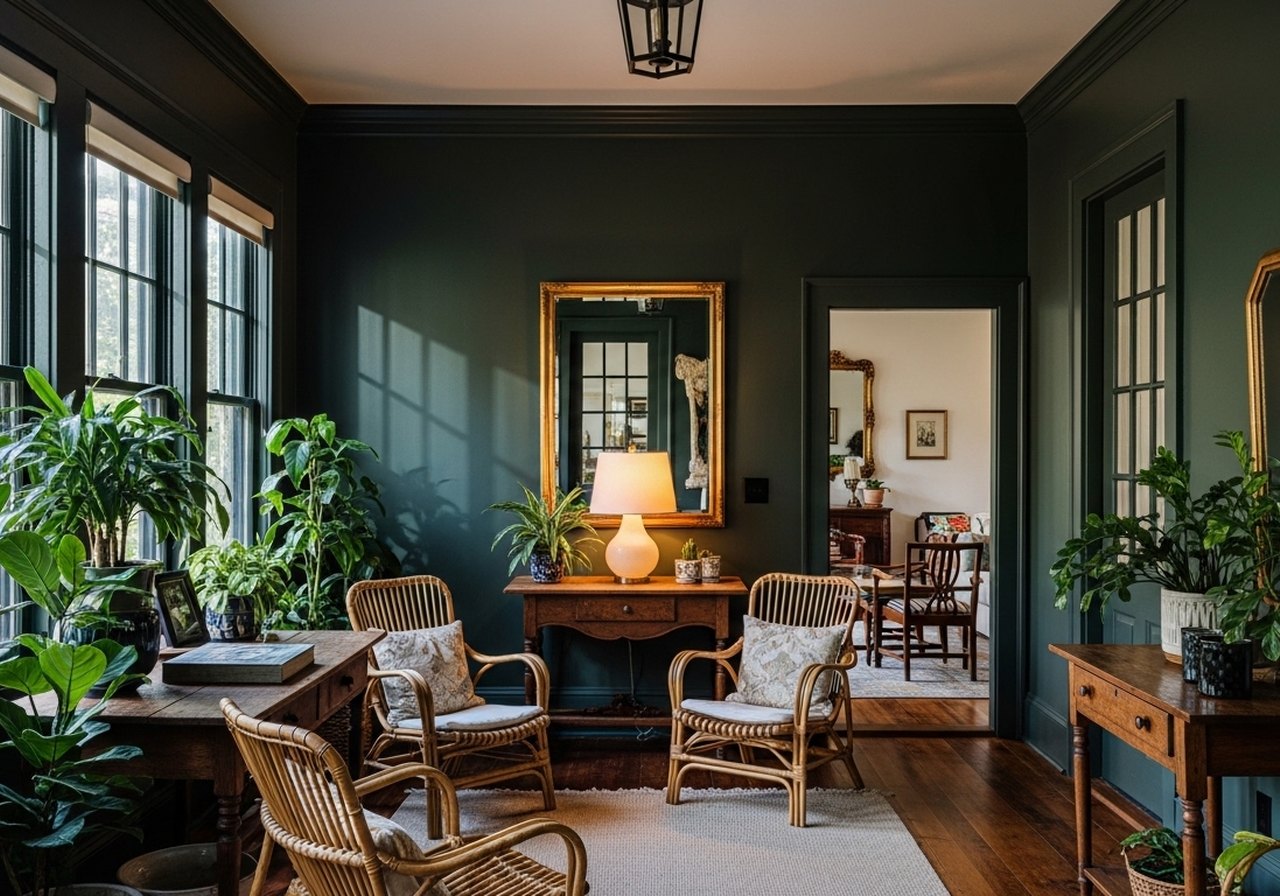
Sunroom paint colors do not have to be white: I painted ours a deep forest green, walls and ceiling the same color, added two brass floor lamps in the far corners and replaced the flush mount with a proper ceiling fixture, and for two gallons of paint and two lamps, about $180 all in, it became my husband's favorite room in the house. The sunroom was white when we moved in, bright white walls, white ceiling, original white-painted wood floor, and it flooded with light in the morning, which sounds ideal and was, in fact, brutal before coffee; it also had no visual weight and nothing to rest the eye on. This post is the argument I had with my husband and how it was settled, the exact green and the three that lost, painting the ceiling the wall color, why dark works in a bright room, the two lamps and where, the ceiling fixture that made the green look intentional, the lumens a dark room needs and where they come from, the floor left white, the furniture and the plants, the room by morning and by night, the windows and what stays off them, the humidity question for a room of glass, the mistakes, and the cost.
The argument
I proposed painting the sunroom dark green; my husband's response was that painting a sunroom dark would defeat the purpose of a sunroom. I argued that a sunroom does not have to be a greenhouse, that it can be a cozy room that happens to have a lot of windows, and that the windows would do the sunroom's job whatever color the walls were. We settled it with a sample: one wall, one weekend, and by Sunday evening with a lamp on he had stopped arguing, and he now refers to it as his favorite room. The sample is how every color argument in this house is settled, and the paint post is the method.
The green
A deep forest green, fully saturated, not a black-green and not an olive; the two that lost were a blue-green that went teal at noon and a grey-green that went muddy at night, and the black-green I did not sample because a room that dark with a white floor is a well. The winner has a yellow undertone that the morning sun warms and the lamps warm again at night, and it reads as a color in both. In a matte finish, because a dark color in a sheen shows every roller mark in a room with this much light.
The ceiling the same color
Walls and ceiling in the same green, which I had been hesitant about and had seen done well in houses older than ours; it works because a dark ceiling over dark walls removes the box's edges and the room becomes a volume instead of a container, and because a white ceiling over dark walls is a lid. The room's windows are large enough that the ceiling never reads as low. It is the move that turns a painted room into an enveloping one, and it is the one people ask about.
Why dark works in a bright room
Counterintuitively, the deep green made the glassy, light-flooded sunroom feel better and not darker: by day the room is still full of light because the windows are two walls of it, and the dark walls give the light something to land on and the eye something to rest against; by night the room is cozy and enveloping in a way white never managed. A pale color had left it feeling washed out and unfinished, and the dark shade gave it character and a clear identity. A room with abundant daylight is the room that can afford a dark color, which is the opposite of what people assume.
The two lamps
Two matching brass floor lamps, one in each far corner, aimed slightly toward the room's center, with linen shades, from an estate sale for $110 the pair; at night with the lamps on and the green walls, the room feels like being inside a lantern. Two lamps because a dark room needs light from more than one point and the corners are where the dark is deepest, and matched because the room's symmetry is its windows and the lamps should agree with it. The lamp placement post is the corner rule; the sunroom is where it is most visible.
The ceiling fixture
The paint transformed the room and the lighting sealed it: replacing the builder's flush mount with a proper ceiling fixture, a 22-inch drum with a linen shade on a short stem, made the green look intentional rather than just dark. A dark room with a builder's disc on the ceiling is a dark room; the same room with a fixture that has presence is a decorated one. It is on a dimmer at 30 percent in the evening, and it was the last thing done and the thing that finished the room.
The lumens a dark room needs
Dark walls absorb light, so a dark room needs more warm sources than a pale one, not fewer: the two lamps at 800 lumens each, the drum at 1,600, and a small table lamp on the side table at 450, about 3,600 at full for 180 square feet, run at about 1,200 in the evening. The lamps and sconces at different heights with warm bulbs make the room glow rather than dim, and the rule for any dark room is one more source than you think and every one of them warm. The layering post is the same rule in a pale room, with one source fewer.
The floor left white
The original painted wood floor stayed white, repainted in a porch enamel, because a dark room needs one pale plane and the floor is the one that reflects the lamps up into the green; a dark floor under dark walls and a dark ceiling is a cave, and the white floor is what keeps the room a lantern. It also shows every footprint from the garden, which is the cost.
Furniture and plants
A rattan sofa and two chairs in natural, with oatmeal cushions, a low teak table, and plants, a fiddle-leaf in the corner between the lamps and a row of ferns on the sill, because a green room with plants in it is a room that explains its color. Nothing dark in the furniture, for the same reason as the floor. The rattan is the eat-in area's pendant's cousin, per the rattan pendant post, and the two rooms are the house's informal end.
By morning and by night
At 8 am the room is the brightest in the house, the sun on the white floor and the green walls glowing like a leaf with light behind it, and it is where coffee happens; at 9 pm it is the darkest and warmest, the lamps in the corners and the drum at 30 and the windows black mirrors that double the lamps. It is two rooms in one, and the white version was one room in one, which is the whole case for the green.
The windows, and what stays off them
Nothing. Two walls of original windows with wavy glass, no curtains, no blinds, because a sunroom's windows are the room and the green walls are what let them be bare; the morning glare that was brutal in the white room is a glare against a green wall, which is softer than a glare against a white one. The room faces east and south, and by afternoon the piazza's overhang shades it.
Humidity in a room of glass
A sunroom in Charleston sweats in August, and the paint is a mildew-resistant interior enamel in matte, the ceiling fan runs on low from May to October, and the ferns are the humidity's beneficiaries. The green has not shown a mark in three summers, and the white floor gets a wipe weekly. A room of single-pane glass is a room whose finishes have to expect condensation, and matte enamel does.
What guests say
That they did not expect a dark sunroom to work, in exactly those words, twice a year; and then they sit in it longer than in any room but the library. A dark room with enough warm light is the room people stay in, and a bright white room is the room people photograph and leave. The green was $90 of paint, and it is the color decision in the house that has changed the most minds.
Mistakes
Painting the sample wall in the wrong sheen first, an eggshell, which showed every stroke in the morning sun and nearly lost the argument. A single lamp for the first month, and a dark far corner. The flush mount left up for a season after the paint, which was a dark room with a disc. And the footprints on the white floor, which are not a mistake but a condition of it.
What it cost
Two gallons of matte enamel and a quart of sample, $110. Two brass floor lamps, $110. The drum ceiling fixture, $180, and its dimmer, $22. Floor enamel, $40. About $460 in all, of which the original claim of "$180 for the paint and the lamps" was the version before the ceiling fixture, and the fixture is the $180 that sealed it.
Painting it
Two coats of matte enamel over a tinted primer, which for a dark color over white is the step that saves a third coat; the ceiling first, then the walls, cutting in at the window frames with a brush because a room that is mostly window is mostly cutting in. Two days, one of them the trim, and the lamps went in on the second evening, which is when my husband stopped arguing. The white floor was done a week later with the room's furniture out, in a porch enamel that takes a week to cure.
The color in other rooms, and why it stays here
The green was proposed for the back parlor and rejected, because the back parlor has one window and the green would have been a cave; the sunroom's two walls of glass are what make the green a lantern and not a cellar. A dark color belongs in the room with the most daylight, which is the opposite of the instinct, and the sunroom is the only room in this house that qualifies. The high ceilings post is why the parlors get the light layer instead.
The sunroom with guests
Drinks before dinner in the sunroom, at dusk, with the lamps at 60 and the drum at 30 and the windows going from garden to black; it is the room guests are taken to first now and the room they were shown last when it was white. A dark room at dusk with warm lamps is a room that holds people, and a white room at dusk is a room that empties as the light goes. The green did that for $460, and the piazza's lanterns coming on through the glass are the room's second chandelier.
If a room has two walls of glass, it can take any color, and the darker the color the more the glass gives back; that is the whole of what the sunroom taught, and it took one gallon to learn.
In one paragraph
Forest green with a yellow undertone, matte, on the walls and the ceiling; the floor left white; two matched brass floor lamps in the far corners and a proper drum fixture on a dimmer in place of the builder's disc; more warm sources than a pale room, every one at 2700K; rattan and plants and nothing on the windows; and a room that is the brightest in the house at 8 am and the warmest at 9 pm, which is what a sunroom that is also an evening retreat should be.
Shop this post: ceiling lights with presence, for a dark room that needs one