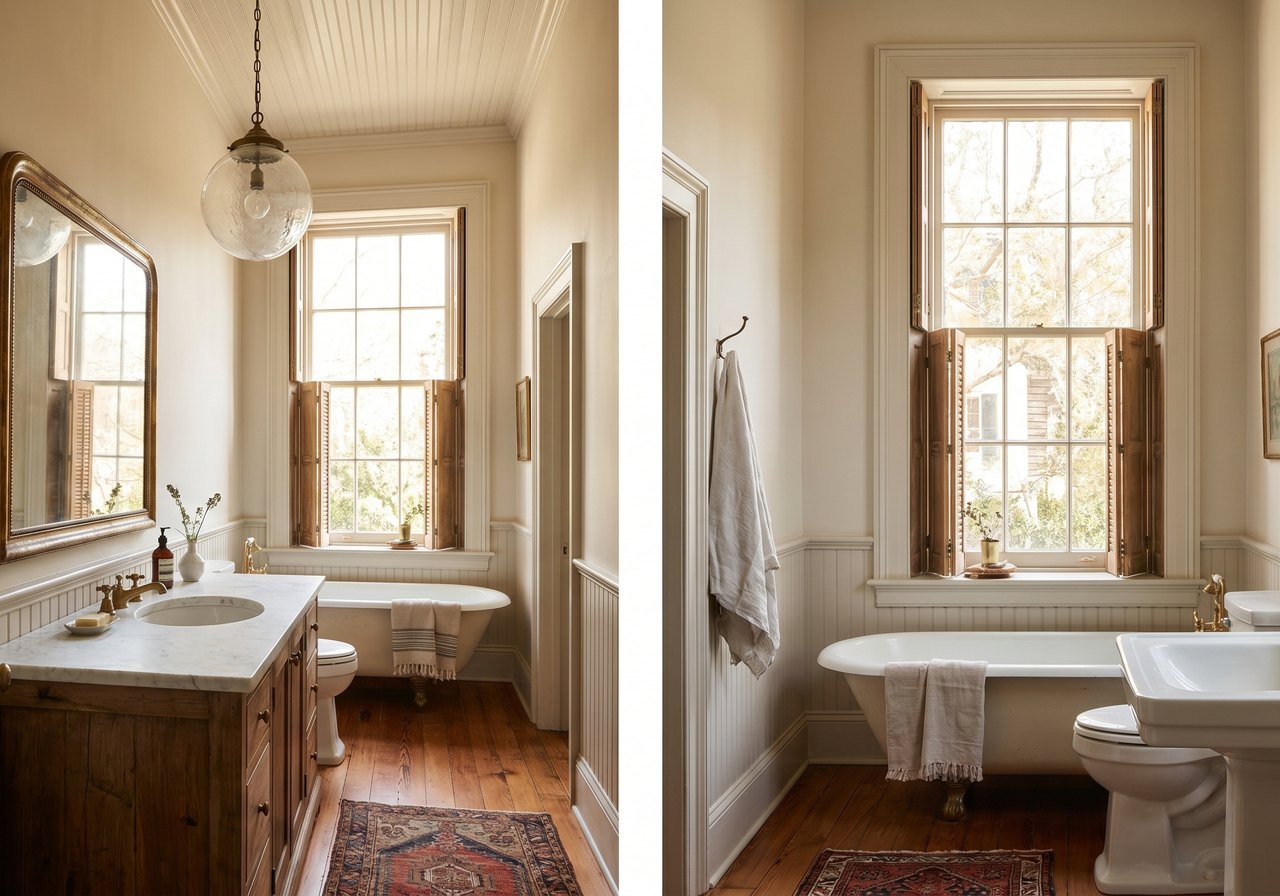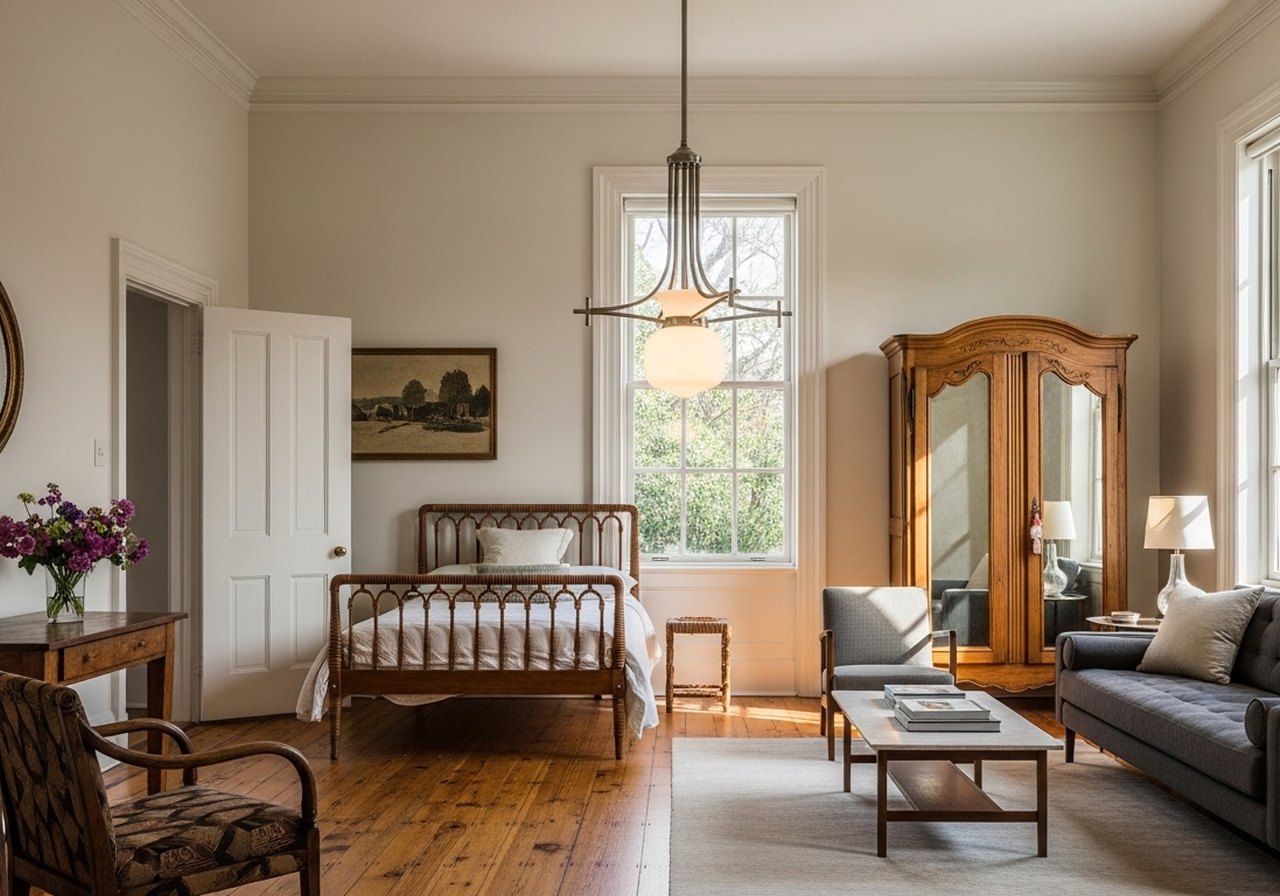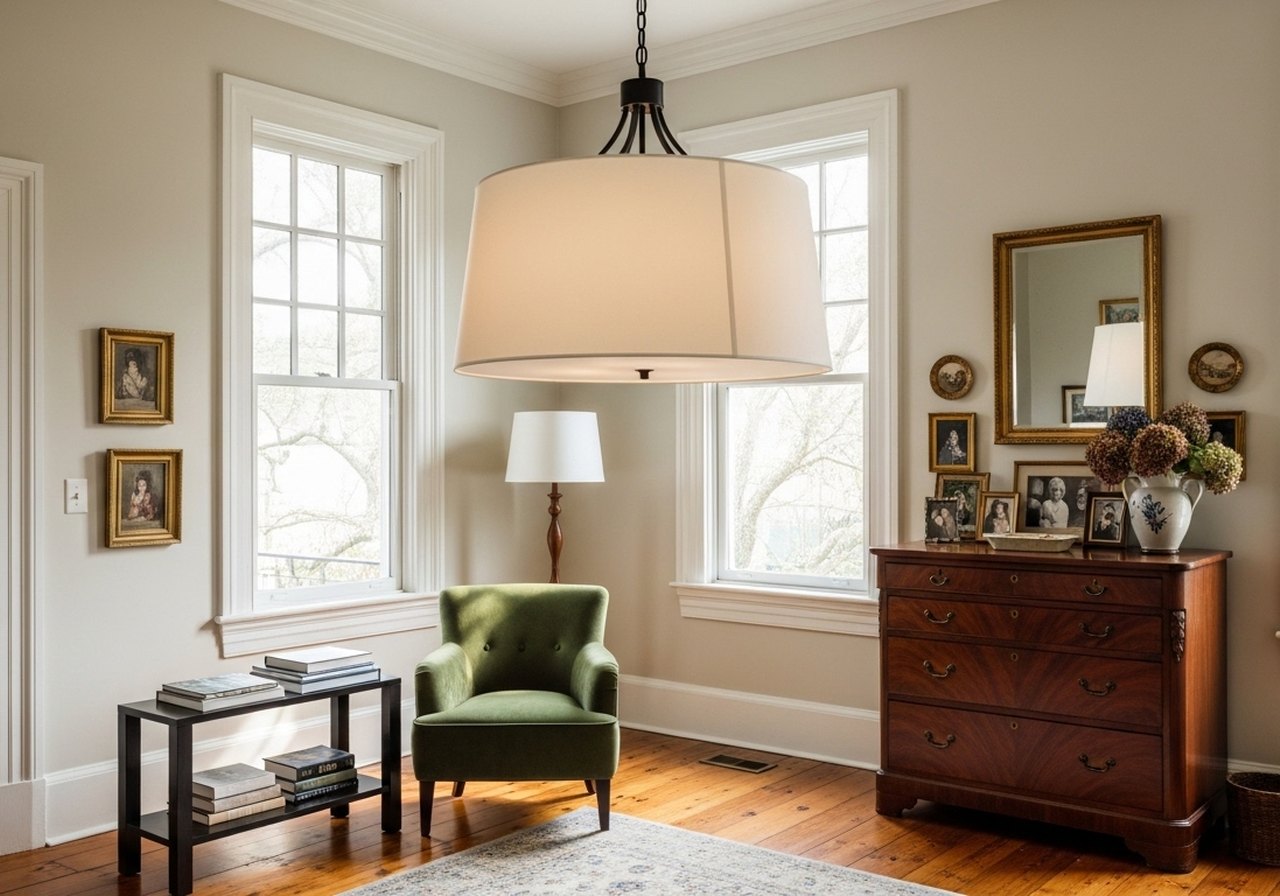
A pendant light size guide for an old house fits on one line: add the room's length and width in feet, and that number in inches is the diameter of a single pendant, so a 14-by-16 room takes a 30-inch fixture, and most people buy 18 to 22 and wonder why it looks wrong. The most consistent mistake I see in historic homes is the pendant that is too small for the room, and it happens because fixtures are photographed in showrooms with 8-foot ceilings and standard furniture; scale the same fixture up to a 10-foot ceiling in a room with a generous footprint and it belongs to a different house. This post is the formula and where it came from, the second formula for fixtures over furniture, the ceiling-height adjustment, why fear is the real reason people go small, the low-clearance exception, the difference between diameter and visual weight, multiples versus one large fixture, the three rooms in our house where we got the size right and the one where we did not, the paper-template test, how drop and diameter work together, what the showroom photograph is hiding, sizing for a hallway and an entry, the cost of going bigger, and what I would tell someone standing in a shop between two sizes.
The formula, and where it comes from
Length plus width in feet, converted to inches: a 12-by-14 room wants a fixture about 26 inches across, a 14-by-16 about 30, an 18-by-20 about 38. It is a designer's rule of thumb that predates lighting catalogs, and it works because it scales the fixture to the room's floor area rather than to the fixture next to it in the shop. Nobody I know who has followed it has regretted it, and everyone I know who has ignored it has bought a second pendant. For a room that is much longer than it is wide, the formula overstates; use the width times two instead, which for our 32-foot hallway is the reason its fixtures are small.
The second formula: over furniture
Over a table or an island, ignore the room and size to the furniture: one-half to two-thirds of the table's width, or a third of the island's length if it is a single fixture. Our dining chandelier is 24 inches over a 42-inch table, which is 57 percent and which I would push to 28 inches if I were doing it again, as the chandelier post admits. The room rule and the furniture rule sometimes disagree; when they do, the furniture rule wins, because the fixture is going to be looked at across the table and not across the floor.
The ceiling-height adjustment
The formula assumes an 8- or 9-foot ceiling. For every foot over 9, add 2 inches to the diameter, because a tall room has more volume to fill and a fixture that is correct on the floor plan can still look small against 10 feet of wall. Our parlor is 11 feet and its chandelier is 4 inches larger than the formula says, and it is the fixture guests photograph. The 10-foot ceiling post is the drop-length half of the same problem.
Why people go small
Fear. A large pendant feels like a commitment, and it is; it is also correct. A 30-inch fixture in a box on the floor of a 14-by-16 room looks enormous, and the same fixture at 7 feet in the air in the same room looks right, and the only way to know that is to have done it once. The second reason is the showroom, below. The third is price, which is real and which is addressed at the end. None of the three is a reason to buy the 20-inch one.
The low-clearance exception
The one place the formula breaks is a space where the fixture's bottom has to clear 7 feet and the ceiling is 8: a 30-inch pendant in an 8-foot hallway is a hazard and a 12-inch semi-flush is correct. Scale to the space, always, and where the space is short, the fixture goes wide and shallow rather than large and deep. The formula gives a diameter; the ceiling gives the drop; and when the drop is not available, the diameter has to carry the fixture's presence on its own.
Diameter versus visual weight
A 30-inch open brass ring weighs less on the eye than a 24-inch solid drum, because the eye reads mass, not span. The formula is for a fixture of average density, a drum, a lantern, a bowl. For an airy fixture, a sputnik or a ring or bare arms, go up a size; for a dense one, a solid dome or a heavy iron cage, the formula's number is a ceiling not a floor. The rattan pendant post is a case of an airy fixture at the top of the formula's range that reads as exactly right.
Multiples versus one
Over a long island or a long table, two or three smaller pendants can replace one large one, and the formula for each is the island's width in feet times 3 to 4 in inches, spaced 30 inches apart. Three 10-inch pendants over an 8-foot island read as one fixture; one 10-inch pendant over the same island reads as a suggestion. The island height post covers the spacing. The rule for multiples is the same as for one: the most common mistake is too small, and the fix is one size up.
Three rooms right, one wrong
Right: the parlor's chandelier, sized up for the 11-foot ceiling; the entry hall's lantern, which is 20 inches in a 9-by-12 space and reads as generous; the sunroom's fixture, replaced from a flush mount to a 22-inch drum that made the green walls look intentional. Wrong: the first master bedroom pendant, which was 30 inches in a 14-by-15 room with a 10-foot ceiling and was correct by the formula and wrong in the room, because it hung over the bed where nobody stands and its size read as a threat from the pillow. It was replaced with a 22-inch fixture, and the bedroom post tells the whole story. The formula is for rooms people stand and sit in, and a bedroom is a room people lie in.
The paper-template test
Cut a circle of kraft paper to the diameter you are considering, tape it to the ceiling where the fixture will hang, and look at it from the doorway and from every seat. Then cut one 4 inches bigger and do it again. The bigger one will look right nine times in ten, and it is a $3 test that has saved us two returns. For a fixture with drop, hang the paper on a string at the intended height; the shape at the right altitude tells you more than the shape on the ceiling.
Drop and diameter together
A fixture's presence is diameter times drop: a 24-inch drum hung 4 inches from a 10-foot ceiling is a ceiling ornament, and the same drum hung 36 inches down is a chandelier. In a tall room, a fixture that is slightly under the formula's diameter can be rescued by drop, and one that is over it can be tamed by hanging it higher. Our dining chandelier's 18-inch stem plus a chain extension brought the bottom to 6.5 feet, and at that height its 24 inches carry the room; at 8 feet it would not.
What the showroom photograph hides
The ceiling height, the room size and the furniture scale, all of which are chosen to flatter the fixture. A pendant photographed over a 30-inch bistro table in a room with an 8-foot ceiling will look half its size over a 42-inch table under 10 feet. Read the dimensions and ignore the picture; better, look for product photographs that show the fixture in a room whose dimensions are given, which some sellers do and which is the only useful kind. The pendant collection we use lists diameter and drop on every fixture, which is the minimum.
Sizing for a hallway and an entry
A hallway takes width times two, so our 4-foot hall takes 8- to 12-inch fixtures, which are semi-flush drums at 12 inches, and the rhythm comes from sconces, not from the ceiling. An entry takes the room formula with the ceiling adjustment, so our 9-by-12 foyer at 11 feet takes 21 plus 4, and the lantern is 20 inches and reads right because a lantern is dense. The foyer post is the lantern.
The cost of going bigger
A 30-inch fixture costs 30 to 60 percent more than the 22-inch version of the same design, which is the real reason people go small and the one nobody says. The arithmetic that answers it: the too-small fixture gets replaced, so its cost is added to the right one's, and the right one bought first is the cheaper path. We have paid for a too-small fixture twice in this house and for a too-large one never.
Between two sizes, in a shop
Buy the bigger one. If the bigger one is not in stock, wait for it. If the bigger one is over budget, buy nothing and save, because the smaller one will be replaced. The rule is not that bigger is always better; it is that between two sizes, the one you are afraid of is the one the room wants, and the paper template will tell you so if you let it.
Where the formula does not apply
Bedrooms, where the fixture hangs over a bed and should be a size under the formula so it does not loom; bathrooms, where the fixture hangs over a tub and is sized to the tub, not the room; and any room where the ceiling fixture is not the room's main light, which in our house is most of them, because the sconces and lamps do the work and the ceiling fixture is for cleaning and for the first impression. In those rooms the fixture can be at the formula's number or a size under, and it will not be noticed either way, which is its job.
The formula applied to every room in this house
Foyer, 9 by 12 at 11 feet: 21 plus 4, a 20-inch dense lantern. Front parlor, 18 by 20 at 11 feet: 38 plus 4, a 40-inch chandelier, which is what hangs there. Dining room, 14 by 16 at 10 feet, over a 42-inch table: the furniture rule, 24 to 28 inches, and ours is the smaller. Back parlor, 14 by 16 at 10 feet: 32, and the fixture is 30 because the sconces do the work. Kitchen island, 8 feet by 3: three pendants at 10 inches. Eat-in area, 10 by 12 at 9 feet, over a 34-inch table: 22 inches. Master bedroom, 14 by 15 at 10 feet: 31 by the formula and 22 in fact, for the reason above. Library, 12 by 14 at 10 feet: 28, and it has a 26-inch drum. Written out, the house is a list of numbers that all agree with each other, and that is what makes it read as one house.
Buying online without a showroom
Read the diameter first, then the drop range, then the weight, and only then the photograph. If the diameter is not listed, the seller does not want you to know, and the fixture is small. If the drop is fixed and short, the fixture is for an 8-foot ceiling and will float under a 10-foot one. If the weight is under 5 pounds at 24 inches, it is thin. The photograph is last because it is the least honest thing on the page, and the numbers are the most.
In one paragraph
Length plus width in feet, in inches, plus 2 inches per foot of ceiling over 9. Over furniture, half to two-thirds of the width instead. Airy fixtures a size up, dense ones at the number, bedrooms a size down. A paper template at the intended height, and then one 4 inches bigger. Between two sizes, the bigger one, because the small one gets replaced and the big one gets photographed.
Shop this post: pendant lights with diameter and drop listed on every fixture