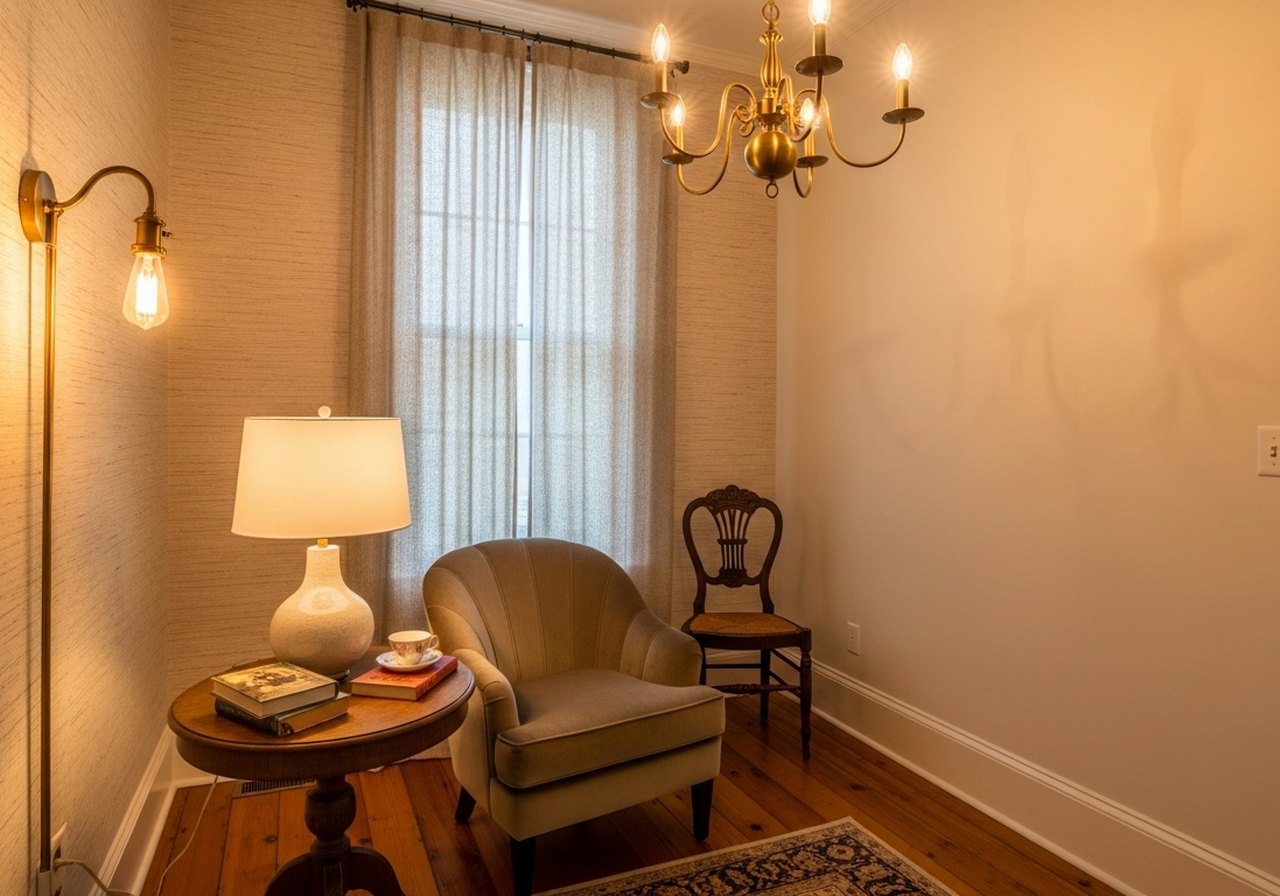
How to layer lighting in a small room is a question of making every source earn its place: a ceiling fixture on a dimmer that never goes above 30 percent for ambient fill, two matched table lamps at the same height for the warmth, a sconce or task light where a job happens, and a single candle on the mantel that pulls it together, which in our back parlor is four sources and about $250 that transformed a 14-by-16 room. Large rooms are forgiving, with space for many sources at many heights and distance between them; a small historic room demands that each light do a different job and that none of them do too much. This post is the three layers and what each is for, the ceiling fixture's 30 percent rule, the two lamps and why matched and why at the same height, the sconce circuit separate from the ceiling circuit, the candle and what I can and cannot explain about it, wall-mounted light that frees surfaces, the mirror that bounces, the bulb temperature rule, the lumens a small room actually needs, the dimmers as the control, the small room's settings, what a single overhead does to a small room, what to leave out, the mistakes, and the cost.
The three layers
Ambient, task and accent: a warm overhead on a dimmer for the fill that removes the deep shadows in the corners; a sconce or a lamp where a job happens, reading, writing, a game; and a small lamp or a candle for the glow that gives the room a place for the eye to rest. Small rooms benefit from layering as much as large ones, arguably more, because a single overhead in a small space is relentless, and several modest sources read as cozy where one bright fixture reads as harsh. Every source in a small room has a job, and a source without one is clutter with a cord.
The ceiling fixture at 30 percent
The back parlor's ceiling fixture is a 26-inch drum on a dimmer and it rarely goes above 30 percent; its job is ambient fill, and at full brightness it flattens everything and makes the lamps pointless. At 30 it removes the pool of shadow that would otherwise sit in the corners, and it is invisible as a source. A small room's overhead is the layer people over-use, and the dimmer is the correction; a room where the ceiling is the main light is a room lit like a waiting area, and the small bedroom post is the same rule at 40.
The two lamps
One on each side of the sofa, matched, at roughly the same height so the light meets in the middle; these are the workhorses, and when we are in the room reading or talking they are the only lights on. Matched, because two different lamps in a small room are two decisions in a room with space for one; the same height, because two pools of light at different altitudes read as an accident. They are ceramic with linen shades, shade bottoms at 40 inches, on plug-in dimmers, and the room's warmth lives in them.
Sconces on one circuit, ceiling on another
The formula that worked: wall sconces on one circuit and the ceiling fixture on another, each on its own dimmer, so the walls and the ceiling can be at different levels; the back parlor's two sconces flank the mantel at 60 inches and light the fireplace wall at 40 percent while the ceiling is at 30 and the lamps at 50. Three circuits in a 14-by-16 room sounds excessive and is the minimum for a room that has to be a reading room, a conversation room and a room seen from the hall. David ran the sconce circuit through the attic and down, per the hardwiring post.
The candle
A single candle on the mantel, lit for dinner and for guests, technically decoration and in practice the thing that pulls the room together; something about a real flame, the slight flicker, the temperature of the light, makes the whole room feel more complete. I do not fully understand the psychology and I have stopped trying; I know that the room with the candle reads as finished and the room without it reads as lit. It is the accent layer at its cheapest, and it costs $3 a week.
Wall-mounted light frees the room
In a small room every surface is precious and every square foot of floor is counted, and a sconce takes neither; the two mantel sconces do what two more table lamps would have done and leave the side tables for a book and a glass and the floor for the chairs. Wall-mounted light is the small room's advantage over the large one, because a large room can afford lamps on every surface and a small one cannot, and the lamp placement post is the large room's version.
The mirror
A 36-inch mirror over the mantel between the sconces, which bounces both of them and the window by day and makes the room read as having two more lights and twice the depth; in a small room a mirror is the cheapest source there is because it adds light without adding a fixture. It is hung so the sconces are reflected at their own height, and it is the only mirror in the room, because a small room with two mirrors is a room that cannot decide where it ends.
One bulb temperature
2700K in every source, the drum, the lamps and the sconces, and a warm-dimming bulb in the lamps so the last hour is amber; a small room with one cooler bulb is a small room with a corner that belongs to a different house. Keeping every bulb warm and consistent calms the whole room, and it is the change that costs $24 and that I would make before buying any fixture.
The lumens a small room needs
Less than the charts say: the back parlor's four sources total about 3,000 lumens at full and run at about 1,000 in use, which is under 5 lumens a square foot and reads as soft, not dim, because none of it comes from above and all of it is warm. A small room lit to 15 lumens a foot from the ceiling is a bright box; the same room lit to 5 from the sides is a room. It is about variety and control, not raw lumens.
The dimmers
Four: the ceiling's, the sconces', and a plug-in on each lamp, $80 in all, and they are the room's real lighting system; the fixtures are what you see and the dimmers are what you feel. A small room without dimmers has one setting, and one setting is wrong for most of the evening. With them the room has a morning, an afternoon, an evening and a night, and the fixtures never change.
The settings
Day: nothing, the window. Afternoon: one lamp for the reader. Evening: ceiling 30, sconces 40, lamps 50. Guests: the same, plus the candle. Night: one lamp at 20, amber, and the rest off. Five settings from four sources, and the room is used from breakfast to midnight without a switch being flipped to full after dark.
What a single overhead does to a small room
Lights the walls and the ceiling evenly so the eye sees the box; puts the brightest light at the top where nobody is; leaves the corners in shadow so the room ends before its walls; and flattens every face in it. It is the most common way a small room is lit and the reason small rooms have the reputation they do. Every fix in this post is a way of taking the light off the ceiling and putting it where people are.
What to leave out
A floor lamp, unless there is a chair with no table; a pendant, which hangs in the room's middle; a second mirror; a fifth source of any kind. The back parlor has four and it is right; a fifth was tried, a small lamp on the bookshelf, and it was a light with no job, and it went upstairs. Layered low light makes a small historic room feel intimate rather than cramped, and the layers are three, not five.
Mistakes
The overhead at full for a year, before the dimmer. Two lamps of different heights, and two pools that argued. A 3000K bulb in one sconce for a month. The fifth lamp. And no candle, for the first two years, on the grounds that it was decoration, which it is, and which the room needed.
What it cost
The ceiling dimmer, $22. Two lamps, $140 the pair from an estate sale, and their plug-in dimmers, $28. Two sconces, $160, on a circuit David ran, $260. Bulbs, $24. The mirror was already here. About $250 in fixtures and dimmers and $260 in wiring for a 14-by-16 room that is the one visitors settle in, and the candle is $3 a week.
The back parlor, specifically
Fourteen by 16 with a 10-foot ceiling, one window, a fireplace on the short wall, a sofa facing it and two chairs; it is the room we sit in, and the front parlor is the room guests are shown. The four sources are the drum overhead, the two lamps at the sofa's ends and the two sconces at the mantel, which is five fixtures and four kinds of light, plus the candle. It is the smallest room on the ground floor and the one with the most dimmers, and the two facts are related.
The reader and the talker
One person reading and one talking is the small room's daily test: the reader has the lamp at her end at 60 percent, the talker has his at 30, the sconces at 40 light the wall they are both facing, and the ceiling at 30 fills the corners. Two people with two needs in 224 square feet, and four sources at four levels are what let the room serve both without either one asking the other to change a light. A single overhead serves neither.
Adding a layer to a room that has one
If the room has only the overhead, the order is: a dimmer on it this weekend, $22; two matched lamps at 40 inches next month; sconces when the wall can be opened or a plug-in pair when it cannot; and a candle tonight. The layers arrive in the order of cost and each one makes the room better on its own, and the overhead's dimmer is the one that makes the others possible, because lamps under an overhead at full are invisible.
The window as the fourth layer by day
The one window faces east and by day it is the room; the drum and the lamps are off until 4 pm, and the sconces come on at dusk on a schedule. A small room's daylight is the layer that costs nothing, and the lamps are placed so they do not sit in the window's light by day and do sit where it was by night, which is the sofa's ends. A layered room is layered in time as well as height, and the window is the morning's fixture.
A small room in an old house has the sources it needs and no more, and the number is four.
In one paragraph
Ambient at 30 percent from the ceiling, warmth from two matched lamps at 40 inches, accent from sconces on their own circuit and a candle on the mantel; a mirror to double it, one bulb temperature, a dimmer on everything, and about 1,000 lumens in use from four sources at human height. Nothing on the ceiling at full after dark, nothing in the room without a job, and a small room that reads as intimate because its light is where people are.
Shop this post: wall sconces for the circuit that frees the tables