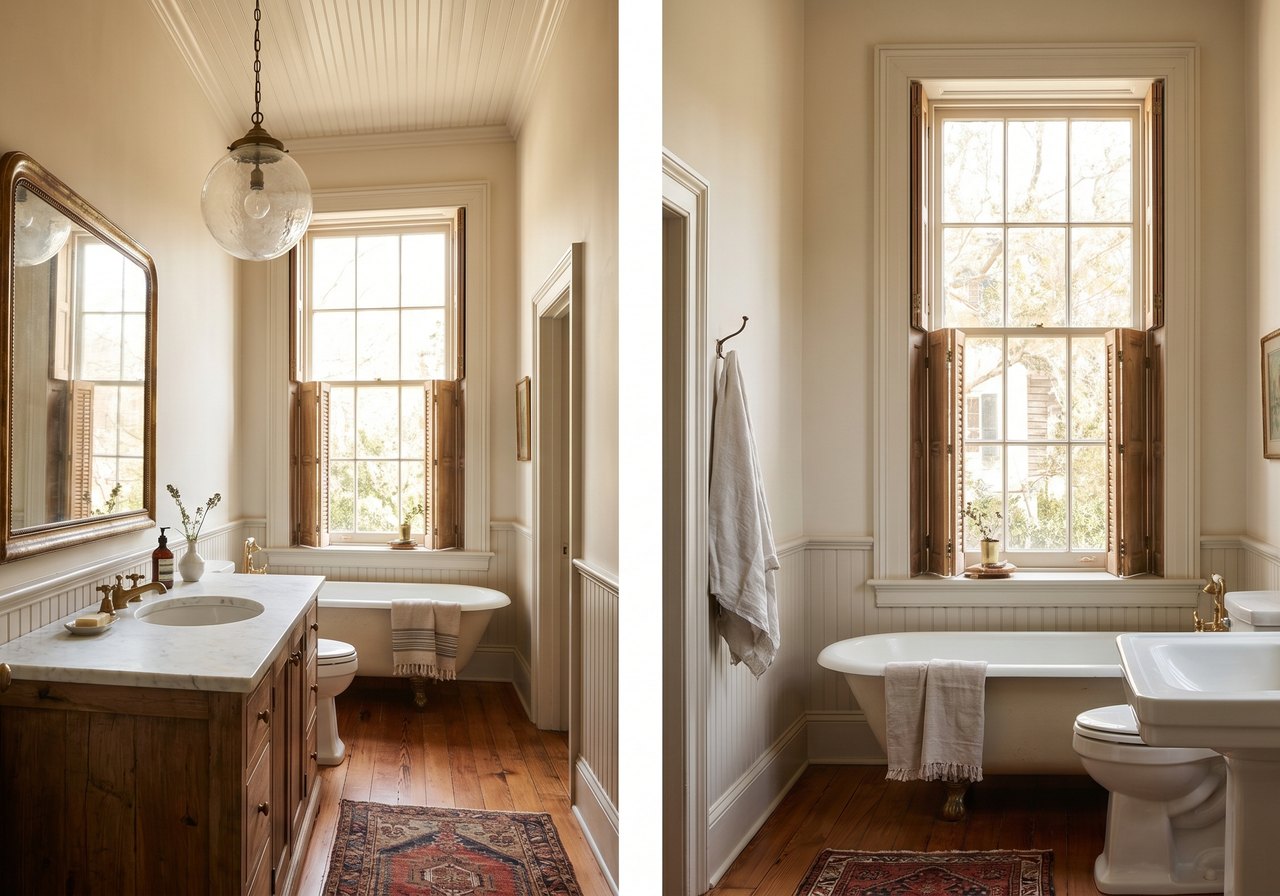
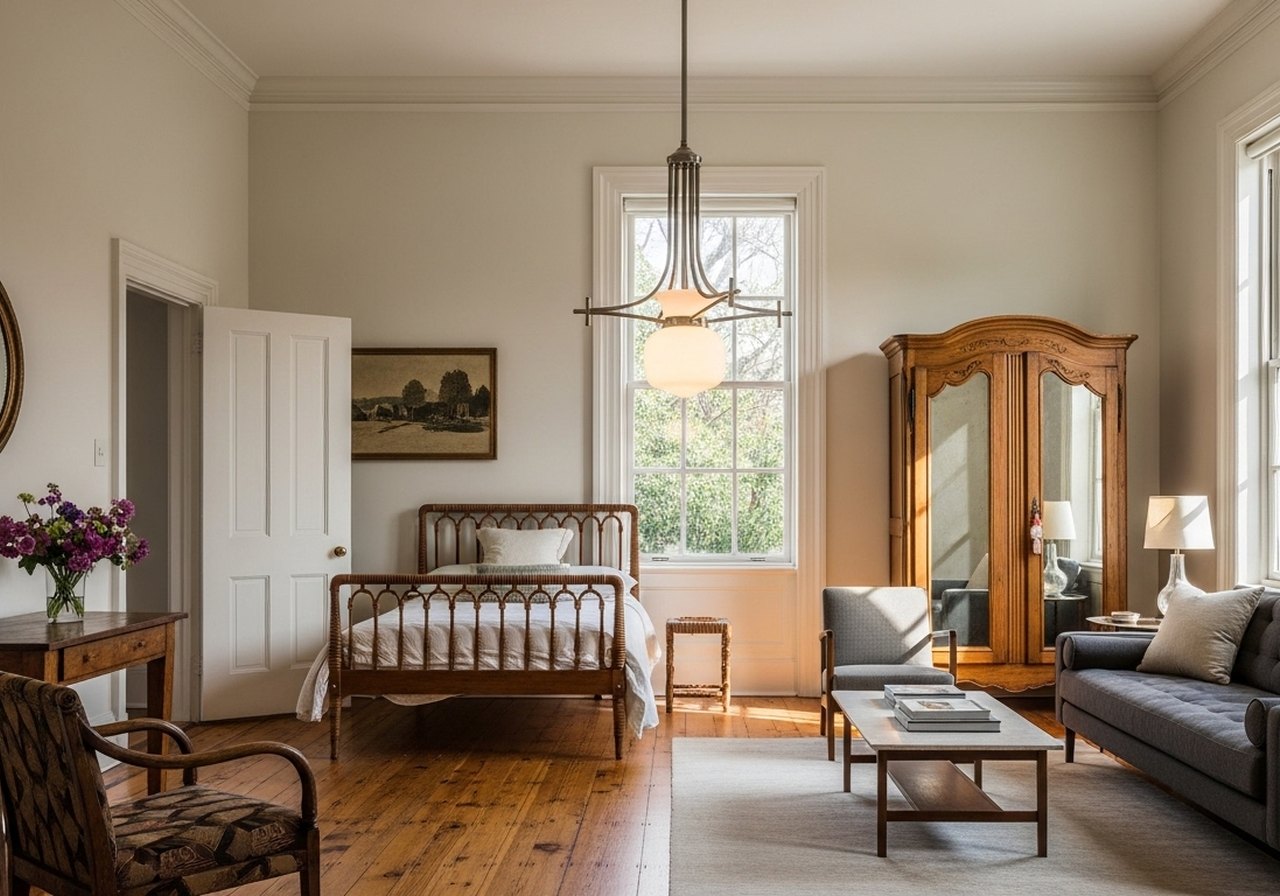
Lighting for high ceilings is easier than lighting for low ones, not harder, because a 10-foot ceiling lets you hang a fixture low enough to feel intimate without it being in anyone's way, gives you a medallion to hang it from, and leaves room for a second layer of light at human height that a low room cannot fit; everyone who visits our house comments on the ceilings first, and the ceilings are the reason our lighting decisions are simpler than a modern house's. Plaster medallions, 10 feet in the main rooms and 11 in the parlor and foyer, hairline cracks that took three rounds of patching. This post is why old ceilings are better for light, the drop-length rule that a tall room makes possible, the parlor chandelier at 7 feet and why that works, the medallion as the ceiling's center point and the weekend we spent stripping one, the human-height layer that a tall room must have, the cold-room problem and its fix, plaster and sound, the buzz you will never hear, sizing up for volume, the stairwell and the two-story problem, semi-flush where the ceiling is tall but the room is narrow, the fixtures we bought with extra drop and where, the bulbs that a tall room asks for, the mistakes, and the cost of doing it in three rooms.
Why old ceilings are better for light
A fixture that hangs low is a fixture whose light is near the people, and in a modern 8-foot room the lowest a fixture can go over a walkway is 12 inches from the ceiling; in a 10-foot room it can drop 3 feet and still clear a tall person, and the light arrives at the table, the chair and the face instead of at the top of the head. Tall rooms were built for hanging fixtures, gas and then electric, and the builders left the height for them. The rooms breathe better under a fixture that is where it was meant to be, and the fixture looks like it belongs because it is at the altitude the room was drawn for.
The drop-length rule
The bottom of any fixture in a room where people stand at 7 feet; in a dining or kitchen context, 6 to 6.5 feet over the surface. With a 10-foot ceiling that is a 3-foot drop to the fixture's bottom, and with 11, 4 feet, before you add the fixture's own height; the chandelier in the dining room has an 18-inch stem and a custom chain extension to bring the total to 36 inches, which is not something most retailers sell configured and which you order as fixture plus chain and assemble. The 10-foot fixtures post is the shopping list; the rule is the reason for it.
The parlor chandelier at 7 feet
In the front parlor, 18 by 20 with an 11-foot ceiling, the chandelier hangs at 7 feet, lower than I would ever put a light in a standard room, and it is perfect: it fills the vertical space the way the original builders intended, its light reaches the seating, and it is the room's object from the doorway and from the street through the window. A guest under 6 foot 4 walks under it without noticing; a taller guest has been under it once and ducked, and I would still not raise it. The parlor post is the room; the height is its lighting.
The medallion
A plaster medallion is a ceiling's center point, and it makes even a simple fixture look intentional, because the fixture hangs from a thing that was made for it; a tall room without one has a fixture on a blank plane, and one with a medallion has a fixture in a frame. We had one in the hallway that was almost entirely painted over, and we spent a weekend stripping and re-priming it with a dental pick and a soft brush, which was worth every hour. A medallion also hides the canopy's edge and forgives a box that is an inch off center, which after 130 years most are.
The human-height layer
The catch with a tall room is that it feels cold if lit only from the ceiling, because both warm air and light rise and the living level is left in a dim, cool band under a bright top; every tall room in this house has sconces at 60 to 62 inches and lamps at seated eye level so the level where people are is lit and warm. A grand fixture overhead plus warm light down low is the combination that makes a tall room inviting rather than only impressive, and the overhead is at 30 percent most evenings while the lamps do the room. The layering post is the same rule in the smallest room.
The cold-room problem
Our back parlor was the cold room for a year: a good chandelier at the right height, 10 feet of wall, and nothing on the wall, so at night the eye went up to the fixture and the seating was in a trough. Two sconces flanking the mantel and two table lamps by the sofa fixed it in an afternoon, and the chandelier went to 30 percent and stayed. A tall room needs more sources than a low one, not fewer, and they need to be low; the fixture at the top is the last 20 percent of the light and the first thing anyone notices.
Plaster and sound
Plaster diffuses sound differently from drywall, with less echo, which means fixtures that produce any ambient hum are much less noticeable; we have one vintage lamp with a slight buzz in its old dimmer that would drive me to distraction in a modern house, and in this one I have never noticed it during a conversation. It is a small gift of an old ceiling and the reason we did not replace the dimmer. A tall plaster room is a quiet room, and quiet rooms tolerate old fixtures.
Sizing up for volume
A tall room has more air to fill, and a fixture that is correct on the floor plan can still look small against 10 feet of wall; the sizing post adds 2 inches of diameter per foot of ceiling over 9, and the parlor's chandelier is 4 inches over the floor-plan formula for that reason. Size and drop together are what give a fixture presence in a tall room, and a fixture that is a size under can be rescued by drop but not by anything else.
The stairwell
The stair hall is the house's one two-story space, 20 feet from the floor to the ceiling over the landing, and it takes a lantern on a 6-foot chain so its bottom sits at 8 feet above the ground floor and 2 feet above the landing's rail, lit from below by a sconce on the landing so the stair is lit where feet go. A two-story space is the one place a very long drop is correct, and the one place the fixture has to be lit from the side as well, because a lantern 12 feet over your head lights the ceiling.
Semi-flush where the room is narrow
Our hallway is 10 feet tall and 4 feet wide, and a drop fixture in it would be a fixture in a corridor's middle; the hall's ceiling fixtures are semi-flush drums with a 12-inch drop, enough to read as intentional without sacrificing the clearance a narrow space needs, and the hall's real light is the sconces from the hallway post. Ceiling height alone does not decide the drop; width does too, and a tall narrow space is a semi-flush space.
The fixtures with extra drop
The dining chandelier with the chain extension; the foyer lantern on a 30-inch chain; the parlor chandelier on 48 inches of chain and stem; the stair lantern on 6 feet. All ordered as fixture plus separate chain, in the same finish, from sellers who list drop length and sell chain by the foot; the ceiling light collection we use filters by drop, which is the filter to use first in a tall house and the one most shops do not offer.
Bulbs for a tall room
A fixture at 7 feet is looked at from below and its bulbs are seen; clear candelabra bulbs in the chandeliers, 2700K, 400 lumens each, dimmable, with the filament visible because seeded or clear glass is the shade and the bulb is the ornament. Frosted bulbs in a clear chandelier read as a fixture with a headache. And more lumens than a low room, because the ceiling absorbs some of the up-light: the parlor's chandelier is 3,200 lumens at full and lives at 30 percent.
The medallion's crack, and the patching
Hairline cracks in a plaster ceiling are normal in a house built in 1892, and ours took three rounds of patching to get right because the first two used joint compound, which is the common mistake, and which cracked again in a season; the third used a plaster repair compound that matches the original's flexibility, applied by George, and has held for four years. A medallion is patched before the fixture goes up, because there is no hiding a repair on an original plaster ceiling once a chandelier is lighting it from 3 feet below.
Mistakes
The back parlor's cold year. A fixture for an 8-foot ceiling in the dining room for eight months, floating uselessly near the plaster. Joint compound on the medallion, twice. A frosted bulb trial in the parlor chandelier. And hanging the foyer lantern at 8 feet on the first try, because 7 felt low, and lowering it a month later when a guest said it looked like it was trying to leave the room.
What it cost, in three rooms
The parlor's chandelier and chain, $1,100, and its medallion's repair, $380. The dining room's chandelier and extension, $620. The foyer's lantern and chain, $340. The sconces and lamps that make the three rooms warm at human height, about $900 across them. Roughly $3,300 for three tall rooms lit the way they were built to be, and the $900 of low light is the part that made the $2,000 of high fixtures work.
The bedroom exception
The one tall room where the drop rule bends is the bedroom, where the fixture hangs over a bed and is seen from the pillow: our master's fixture is at 8 feet, not 7, and a size under the formula, because a large fixture 3 feet over a lying face is a threat, and the bedroom post records the pendant that taught us. In a bedroom the tall ceiling's gift is the sconces' height and the room's air, and the ceiling fixture is a utility hung high.
Reading a tall room before buying anything
Stand in the doorway at night with the existing fixture on and look at where the light is: if it is on the ceiling and the upper walls and the seating is dim, the room needs the low layer first and the fixture second; if the seating is fine and the ceiling is a blank, the room needs drop. Most tall rooms need both and the low layer is cheaper, and it is the order we would do it in again: sconces and lamps for a season, then the chandelier, so the chandelier arrives in a room that is already warm.
In one paragraph
A tall ceiling lets a fixture hang low enough to be near people, from a medallion made for it; drop to 7 feet in a standing room and 6.5 over a table, order the chain separately, size up 2 inches per foot over 9, and then light the human level with sconces and lamps so the room is warm and not only impressive. Semi-flush where the room is narrow, a long chain in the stairwell, clear bulbs where they are seen, and the overhead at 30 percent while the low layer does the evening.
Shop this post: ceiling lights filtered by drop, and wall sconces for the layer below them