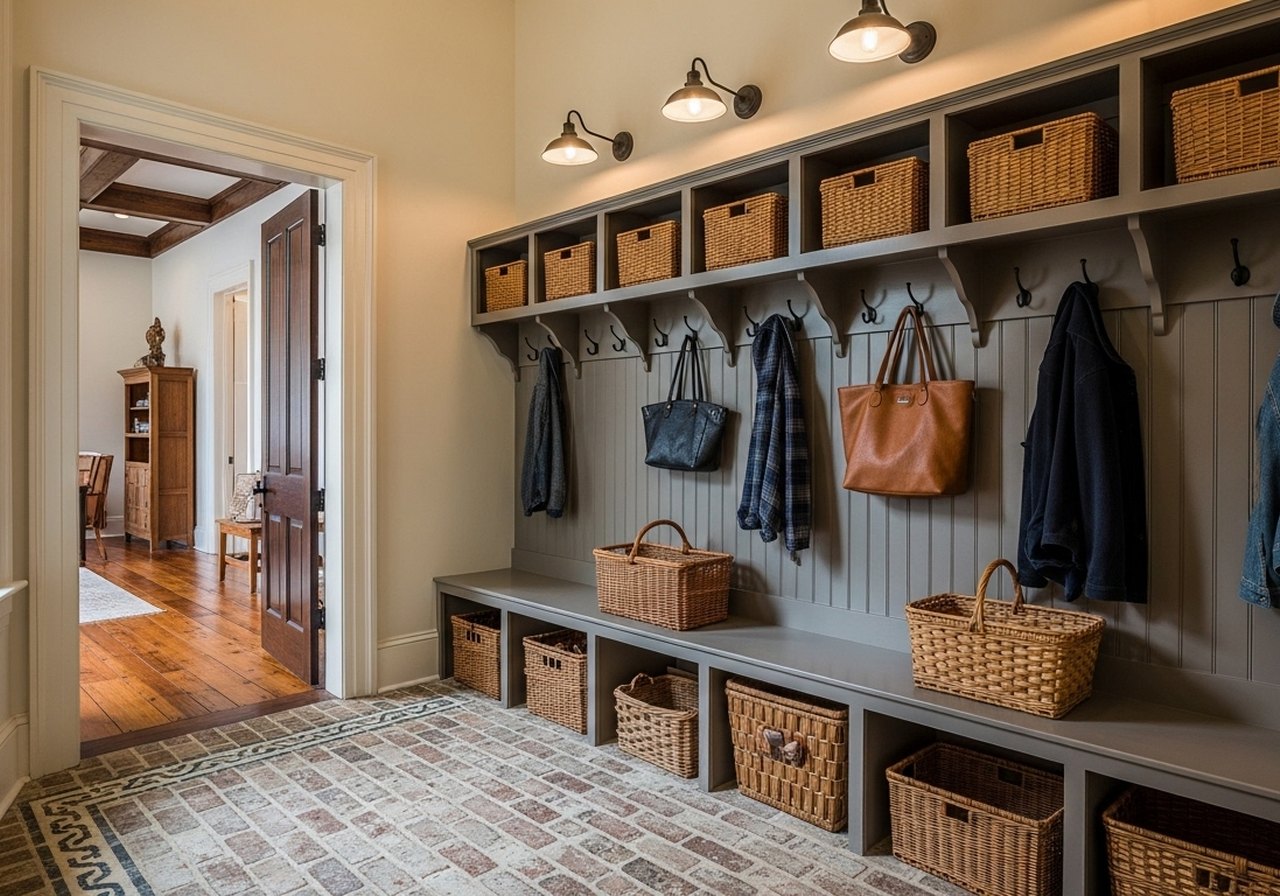
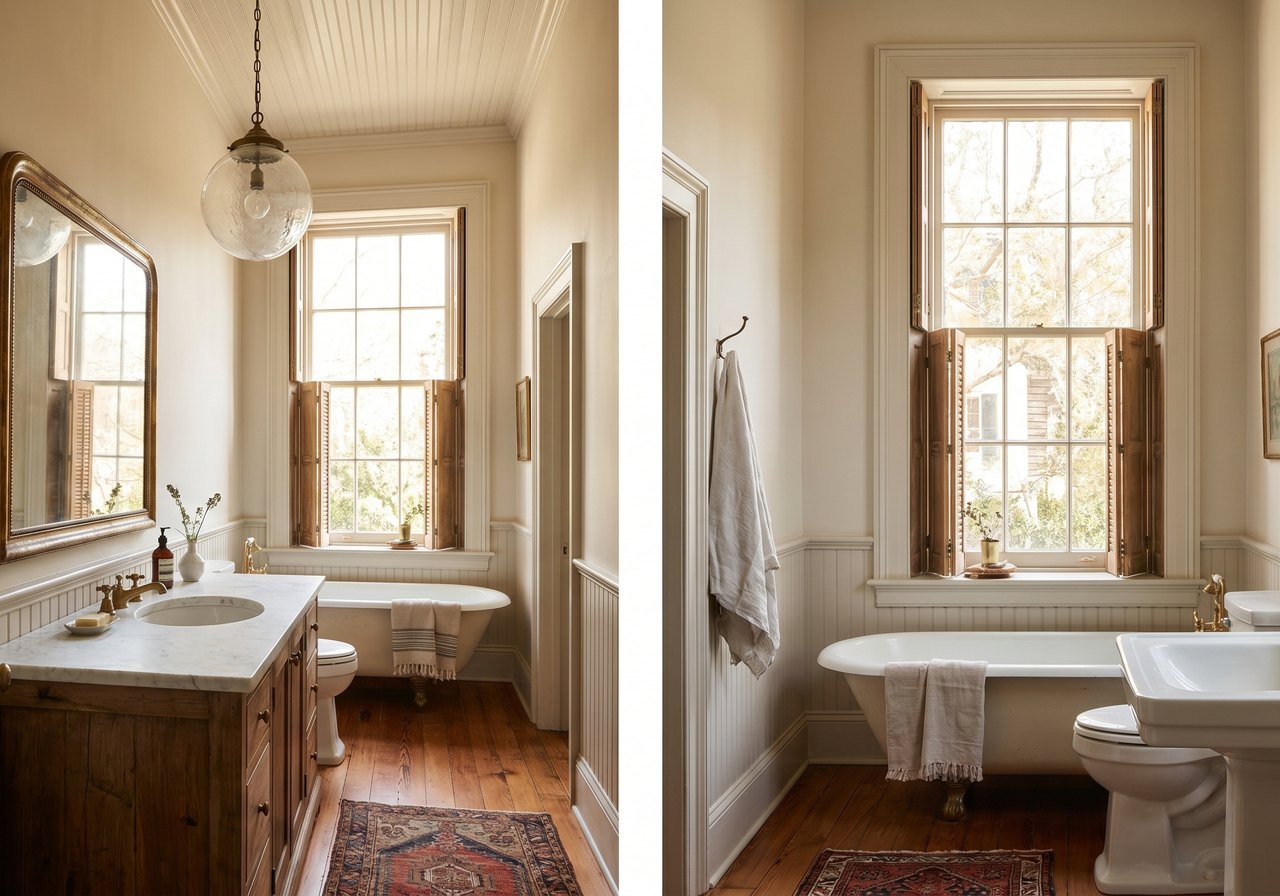
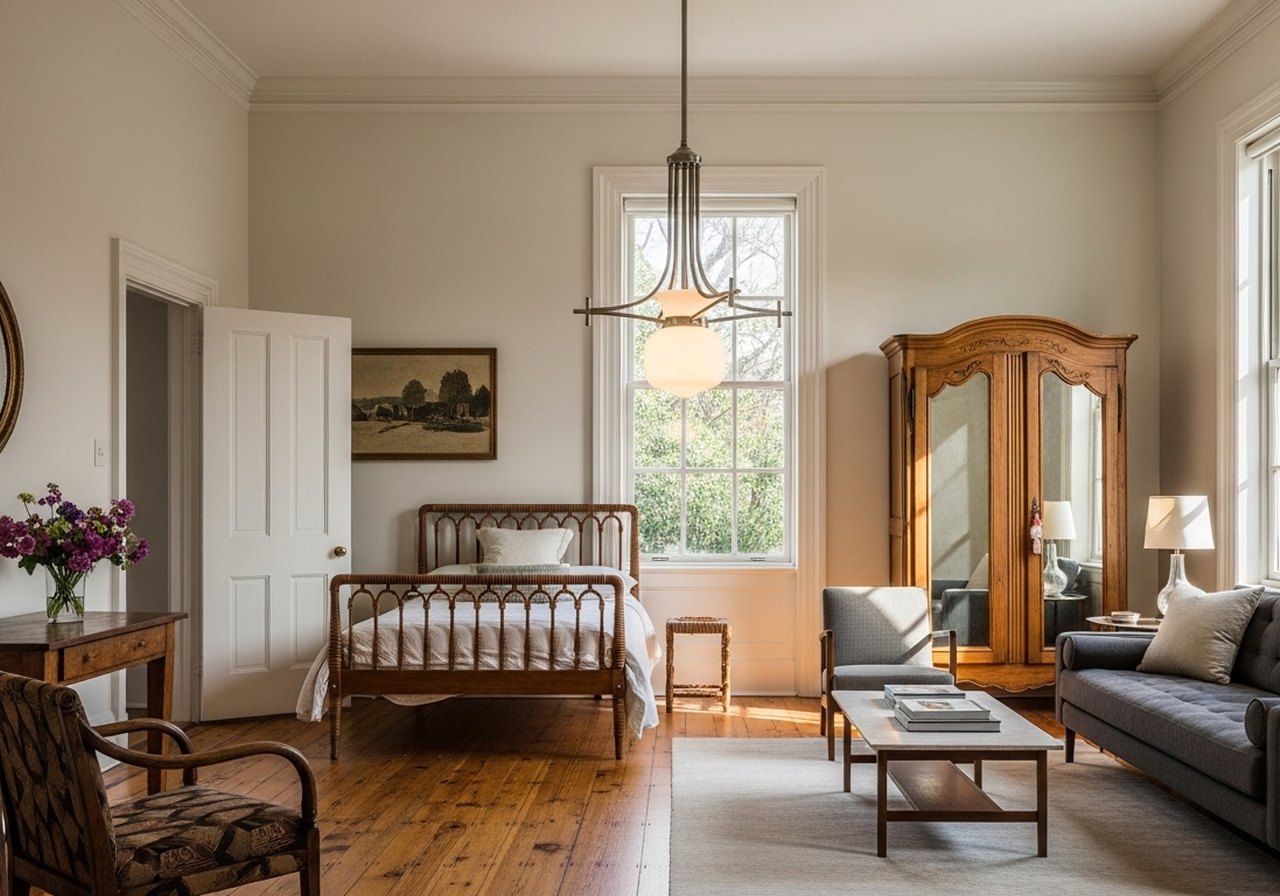
I've written before about the general principles of mudroom lighting, but the question I get asked more specifically is about fixture type. Not "how bright" but "which kind." Flush mount, semi-flush, pendant, schoolhouse globe, a pair of sconces instead? Here is what I've learned from our mudroom, and from the three mudrooms I've redesigned in neighboring houses since.
Skip the Pendant
The pendant is the natural first instinct because it looks great in kitchens and entries. In a mudroom it's a mistake. At standard 7-foot mudroom height, a pendant hangs right at the level of a backpack swung over a shoulder. Our neighbor cracked the glass on hers within three weeks of installation. Beyond the breakage risk, pendants swing when a door opens quickly, they collect dust in the socket, and a bug can get into an open shade and stay there indefinitely. A flush mount solves all of these problems without sacrificing the look.
Flush Mount vs Semi-Flush
A flush mount sits flat against the ceiling with no gap. A semi-flush has a short stem, typically 4 to 8 inches, that drops it away from the ceiling. In a mudroom with 8-foot ceilings, either works. In a mudroom with 7-foot ceilings, a semi-flush at 8 inches will catch taller coats and anyone over 6 feet. Measure before you commit.
The advantage of semi-flush is that it reads as a more intentional fixture and throws light at a slightly wider angle. The advantage of flush mount is clearance and simplicity. For our mudroom, which has just under 8-foot ceilings and a door that swings toward the light switch, flush mount was the correct call.
What Finish Actually Holds Up
Antique bronze, oil-rubbed bronze, and brushed nickel all tolerate the humidity, cleaning spray, and occasional knock of a mudroom better than polished finishes. Polished brass and chrome show fingerprints and water spots, and you'll be touching the switch plate near this fixture hundreds of times. Matte and brushed finishes age gracefully; polished ones show every mark. We chose antique bronze on ours, and three years later it still looks exactly the same.
Lumen Count for a Mudroom
Our mudroom is 6 by 9 feet. We run a 450-lumen warm-white bulb and it's comfortably bright, enough to read a tag, find a key, and check that the dog's lead is properly clipped, without feeling clinical. For a narrower mudroom (under 5 feet wide) 300 lumens may be sufficient. For anything larger than 80 square feet, plan for a second fixture or a supplemental sconce at the bench.
The warmer the bulb (2700K rather than 3000K or higher), the more the mudroom reads as part of the house rather than as a utility space. This matters more than people expect. A 3000K bulb makes the mudroom feel like a public bathroom. A 2700K one makes it feel like your home.
Damp-Rated or Not
Our mudroom opens directly to the rear porch, which means the door lets in real Charleston summer humidity and the occasional splash of rain. A dry-rated fixture in this location isn't rated for condensation; it's a slow degradation waiting to happen. We chose a damp-rated sealed globe, which costs maybe fifteen dollars more than the dry-rated equivalent and will last decades. If your mudroom is purely interior with no exterior door, a standard dry-rated fixture is fine.
The Second Switch
This isn't fixture selection, but it belongs in the same decision: put a switch at the exterior door as well as at the interior entry. We added one at our back porch door and it changed how we use the mudroom entirely. Coming in after dark with hands full, you can turn the light on before you open the door. It costs almost nothing to add at rough-in stage and is irritating to retrofit. I'd have done it the first time if I'd thought about it.
Adding a Sconce at the Bench
If your mudroom has a bench or a homework drop zone, the overhead fixture alone usually leaves the bench surface in partial shadow. A single wall sconce above the bench, on its own switch, solves this. We added one to a client's mudroom last spring and it became the fixture they use most, low, warm light at the bench when they're sorting mail or helping a child with shoes, full overhead on when they're moving quickly. Two fixtures, two moods, one mudroom.
What we run: a sealed antique-bronze flush mount with a 450-lumen 2700K bulb as the main fixture, plus one plug-in sconce at the bench. Two switches, neither on a dimmer because the mudroom always needs full light.
The One Thing I'd Do Differently
I'd have wired for a motion sensor at the mudroom from the start. We have a dog who regularly turns the lights on by bumping the low switch with her nose, which is charming but inconvenient. A motion sensor would have eliminated the problem. It would also mean the light comes on automatically when you walk in with arms full of groceries and can't reach the switch, which is a surprisingly frequent problem in a mudroom.
Shop this post: wall sconces for the mudroom bench and entryway ceiling fixtures