Mudroom lighting has one job before it has any other: to be bright enough to find a key, tough enough to survive a swung backpack, and warm enough that the room still feels like part of the house. Ours is a narrow back hall, 6 by 9 feet, connecting the kitchen of an 1890s Charleston single house to the rear porch, and it takes more abuse than any room we own: wet boots, a muddy dog, groceries in paper bags that have given up. This is everything we've settled on after three years and three neighbors' mudrooms I've since redone: which fixture type to choose and which to skip, the finish that actually holds up, the lumen count that works for the size of the room, damp rating, the sconce at the bench, and the two switches I'd wire before anything else.
It is not the place to spend money on a statement fixture. It is the place to spend it on a practical one, and then not think about it again for twenty years. I say that as someone who spent four months choosing the dining room chandelier and eleven minutes choosing the mudroom light, and the mudroom light is the one nobody has ever complained about.
What is the best light fixture for a mudroom?
A sealed flush-mount ceiling fixture, damp-rated, in a brushed or antique finish, with a 2700K bulb, plus one sconce at the bench on its own switch. That's the short answer and it's the setup we run. The reasoning takes the rest of the post, because the tempting options (a pendant, a bare schoolhouse globe, a bright cool bulb) are wrong in specific ways that only show up after you've lived with them.
Skip the pendant
The pendant is everyone's first instinct because it looks right in a kitchen or a front entry. In a mudroom it's a mistake. At a typical 7-foot to 8-foot mudroom ceiling height, a pendant hangs at the level of a backpack swung over a shoulder or a coat lifted onto a hook. Our neighbor cracked the glass on hers within three weeks. Beyond breakage, pendants swing when a door opens fast, collect dust in the socket, and a bug can get into an open shade and stay there for a season. If you love the look of a pendant, a semi-flush fixture with a short stem gives you most of it without the swing, and a schoolhouse-style semi-flush in particular reads as a pendant from across the kitchen.
Flush mount versus semi-flush
A flush mount sits flat against the ceiling with no gap. A semi-flush has a short stem, usually 4 to 8 inches, that drops the fixture away from the ceiling and throws light at a slightly wider angle. With 8-foot ceilings, either works. With 7-foot ceilings, a semi-flush at 8 inches will catch tall coats and anyone over 6 feet. Measure from the floor to the lowest point of the fixture you're considering; anything under 6 feet 8 inches in a passage is going to get hit. Our mudroom has just under 8-foot ceilings and a door that swings toward the switch, so flush mount was the right call: a sealed glass globe in antique bronze that reads as period-appropriate without being precious about it. Fully enclosed, so it doesn't collect insects. Dimmable, which we've never once used, because a mudroom always needs full light.
What finish holds up in a mudroom?
Antique bronze, oil-rubbed bronze, and brushed nickel all tolerate humidity, cleaning spray, and the occasional knock better than polished finishes. Polished brass and chrome show fingerprints and water spots, and you'll touch the switch plate near this fixture hundreds of times a month. Matte and brushed finishes age gracefully; polished ones show every mark. Ours is antique bronze and three years on it looks exactly as it did the day it went up, which is more than I can say for the polished brass sconces in the front hall that I love and polish quarterly.
How many lumens does a mudroom need?
For our 6 by 9 foot room, a single 450-lumen bulb is comfortably bright: enough to read a tag, find a key, and check the dog's lead is clipped without feeling clinical. A narrower passage under 5 feet wide can get by on 300 lumens. Anything over about 80 square feet, or an L-shaped mudroom, needs a second ceiling fixture or a supplemental sconce, because one point of light in a long room leaves the far end in shadow where the boots live.
Color temperature matters more here than people expect. A 3000K or 3500K bulb makes a mudroom feel like a public restroom; a 2700K bulb makes it feel like your house. We carry the same 2700K through from the adjacent entry hall so there's no visible change when you walk from one to the other. Bulb type: an LED, obviously, in an A19 shape if the globe is enclosed, and check the fixture is rated for enclosed use so the LED doesn't overheat. Ours is on its second bulb in three years, and the first one was a cheap one that flickered for a month before it went, which in a mudroom you notice every single time you come home.
Damp-rated or not?
Our mudroom opens directly to the rear porch, which means the door lets in real Charleston summer humidity and the occasional slap of rain. A dry-rated fixture in that location isn't rated for condensation; it's a slow degradation waiting to happen, corrosion on the socket and a yellowing gasket. A damp-rated sealed globe costs maybe fifteen dollars more and will last decades. If your mudroom is fully interior with no exterior door, a dry-rated fixture is fine. If it has an exterior door, or a floor drain, or you hose it out, damp-rated, no discussion.
Mudroom light placement
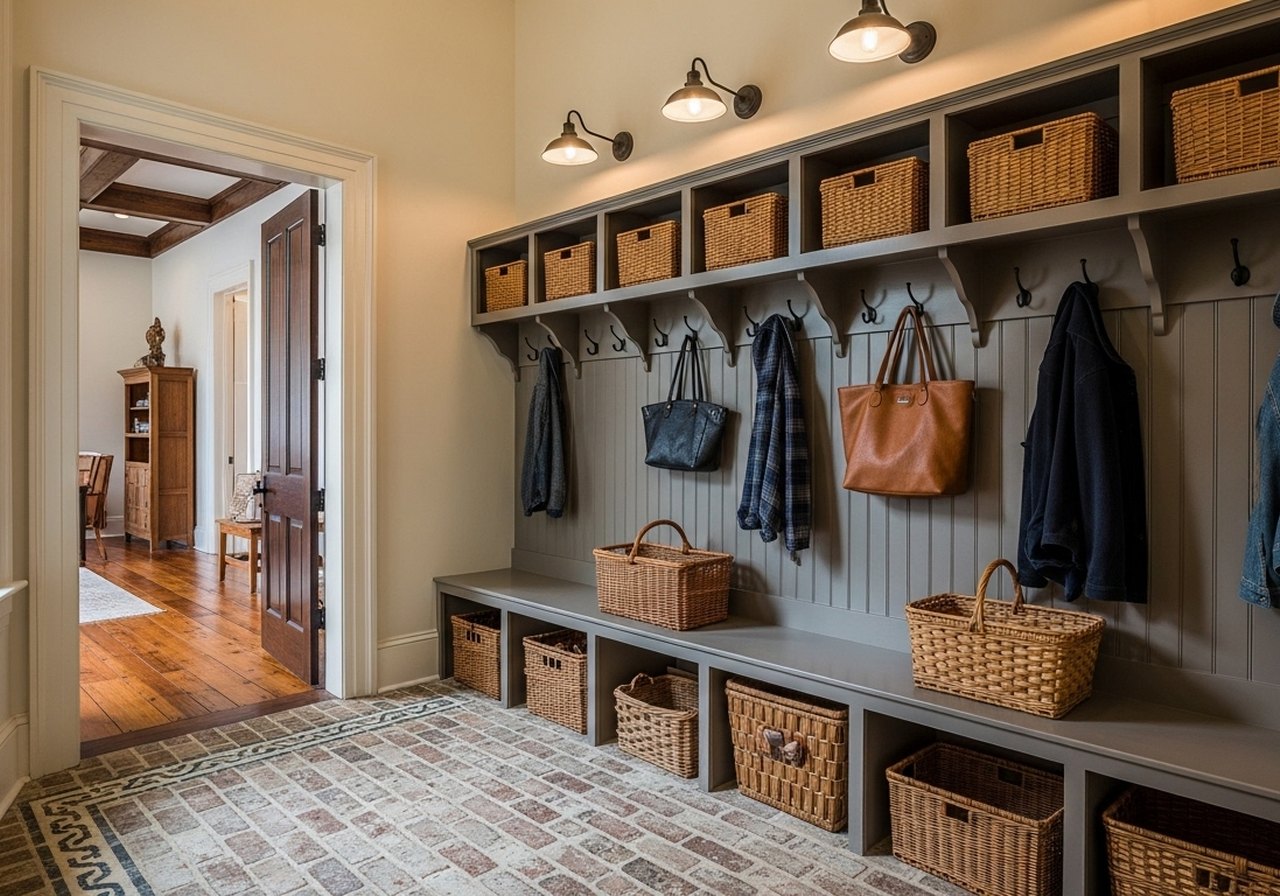
Center the ceiling fixture over the traffic path, not over the geometric center of the room, because in a narrow mudroom those are different points. Ours sits over the walkway between the door and the kitchen, which leaves the hook wall lit from the side rather than from directly above, and that's what you want: light from straight above a coat hook throws the coat's own shadow onto whatever's beneath it. Our hooks are at three heights, 72 inches for adult coats, 48 inches for bags, 30 inches for small people and small things, and a fixture slightly forward of the hook wall lights all three without a shadow band.
If you have a mudroom lamp on a shelf or a bench, and some people do, put it on the same switch as the sconce or it will never be turned on. A lamp in a mudroom is charming for a week and then it's something to knock over, usually by the dog, usually at night.
The sconce at the bench
If your mudroom has a bench, a drop zone, or a spot where a child puts on shoes, the overhead fixture alone usually leaves that surface in partial shadow because whoever is sitting there is blocking the light. A single wall sconce above the bench, on its own switch, solves it. We added one to a client's mudroom last spring and it became the fixture they use most: low, warm light at the bench when they're sorting mail or helping a child with laces, full overhead on when they're moving quickly. Two fixtures, two moods, one mudroom.
In our own mudroom the bench wall has no box, and I wasn't opening 130-year-old plaster for one, so ours is a plug-in sconce with the cord run down behind the bench to an outlet. It has been there two years and nobody has noticed the cord. Mount it at about 60 inches to the center of the shade, high enough that a coat on the adjacent hook doesn't bump it.
The two switches I'd wire before anything else
This isn't fixture selection but it belongs in the same decision. First: a switch at the exterior door as well as the interior one, a three-way. We added one at the back porch door and it changed how we use the room. Coming in after dark with your hands full, you turn the light on before you open the door. It costs almost nothing at rough-in and is irritating to retrofit through plaster; ours was retrofitted, and I know.
Second: a motion sensor, or a switch that can take one. I resisted this for two years because motion sensors felt like a parking garage, and then I lived with a dog who turns the light on by bumping the low switch with her nose, and with the weekly experience of walking in with arms full of groceries and no free hand. An occupancy sensor switch at the interior entry, set to turn on with motion and off after ten minutes, costs about $25 and fits in the existing box. The sconce stays on a plain switch so the bench light is a choice rather than a reflex. If I were wiring a mudroom from scratch: three-way to the ceiling fixture with the interior leg on a sensor, separate switch for the sconce, and a plain single switch for an exterior porch light beside the door.
Mudroom lighting ideas by layout
A narrow pass-through like ours, under 6 feet wide: one flush mount over the path, one sconce at the bench, done. A square mudroom with a bench wall and a locker wall, 80 to 120 square feet: two flush mounts spaced a third of the way in from each end, and a sconce over the bench. A mudroom that doubles as a laundry: add a light over the machines on its own switch, because the ceiling fixture will be behind you when you're loading. A mudroom with a window: lucky you, but the light still has to work at 6 pm in December, so plan it as if the window weren't there. A mudroom off a garage with no exterior door: dry-rated is fine, and this is the one case where a semi-flush with some presence makes sense, because it's the first thing you see coming in from the car.
What none of those layouts needs is a chandelier, a fan light, or anything with a fabric shade. The mudroom is where the house meets the weather. Light it like a working room that happens to be warm, and it will look like it belongs to the house, which is the whole point of the sconce heights and bulb temperatures we carry through every passage in this one.
What we run, exactly
Ceiling: a sealed antique-bronze flush mount, damp-rated, one 450-lumen 2700K LED, on a three-way with a sensor at the kitchen end. Bench: one plug-in sconce in a matching bronze, 2700K, on its own switch. Neither on a dimmer. Total cost, fixtures and bulbs: about $210, plus the electrician's hour for the three-way, which was the best $140 in the house. The one thing I'd change is the order: I'd have wired the sensor and the second switch at the same time as the fixture instead of two years later.
Mistakes I've seen in other people's mudrooms
A pendant at head height, see above. A single 3500K "bright white" bulb that makes everyone look ill at 7 am. A dry-rated fixture six feet from a door that opens onto weather. An expensive fixture with an open top that has become a moth graveyard. A lamp on the bench with a cord across the floor. A dimmer on a room that never needs dimming. And the most common one: no light at all at the bench, so the family shoe-tying happens in the shadow of the person tying. Every one of those is a $20 to $60 fix, and I've fixed all of them for other people, which is how I know.
Shop this post: entryway ceiling fixtures, wall sconces for the mudroom bench and plug-in wall sconces