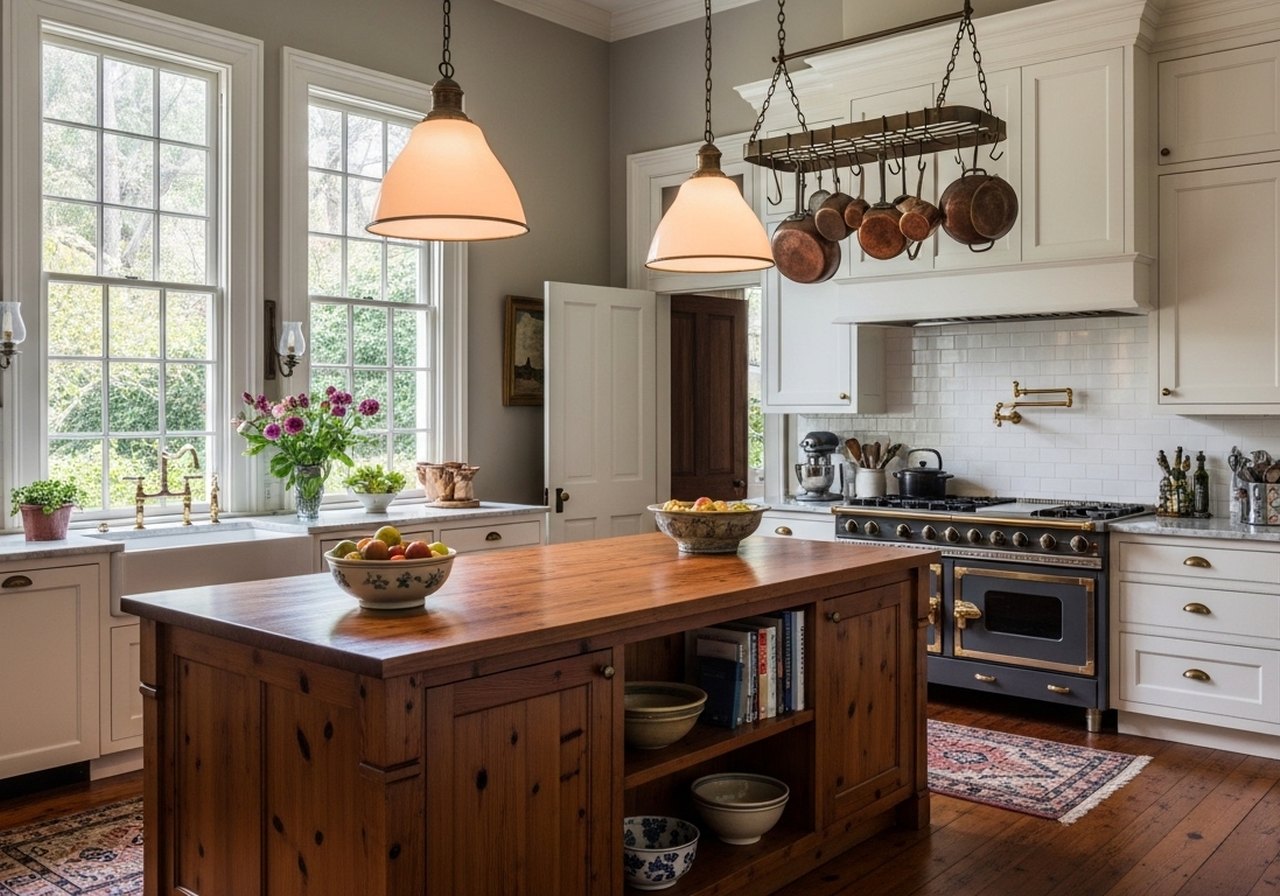
Pendant light height over an island is 32 inches from the countertop to the bottom of the fixture for most pendants and most counters, and the standard 30-to-36 range is where the honest answers live; I have measured a lot of kitchens and 32 is the number I keep landing on. The caveats are real: an opaque or partly enclosed pendant should go lower so its light washes the surface, an open globe should go higher to avoid glare, and multiple pendants over one island must be at exactly the same height, not approximately, because an inch of variation reads as an installation error. This question comes up more than any other I get, and this post is the answer with its arithmetic: the 32-inch rule and how we tested it, the sightline test with the tallest person in the house, opaque versus open shades and the adjustment for each, the exactly-level rule for multiples, marking the wall before the electrician arrives, sizing relative to the island so height is not doing all the work, the task-light layer the pendants cannot provide, counter height variations, ceiling height and the cord length arithmetic, a pendant over a sink or a cooktop, the plug-in and swag case, our kitchen's three pendants and their numbers, the mistakes, and the cost.
The 32-inch rule, and how we tested it
We hung our three pendants at 34 inches, lived with them a week, and found the light a touch high and the fixtures a touch remote; at 32 the pool of light landed on the board and the shades sat where the eye expected. Thirty-six is a number for a pendant with a wide, downward-facing shade in a kitchen with very tall people; 30 is a number for a small opaque pendant on a low counter. Thirty-two is where a 10-inch brass dome over a 36-inch counter under a 10-foot ceiling wants to be, and it is where most kitchens I have measured were happiest. Hang at 34, live a week, and drop; the second measurement is the one you keep.
The sightline test
Stand the tallest person in the house at the island and have them look across it at someone seated on the other side; if a shade is in the line between their eyes, the pendants are too low, and if they are looking at a bulb through an open shade, too high. My husband is 6 foot 1 and at 32 inches he sees over the domes; at 30 he was looking through them. You want to see faces at dinner, not a glowing shade, and the test takes a minute with a pendant held on its cord by a second person.
Opaque versus open
An opaque or partly enclosed shade, a metal dome, a solid cone, throws its light down and needs to be close to the surface for the light to reach it: 30 to 32 inches. An open shade or a clear globe throws light in every direction, and at 30 inches its bulb is at a seated person's eye level, so it goes to 34 or 36 and the glare is managed by the height. Our domes are opaque and closed on the sides, and 32 is the compromise between the two rules; a clear glass globe over the same island would hang at 35.
Exactly the same height
For multiples, the bottom of every fixture at the same height to the quarter inch: not approximately, exactly. Three pendants at 32, 32.5 and 31.75 look like an installation error, and the eye cannot say why the kitchen looks off but it knows. Use a level, a laser if there is one, and a story pole cut to the height; cut the cords after the fixtures are hung and adjusted, never before. The one job in a kitchen where "close enough" is visible from the doorway.
Mark the wall before the electrician
Painter's tape on the wall behind the island at the intended bottom-of-fixture height, and tape on the ceiling at the box centers, before anyone arrives with a ladder; an electrician cutting cord length to a number I gave on the phone is an electrician cutting it wrong. Ours hung the fixtures long, I checked the tape and the sightline, and he cut. An hour of my marking saved a return visit, which in this house costs $260.
Size, so height is not doing all the work
A single 10-inch pendant over a 4-foot island looks like a suggestion at any height; two or three pendants, or one fixture sized to a third of the island's length, reads as intentional, and the sizing post is the arithmetic. Height and size are one decision: a pendant that is too small is hung lower to compensate and then it is in the way, and one that is the right size sits at 32 and is left alone. Get the size right first and the height stops being an argument.
The task-light layer
Decorative island pendants set the mood but rarely light the counter enough to cook by, so ours are backed by under-cabinet strips at 3000K and a warm overhead on its own dimmer; the pendants are the focal point and the hidden light does the chopping. The under-cabinet post is that layer. A kitchen that asks its pendants to be the task light hangs them too low and buys them too bright, and the division of labor is what lets the pendants be at 32 inches and 800 lumens each.
Counter height
The 32 inches is above the counter, not the floor, and counters vary: a 36-inch counter puts the fixture's bottom at 68 inches from the floor, a 34-inch farmhouse counter at 66, a 42-inch bar at 74. Measure from the surface, and if the island has a raised bar section, measure from the lower prep surface and let the bar's pendants, if it has its own, follow their own counter. Ours is 36 and the domes are at 68.
Ceiling height and cord length
Ceiling height minus counter height minus 32 minus the fixture's own height is the cord or stem length: our 10-foot ceiling, 36-inch counter, 32-inch gap and 10-inch dome gives 42 inches of cord, and the fixture shipped with 60, which is why they hung long and were cut. An 8-foot ceiling with the same numbers gives 18 inches, which is a short pendant on a short cord and the reason the 10-foot ceiling post exists: tall rooms make pendants easy and short rooms make them a compromise.
Over a sink or a cooktop
Over a sink, the same 32 inches, with the fixture centered on the basin and out of the splash; over a cooktop, 34 to 36 to clear the steam and the pot handles, and only with a hood that takes the grease, because a pendant over a cooktop without one is a pendant that needs washing monthly. Our island has neither, which is why three pendants at 32 worked; a friend's island with a cooktop has two at 35 either side of the hood.
Plug-in and swag
An island with no ceiling box takes a plug-in pendant on a swag hook in a joist over the island's center, the cord swagged to the wall and down in a channel, and the height rule is the same: 32 inches from the counter, set by where the hook is and how much cord is swagged. A swag pendant in a rental or a plaster kitchen where the ceiling is not coming down is the honest option, and the sightline test does not know the difference.
Our kitchen's three
Three unlacquered brass domes, 10 inches, over an 8-foot island, 30 inches apart center to center, 15 inches in from each end, bottoms at 32 inches above a 36-inch quartz counter, 42-inch cords cut after a week at 34, on their own dimmer at 60 percent for cooking and 25 for the evening, with 800-lumen 2700K bulbs. The brass post is why brass, and this is why 32.
Lighting the island for two jobs
The island is prep at one end and the place people sit with a glass at the other, and 32 inches serves both because the dome's light reaches the board and the dome's edge clears a seated face. A pendant hung for prep alone would be at 30 and in the way of every conversation; one hung for conversation alone would be at 36 and useless for a knife. The number is a compromise between two uses, and it is the reason it is a number and not a range.
Mistakes
Thirty-four for a week, which was the plan and was fine. Cutting one cord before the other two were checked, in the first house, and one pendant a half inch high for three years. A clear globe at 30 inches in that same kitchen, and a bulb in everyone's eyes at dinner. And a single small pendant over a long island, which is a suggestion at any height and which was replaced by three.
What it cost
Three pendants, $540. The electrician's three boxes and a dimmer while the ceiling was open, $380. Bulbs, $18. About $940 for the fixtures everyone who walks into the kitchen looks at, and the 32 inches cost nothing but a week and a roll of tape.
Living with pendants over an island for four years
The domes get wiped monthly on the inside, where the brass shows a film from the stove; the bulbs have been changed once; the height has not been touched. The one change we made was the dimmer's evening setting, from 40 to 25 percent, because at 40 the domes at 32 inches were a little bright on a seated face, and the number is the height's partner: a pendant hung right and dimmed wrong is still wrong at dinner. Height, size and dimmer are three settings of one fixture, and the island is the room where all three are visible at once.
Telling a friend by text
Thirty-two inches from the counter, exactly level for all of them, cut the cords after, tape on the wall before the electrician, and if the shade is open go to 35; that is the message I send about once a month, and it has been right for every kitchen it has gone to but one, which had a 7-foot-6 ceiling and got a semi-flush instead. The number is the answer and the sightline test is the check, and between them there is no kitchen I have seen that needed a longer conversation.
Where the electrician's boxes go
Centered on the island's long axis, which is not always the room's, and marked on the ceiling from a plumb line dropped from the island's centerline at each pendant position; the boxes went in before the drywall closed during the kitchen renovation, and a friend retrofitting hers into a plaster ceiling paid George for a day of patching that a swag hook would have avoided. Boxes during a renovation, swag hooks after, and the height rule is the same for both.
The height for a table instead of an island
Over a dining table the range is 30 to 34 inches from the table top, because nobody walks under it and the sightline is across seated faces only; we live at 32 over the dining table too, which is a coincidence of two different rules landing on one number. A table is lower than a counter by 6 inches, so the fixture's bottom is 6 inches lower from the floor, and a fixture moved from a table to an island without rehanging is a fixture in the way.
In one paragraph
Thirty-two inches from the counter to the fixture's bottom, tested by hanging at 34 for a week and dropping; lower for opaque shades, higher for open ones; exactly level for multiples, cut after hanging; tape on the wall before the electrician; size to the island first so height is not compensating; under-cabinet strips for the actual cooking; and the tallest person in the house looking across at a seated face as the final test.
Shop this post: kitchen pendant lighting, useful to have a specific fixture in hand before you commit to a height