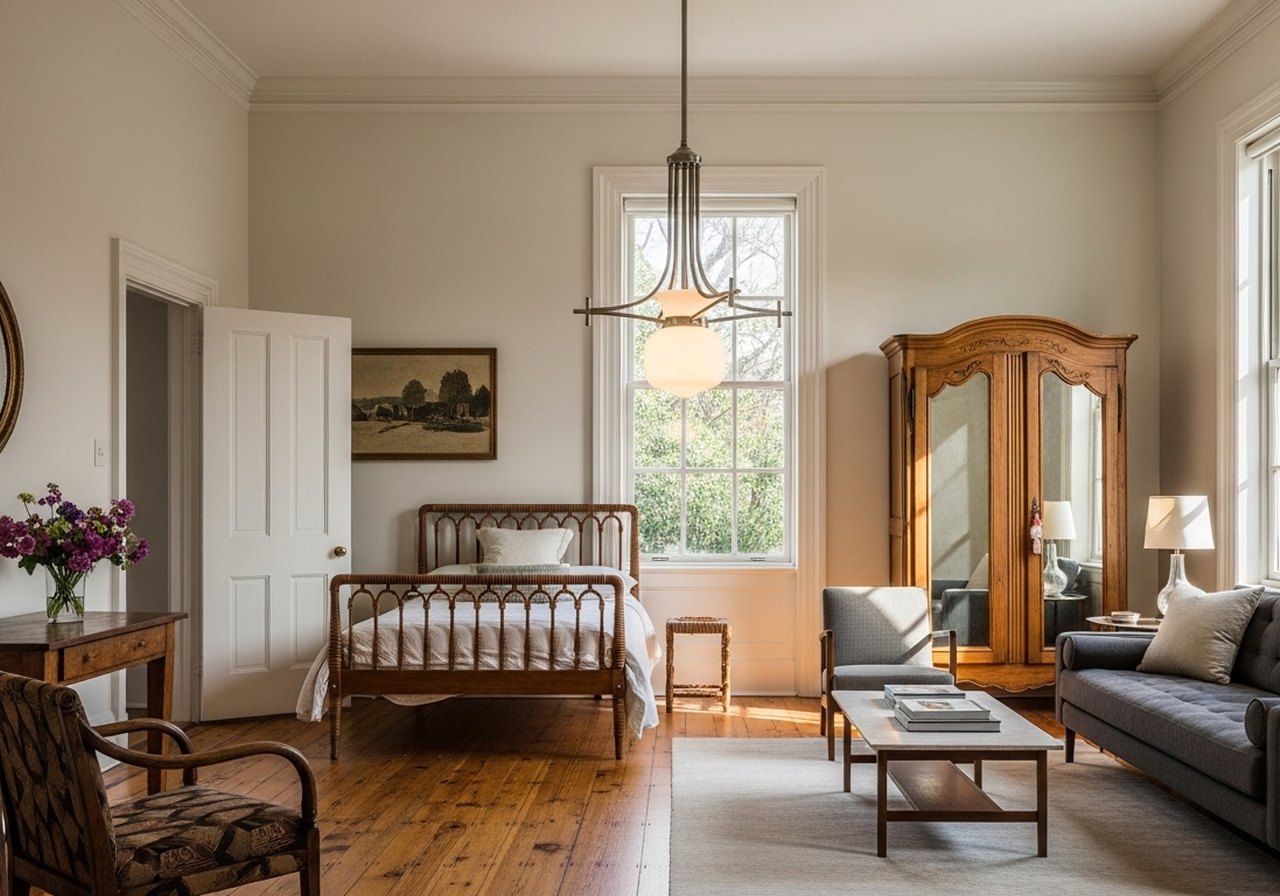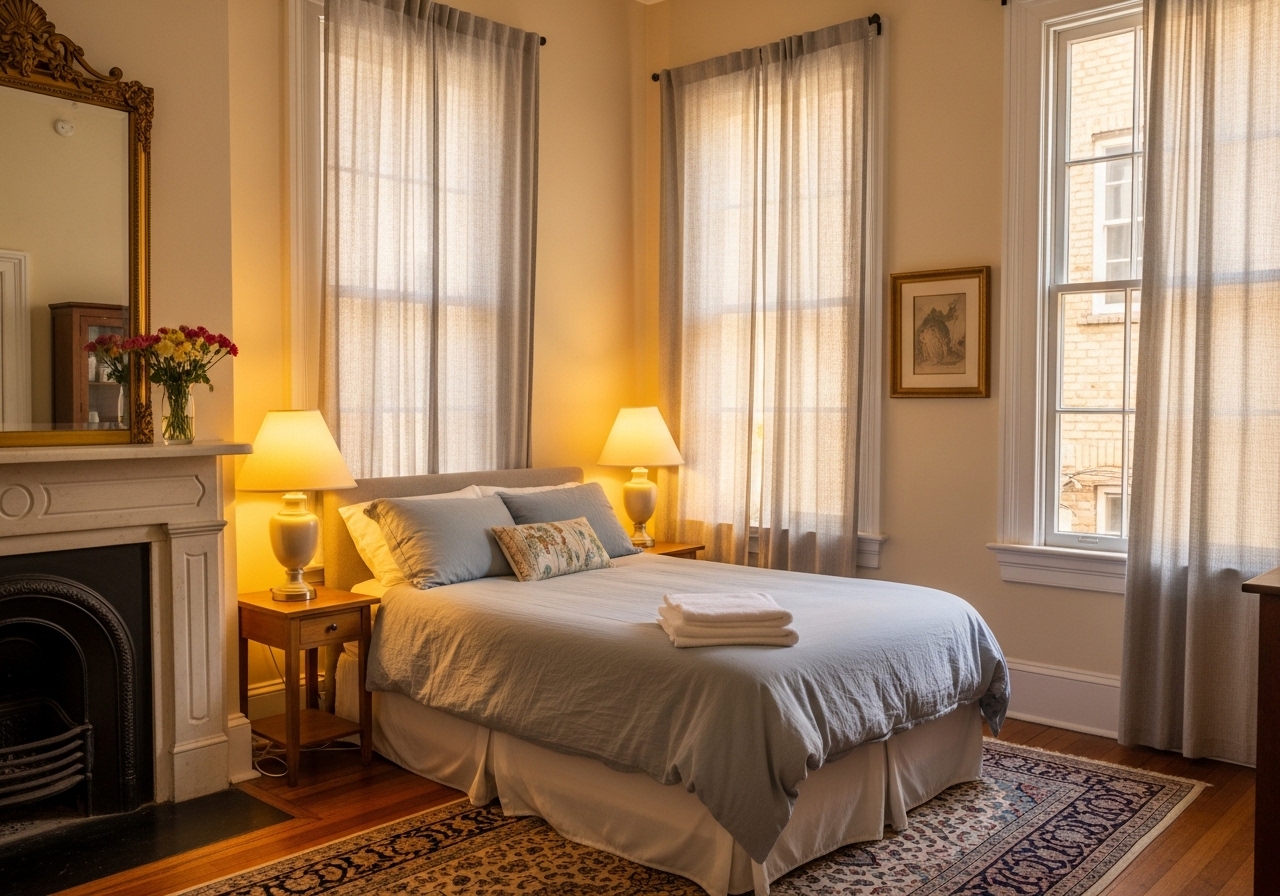
Small bedroom lighting ideas for an old house begin with abandoning the overhead fixture as the primary light: use it for ambient fill on a dimmer at no more than 40 percent, put the real light on the walls beside the bed at 60 inches, and let the corners be lit by a lamp rather than the ceiling. Small rooms have a lighting paradox: they need enough light to function, and too much overhead light makes them feel like the inside of a cardboard box. Our smallest bedroom is 11 by 12 with a 10-foot ceiling, original plaster on four walls and one window, and the change that freed the most floor space was moving the bedside light from the nightstands to the wall and using the nightstand space for a reading chair. This post is the paradox and its cause, the ceiling fixture's demotion and its dimmer, the two matched sconces and why matched, the height, plug-in versions in plaster walls and the cord cover, the tall lamp that makes a small room taller, what recessed lighting does to an old room and why we have none, 2700K and the amber last hour, the mirror trick, the window and the curtain, the reading chair the sconces made room for, the small room's two settings, the bulbs and the lumens, what a small bedroom does not need, the mistakes, and the cost.
The paradox, and why the ceiling causes it
A ceiling fixture in a small room lights the walls and the ceiling equally, and a small room whose walls are all evenly bright is a box whose edges you can see at once; the eye measures the room and finds it small. Light from the sides at human height, with the ceiling and the upper walls left soft, hides the box's edges and the eye stops measuring. It is why a candlelit small room feels intimate and the same room under a bright overhead feels like a cell, and it is the whole of small-room lighting: take the light off the ceiling and put it where people are.
The ceiling fixture, demoted
The original fixture stayed, a small semi-flush with a frosted bowl, on a $22 dimmer, and its rule is 40 percent at most and off by 9 pm; it is for making the bed, finding the sock and the twice-a-year clean. At full it flattens everything and at 40 it fills the corners without drawing the eye. In a small historic bedroom the ceiling fixture is a utility, and the money and the attention go to the walls.
Two matched sconces
Two bedside wall lamps, matched, at the same height, one either side of the bed, which produce a kind of light no overhead can: warm, directional, human-scaled, from where you need it, and not on the ceiling. Matched, because two different sconces in a small room is two decisions in a space that has room for one; ours are brass swing arms with linen shades that put the light on a book and stop at the pillow's edge, and the swing arm is what lets one person read while the other sleeps 3 feet away. The master bedroom post is the same fixture chosen after two wrong ones.
The height
Sixty inches to the center of the backplate, which is about 24 inches above a standard mattress and puts the shade's bottom at seated eye level, so the bulb is hidden sitting up and the light lands on the page. Lower and it glares at a sitting reader; higher and it lights the wall. Measure with the mattress on the bed and the pillows in place, because a mattress's height varies by 6 inches between beds and the sconce is set to the mattress, not the floor.
Plug-in, in plaster walls
Our walls are horsehair plaster on lath, and opening them for a box is George the plasterer at $85 to $120 an hour plus David the electrician; plug-in versions with the cord run down behind the headboard in a paintable cover to the outlet the bed hides gave the built-in look with no wall opened, and at a glance they are indistinguishable from hardwired. A plug-in dimmer on each cord. In a rental, a plaster house or any room where the wall is not coming down, the plug-in sconce is the sconce, and it has been in this room for four years without anyone noticing a cord.
The tall lamp in the corner
A slim floor lamp, 62 inches, in the corner by the window, with a narrow linen shade, which does two things: it lights the corner the sconces do not reach, and it pulls the eye up toward the 10-foot ceiling and makes the room feel taller. In a small room vertical light is a second dimension; a table lamp on a dresser lights a surface, and a tall lamp lights a wall and the height. It is on a foot dimmer at 30 percent in the evening, and it is the only lamp in the room.
What recessed lighting does, and why we have none
Recessed cans flatten a small room and create a sense of exposure, because they light from above in a grid and leave nothing in shadow; a room with nothing in shadow has no depth. Historic houses were not designed with recessed lighting in mind, and the rooms breathe better for it: a plaster ceiling with one fixture and a medallion is a ceiling, and one with six holes is a ceiling with six holes. We have no cans in the house and the small bedroom is the room that proves the case; it would be a shoebox under cans and it is a room under sconces.
2700K, and the amber last hour
Every bulb in the room is 2700K, and the sconces take a warm-dimming bulb that drops toward 2200K as it dims, so the last hour before sleep is amber, because cooler evening light works against winding down and the bedside should be the softest, warmest light in the house. The ceiling fixture is 2700K too, and never on at night. A small bedroom at 3000K is a small office, and the swap is $6 a bulb.
The mirror
A 30-inch mirror on the wall opposite the window, in a plain frame, which doubles the window by day and the sconce nearest it by night, and which in a small room is the cheapest square footage there is. It is hung at 60 inches to center, the sconce height, so the reflected sconce is at the same level as the real one and the room reads as having three lights. One mirror; two would be a hall of them.
The window and the curtain
One 9-foot window with wavy glass, a linen panel on a rod 2 inches below the crown per the window post, which makes the window and the room taller, and which is drawn only in July when the afternoon sun is a problem. Daylight is the small room's best light and the curtain's job is to frame it, not to block it; a small room with heavy curtains is a smaller room.
The reading chair the sconces made room for
Moving the light to the wall freed both nightstands, and the nightstand on the window side was replaced with a small armchair, because a small bedroom with a chair is a room you can be in awake, and one with two nightstands is a room for sleeping in. The chair is lit by the sconce above it, which swings to it, and by the tall lamp beside it. It is the change that made an 11-by-12 room feel like it had two uses, and it cost the price of the chair, because the light was already on the wall.
Two settings
Evening: sconces at 50, lamp at 30, ceiling off. Night: one sconce at 20, amber, for the reader; everything else off. There is no "full" setting after dark, because the room has no reason for one. In the morning the ceiling at 40 for the bed and the sock, and off. A small room's lighting has fewer settings than a large one's, and the discipline is not adding a third.
Bulbs and lumens
Sconces, 450 lumens each; the floor lamp, 800; the ceiling, 1,200 and never above 40 percent. About 1,700 lumens in use in the evening in a 132-square-foot room, which is 13 a foot and reads as soft because none of it comes from above. A small room needs fewer lumens than the charts say and needs them from the right direction, and the direction matters more than the number.
What a small bedroom does not need
A pendant, which hangs in the room's middle where there is no middle. Two table lamps, which take the nightstands. A ceiling fan with a light kit, which is a fan and a bad light. String lights. More than one mirror. A second color temperature. The list of what it needs is three fixtures and a dimmer for each, and the list of what it does not need is longer, which is what a small room's design is.
Mistakes
Two table lamps for a year, and no chair. A 3000K bulb in the ceiling for a month of poor sleep. The sconces at 64 inches on the first hang, lighting the wall above the book. A heavy curtain in the first winter that made the room a closet. And the ceiling fixture at full every evening until the dimmer went in, which is the mistake the whole post is about.
What it cost
Two plug-in sconces, $190, and two plug-in dimmers, $28. The floor lamp, $120. The ceiling dimmer, $22. The mirror, $85. The chair, $240, which is furniture and not lighting. Bulbs, $24. About $470 in lighting for a small bedroom that feels twice its size at night, and the sconces are the $190 that made the rest possible.
The small bedroom by day
By day the room is the window, and everything else is off; the mirror doubles it and the pale walls hold it, and at 10 am on a clear day the room needs nothing. The sconces are the room after 5 pm, and the ceiling is the room for five minutes at 7 am. A small bedroom that is lit correctly is a room whose lights are off most of the day, which is another way of saying that the window is the first fixture and the one to design the rest around.
Reading in bed, specifically
The swing arm pulled to the book at 20 percent, amber, is a pool of light 18 inches across on the page and nowhere else, and the person on the other side of the bed does not know it is on; that is the test of a bedside sconce and the one a table lamp fails, because a table lamp lights the whole nightstand and the wall and the ceiling above it. If a sconce's shade does not close on the side away from the reader, it is not a reading sconce, whatever the catalog calls it, and ours were chosen in the shop with a book held under them.
The one thing to do first
The dimmer on the ceiling fixture, $22 and twenty minutes, because it is the change that stops the room being a box every evening and the one that makes the sconces feel necessary rather than decorative. A small bedroom with a dimmed ceiling and two table lamps is already better than most; the sconces and the chair are what it becomes after. If the budget is $22, it is the dimmer, and the sconces are the next $190.
In one paragraph
Ceiling fixture on a dimmer at 40 percent at most, off by 9. Two matched sconces at 60 inches, plug-in with a painted cord cover in plaster walls, warm-dimming to amber. A tall slim lamp in the corner for the height. A mirror opposite the window. No cans, no pendant, no table lamps, no second temperature. The nightstand's space becomes a chair. Light from the sides at human height, and a small room that stops measuring itself.
Shop this post: bedroom wall lamps and plug-in wall sconces for plaster walls