A statement pendant belongs in a historic home in the rooms whose register is informal, over furniture it is sized to, in a material that does not compete with plaster and old wood, and in the wrong room it reads as imported no matter how good the fixture is. The difference between a statement pendant that looks like it was always meant to be there and one that looks like a staging mistake is proportion and material, not the fixture itself. Ours is a 22-inch woven rattan pendant over the eat-in dining area off the kitchen, a 10-by-12 space with a 9-foot ceiling, hung on a cloth-wrapped cord so the bottom sits at 6 feet, and three people have asked where we found it, which is usually the sign. This post is the register test and how to read a room's, why rattan works where metal and glass would not, sizing a statement piece to the table and the ceiling, the quiet-room rule that lets a loud fixture speak, the dimmer that lets it recede, where a statement pendant would fail in this house and why, the formal rooms and what they take instead, the cord and the canopy, the three materials that suit an old house and the three that do not, the light the fixture actually gives, what a statement pendant costs versus what it does, the mistakes, and the room a year on.
The register test
Every room has a register, formal or informal, and it is set by the architecture before you bring anything in: a room with a plaster medallion, a marble mantel and 11-foot ceilings is formal whatever you put in it, and a room with a 9-foot ceiling off the kitchen where breakfast happens is informal whatever you put in it. A statement pendant has a register too, and rattan's is informal. The test is to stand in the doorway and ask what the room would be used for in 1892; if the answer is receiving guests, the fixture should be a chandelier, and if it is family meals, a statement pendant is allowed. Our dining area was the back of the house, near the kitchen, and it passes.
Why rattan
Rattan is organic, and organic materials do not compete with plaster and heart pine the way metal and glass do; a woven pendant introduces texture without shine, and shine is what makes a modern fixture fight an old room. It is also light, which matters on a 9-foot ceiling where a heavy fixture at 6 feet would feel like a lid. And it is warm in color, which sits between the pine floor and the cream walls without asking for attention. The caveat is that it is informal, and it would be strange in the formal dining room 20 feet away; the chandelier post is that room's answer.
Sizing to the table and the ceiling
Two-thirds of the table's width, so 22 inches over a 34-inch-wide table, and a size that the 9-foot ceiling can carry at a 6-foot bottom: a 30-inch pendant at 6 feet in a 10-by-12 space is a hat over the table, and 22 is the largest that still leaves air around it. The sizing post is the arithmetic and says go bigger, and this is the one room where "bigger" hit the ceiling first. The rule is the table's width sets the maximum and the ceiling's height sets whether you can reach it.
The quiet-room rule
A statement fixture only works if it is the loud thing in the room. We kept the table plain, a farmhouse table in waxed pine, the chairs plain, the walls the same cream as the kitchen, and the window bare, so the pendant is the only object with a texture. A statement pendant in a room with a patterned rug, a gallery wall and a colored table is one of four statements, and four statements is noise. If you want the fixture to speak, take something else out of the room first, and the thing to take out is usually the art.
The dimmer
On a plug-in dimmer at the wall, and at 40 percent for dinner, so the pendant recedes in the evening rather than dominating every meal; a statement fixture at full brightness at 8 pm is a fixture that will not let you finish a conversation. At full it is a breakfast light and a homework light. The dimmer is what lets one fixture be a statement at noon and a glow at night, and a statement pendant without one is a fixture you will resent within a month.
Where it would fail in this house
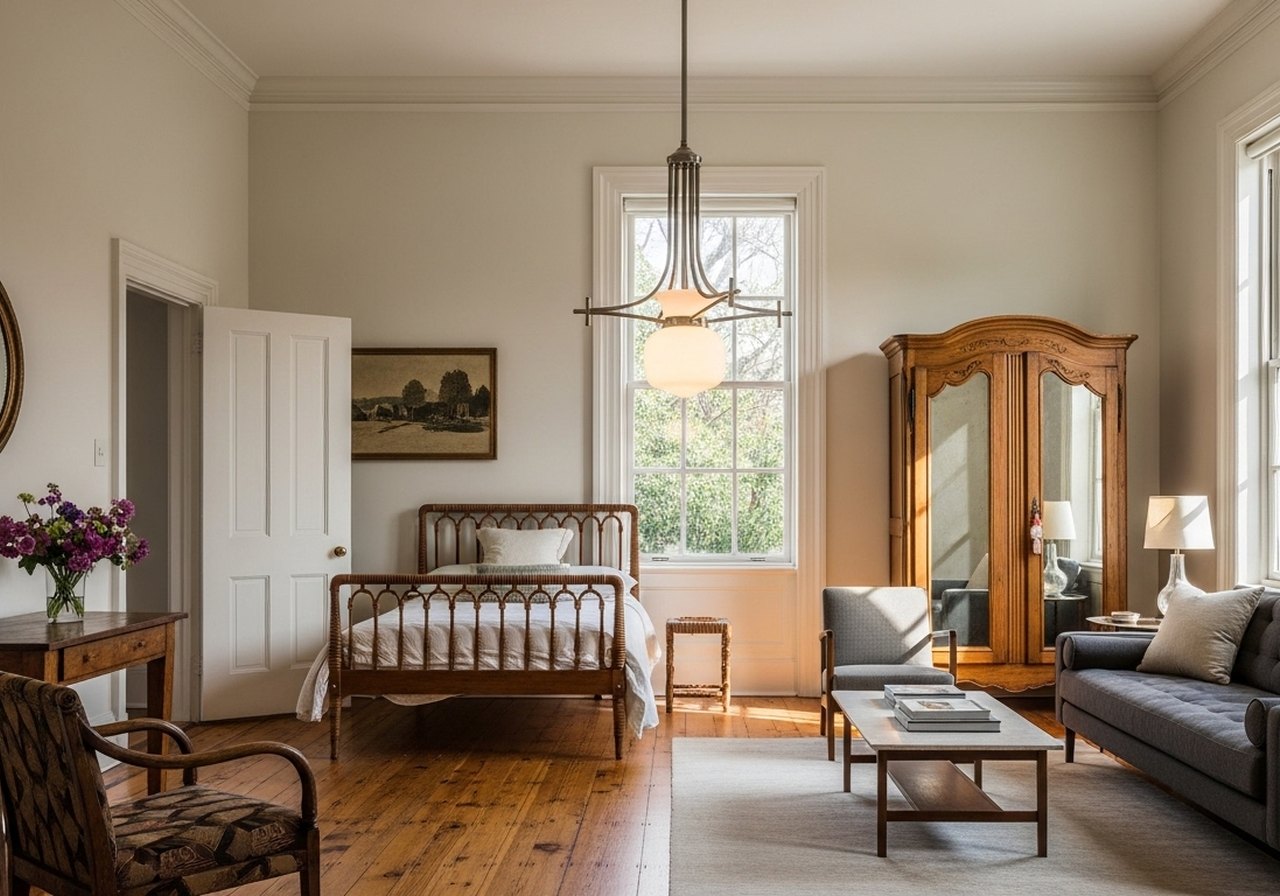
The formal dining room, where a rattan pendant under a 10-foot plaster ceiling and beside built-ins painted to match the trim would look like a beach house had wandered in. The front parlor, obviously. The master bedroom, where the first pendant we tried was a statement and the bedroom post records how that went: too large, too loud, and replaced. The entry, which wants a lantern. A statement pendant fails wherever the architecture is already making a statement, and in an 1892 single house that is most of the ground floor.
What the formal rooms take instead
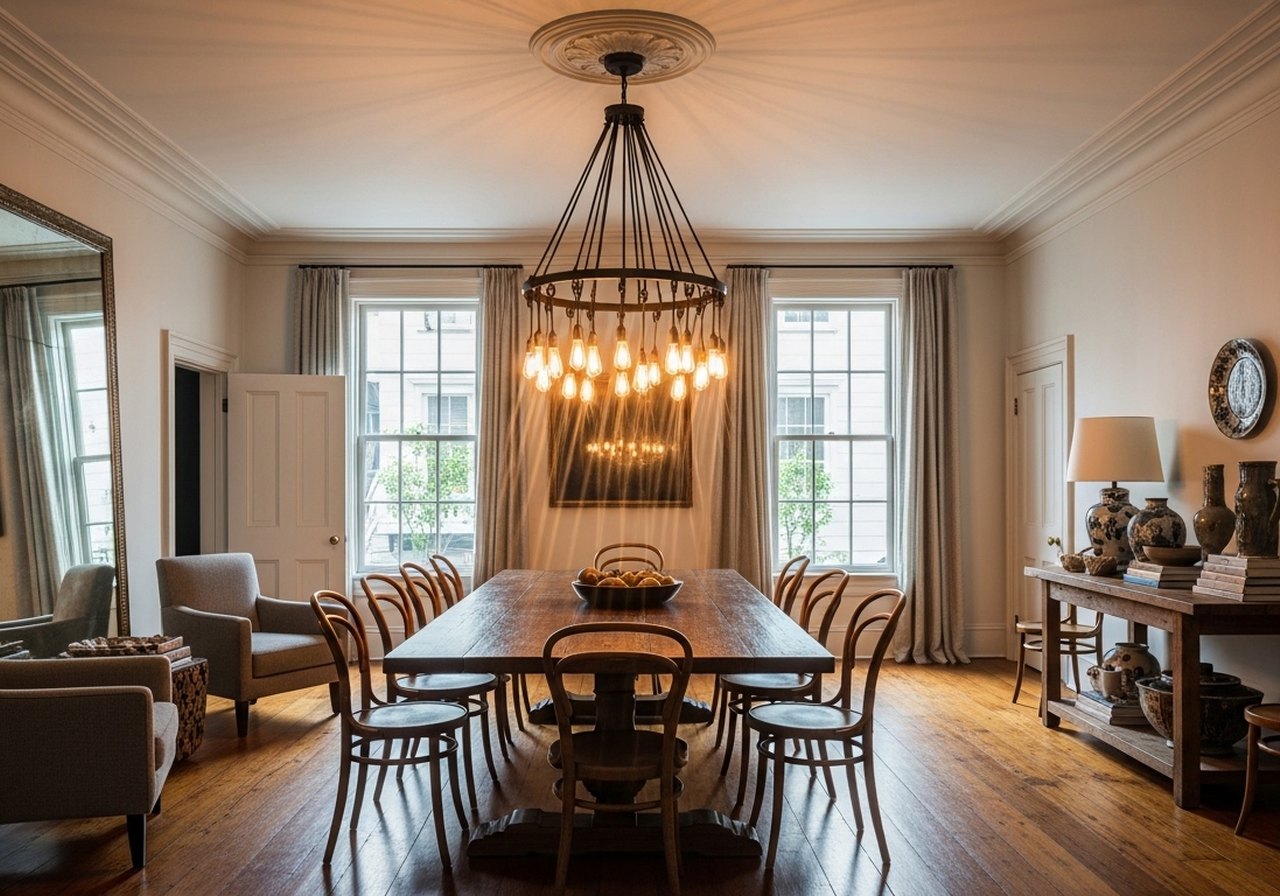
A fixture that defers: a brass and seeded-glass chandelier in the dining room, sized to the table and hung low, that reads as belonging to the room's period without being a reproduction; a chandelier in the parlor at 7 feet under the medallion; a lantern in the foyer. Those are statements too, but they are the house's statements and not the fixture's. The antiques and modern post is the rule for when a modern fixture is allowed in a formal room, and the answer is when it is clearly chosen as a foil and not as a hero.
The cord and the canopy
A cloth-wrapped cord in a natural jute color, not a chain and not a bare wire, because a rattan pendant on a chain is two materials arguing and on a wire is a fixture that looks temporary. The canopy is small, painted the ceiling color, and forgettable, which is right; the pendant is the statement and the canopy is the ceiling's. A cloth cord also lets the fixture be plug-in if there is no box, which in an old house is often the case, swagged to the wall and down in a cover painted to match.
Three materials that suit an old house, and three that do not
Suit: rattan and woven fiber, for the texture; unlacquered brass, for the patina; linen and paper shades, for the diffusion. Do not: polished chrome, which is a mirror in a room that does not want one; clear acrylic, which is invisible and cheap at once; and anything matte black in a large size, which reads as a modern kitchen's idea of edge and which in a plaster room is a hole. The rule is that a material that ages, or that light passes through softly, belongs; a material that stays perfect and reflects does not.
The light it gives
A woven pendant is a shade with holes, and it throws a pattern on the ceiling and the walls at full and a soft pool on the table at 40 percent; the pattern is the fixture's second statement and it is why the ceiling above it is plain. One 800-lumen 2700K bulb inside, which is enough for a 34-inch table and not enough to light the room, which is the point, because the room's other light is a wall sconce by the door and the kitchen's strips through the opening. A statement pendant is not a room's light; it is the table's, and it should be bought for the table.
Cost versus effect
The pendant was $240, the dimmer $22, the cloth cord and canopy included; about $260 for the object that everyone who eats in that room asks about, in a room where the table was $400 and the chairs $60 each. A statement pendant is the cheapest way to give an informal room a focus, and it is a better use of $260 than the art it replaced, because a fixture is on at every meal and art is looked at once.
Mistakes
The bedroom's first pendant, a statement in a room that did not want one. A metal statement pendant we tried in this dining area first, a black dome, that made the corner feel like a diner and went back within the week. No dimmer for the first month, and dinners under a breakfast light. And hanging the rattan at 5 feet 6 inches on the first try, which looked dramatic and which my husband walked into, and which is why the rule is 6 feet in a space where people stand.
The room a year on
The rattan has darkened slightly in the harbor air, which suits it; the cord has not sagged; the pattern on the ceiling is the thing the children of guests point at. The corner it hangs in was the least considered space in the house and it is now the one where breakfast lasts longest, which is what a statement fixture in the right register does: it makes a room a destination without making it grand. It would not have done that in the parlor, and knowing which room is which is the whole skill.
Testing before committing
Hang the fixture, or a paper mock-up of it, at the intended height for a week before wiring; look at it at breakfast and at dinner and from the kitchen through the opening; and ask whether it is the only thing in the room asking for attention. If it is not, remove something else or choose a quieter fixture. If it is, and the room's register is informal, it stays. That week has saved us from two fixtures and confirmed one, and the one that was confirmed is the one in this post.
The kitchen's view of it
The dining area opens off the kitchen through a cased opening, and the pendant is seen from the sink as often as from the table; it had to work as an object at 15 feet as well as a light at 3, and rattan's texture reads at both distances where a smooth fixture would be a shape at one and a blank at the other. The kitchen's own pendants are brass and glass over the island, a different register 12 feet away, and the two do not fight because the opening frames the rattan as a picture. If the two spaces were one room the answer would have been one fixture family, and the opening is what allowed two.
Cleaning a woven pendant over a table
A soft brush attachment on the vacuum every couple of months, from the outside, and a barely damp cloth on the inside once a year; rattan holds dust in its weave and a table below it means grease in the air. It is five minutes and it is the one maintenance item a woven fixture asks for that a glass one does not, and in exchange it never shows a fingerprint, which a brass or glass fixture at 6 feet over a table shows weekly. In a coastal climate it will darken a shade a year, which is what it is supposed to do, and which the brass on the island's pendants is doing at the same pace.
In one paragraph
Read the room's register from its architecture; a statement pendant belongs in the informal rooms. Choose a material that does not shine, size it to two-thirds of the table and to what the ceiling can carry, keep everything else in the room quiet, put it on a dimmer, hang it at 6 feet on a cloth cord, and let it be the only thing talking. In the formal rooms, let the house talk instead.
Shop this post: pendant lights and swag pendants for a table with no ceiling box