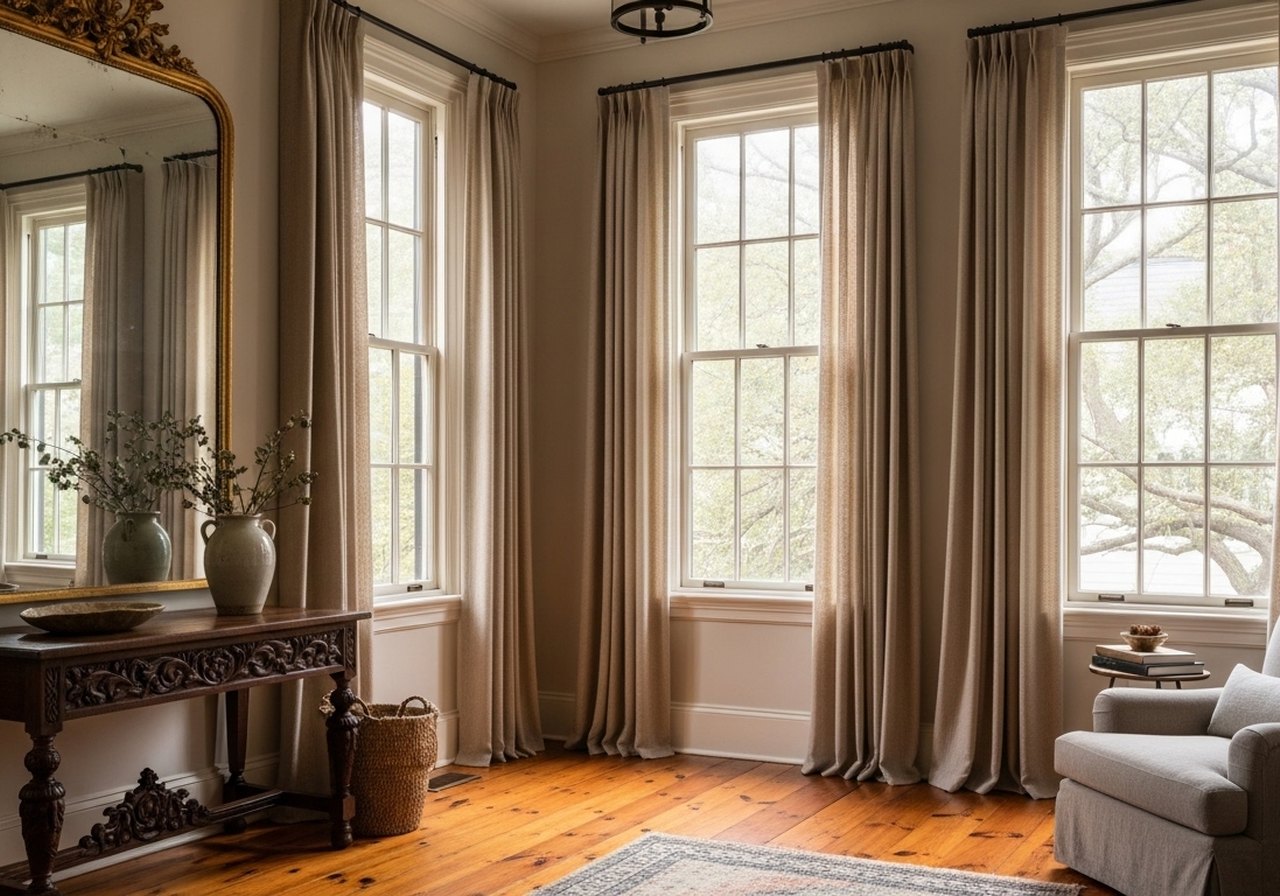
Curtains for tall windows in an old house are a hardware problem first and a fabric problem second: our windows are 9 feet tall with original wavy glass, and standard curtain rods, which max out at a diameter and a reach scaled for a 7-foot window, were never going to work. The rod goes 2 inches below the plaster crown regardless of where the window frame sits, which is the visual trick that makes a tall window taller and the rod read as part of the wall's architecture; the fabric is a medium-weight undyed linen, pinch-pleated and weighted, made by a workroom that has dressed historic houses in this city for thirty years. This post is the hardware and where it came from, the crown-minus-2-inches rule, the width rule that lets the glass show, the wavy glass and the storm-window decision, thermal linings and the cold nights, the fabric and why linen, the header and the hem, the rings and the finials, the workroom versus ready-made, the sheer question, how the curtains shape the light through the day, the sconces changed at the same time, the rooms where we hung nothing, the mistakes, and the cost.
The hardware
A 1.5-inch iron rod in a black finish, in 12-foot lengths cut to size, on brackets that project 5 inches and are screwed into the window's original casing and, at the center, into a stud found behind the plaster, with rings that slide and finials that are plain balls; all from an architectural hardware supplier, not a home goods store, because a rod that spans 8 feet of 9-foot linen has to not flex, and the home goods rods flex. The hardware was $340 a window, which is more than the fabric for a small window and less than a bent rod replaced twice.
Two inches below the crown
The rod is mounted 2 inches below the plaster crown molding regardless of where the window frame actually sits, which in our rooms is 14 inches below it; the curtain then runs from just under the crown to the floor and the eye reads the whole height as window. Mounting at the frame's top makes a 9-foot window look 9 feet tall in a 10-foot room, which is fine; mounting at the crown makes it look like the wall is glass, which is better. The rod reads as part of the wall's architecture rather than an accessory to the window, and it is the single rule in this post that changes a room.
The width rule
The rod extends 12 inches past the frame on each side, so the panels, when open, stack on the wall and not on the glass, and the full width of the wavy glass shows by day; a curtain that covers a third of the window when open is a curtain that has cost you a third of the light. Each panel is 2.5 times the width it covers, so the pleats hold when closed and the stack is deep when open. The rule adds 24 inches of rod and a yard of fabric per window, and it is where the daylight is kept.
The wavy glass, and the storm windows
Original single-pane wavy glass is irreplaceable and thermally inefficient, and the choice was interior storm windows, which are effective and which put a flat modern pane between you and the wavy one, or no storms and curtains that close fully on cold nights; we chose the curtains, which is the more period-appropriate decision and the one that keeps the glass as the room's feature. Charleston has perhaps twenty cold nights a year, and on those the linen with its thermal lining is drawn and the rooms hold their heat; on the other 345 the glass is what the room is about.
The lining
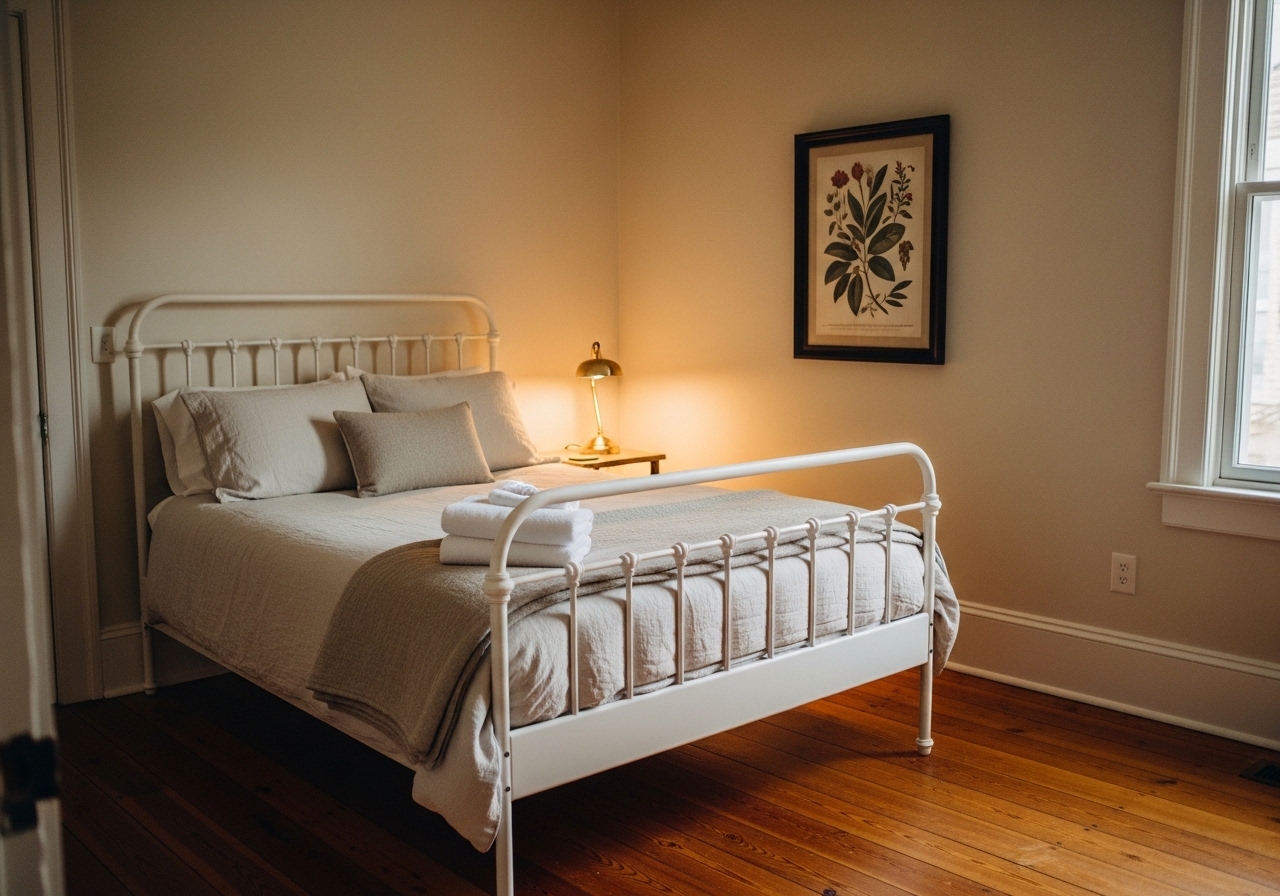
A cotton sateen lining with a thermal interlining on the north- and west-facing windows, plain sateen on the east and south, sewn in by the workroom; the interlining is what makes the curtains work as the storm windows we did not install, and it adds body to the pleats. It also darkens the bedroom fully at 6 am in June, which the master bedroom's makeover, in the bedroom post, needed more than the parlor did.
Linen, and why
A medium-weight linen in a natural undyed color, 11 ounces, because it hangs in soft folds that read as fabric rather than drapery, because its color sits between the cream walls and the honey floors without arguing, and because it is what a house of this age and this climate would have had. Silk would be correct and would rot in the sun in three years; velvet would be heavy in a room that is warm eight months a year; a print would fight the plaster. Linen is the fabric that makes a tall window look dressed and not decorated.
The header and the hem
A pinch-pleat header, three-finger, hand-sewn, on drapery hooks into rings, which is the header that holds a 9-foot panel in even folds and that a rod-pocket or a grommet cannot; a 4-inch double hem with lead-weight tape sewn in, so the panels hang straight and do not billow in the piazza's breeze through an open window. The pleats and the weights are the two things ready-made curtains do not have and the two things that make the difference at 9 feet.
Rings and finials
Iron rings of 2 inches with eyelets for the hooks, one per pleat plus one at each end, which slide without catching; ball finials, plain, 3 inches, because a tall window with an ornate finial is a window with a hat on. The rings and finials match the sconces' black iron in the rooms that have black sconces and were chosen after the sconces, which is the order.
The workroom versus ready-made
Custom length, custom width, the header and the hem above, from a workroom that has been making curtains for historic homes in Charleston for thirty years; the cost was about three times a ready-made panel of the same fabric, and the result is incomparable, because no ready-made panel comes in 108 inches with a pinch pleat and a weighted hem. The workroom measured twice, made a sample pleat for approval, and hung the panels, which took a morning and which I would not have done as well.
The sheer question
No sheers, because sheers on wavy glass are a veil over the one thing in the room worth looking through, and because the piazza's overhang already shades the south windows at noon. In the sunroom, where the afternoon light is a problem, the answer was paint, per the sunroom post, and not a second layer of fabric. A sheer is for a window with a view you want to soften, and none of ours qualify.
How the curtains shape the light
Open by day, stacked on the wall, and the rooms are lit by 9 feet of wavy glass; drawn at dusk in winter and the rooms are warm boxes lit by lamps; half-drawn on a bright afternoon in the west rooms and the light is a soft wash instead of a glare. Lighter treatments preserve daylight and heavier ones darken and warm a room, and ours are light with the option of heavy, which is what the lining does. The evening's warmth comes from the lamps and the sconces, not from dense fabric, which is the high ceilings post's layer at work.
The sconces, changed at the same time
The parlor's sconces were replaced the week the curtains went up, because the old ones were brass with pleated shades that fought the linen's texture and the new ones from the wall sconce collection are black iron with linen shades that agree with both the fabric and the window trim; a sconce beside a curtained window is seen against the curtain, and the two have to be chosen together. The hardware's black and the sconces' black are the same black, which is the detail that makes the wall read as one decision.
The rooms where we hung nothing
The library, whose single east window faces the garden and needs no privacy and no shade; the stair hall, whose window is the stair's light; and the bathroom, whose salvage window has wavy glass and a film on the lower sash. A tall window with nothing on it is the finest thing an old house has, and the rule is that a curtain has to earn its place with privacy, warmth or glare, and three windows in this house could not make the case.
Mistakes
A home goods rod on the first window, which bowed in a week under 9 feet of linen. Panels ordered at 2 times the width instead of 2.5, in the first room, with pleats that fell open when closed. Mounting at the frame in the guest room before I knew the crown rule, and re-mounting. And a sheer trial in the parlor for a month, which veiled the glass and came down.
What it cost
Hardware, $340 a window for six windows, $2,040. Fabric, lining and the workroom's making, about $520 a window, $3,120. Hanging, $300. About $5,460 for six 9-foot windows dressed for a hundred years, and the rods at 2 inches under the crown are the part of it that a photograph shows.
Curtains and the sconces' light at night
With the curtains drawn the linen becomes a wall, and the sconces beside the windows light it as they would a plaster wall: a soft wash down the pleats that makes the fabric read as texture. The pleats' shadows are the evening's decoration, and a flat panel without pleats would be a flat panel. The rooms with drawn curtains and sconces at 40 percent are the rooms guests describe as warm, and the warmth is the light on the fabric.
Washing and the years
Linen panels come down once a year, are washed cold and hung damp to dry on the rod, and the pleats re-set themselves; the lining is dry-cleaned every three years. The undyed linen has softened and lightened slightly in four years of southern sun on the west windows, which it is meant to do, and the east panels have not changed. A curtain that is washed and re-hung once a year is a curtain for decades, which is the workroom's argument and now mine.
The hardware's weight, and the wall
Nine feet of lined linen at 2.5 times fullness weighs about 14 pounds a panel, and two panels and an iron rod is close to 40 pounds on three brackets; the outer brackets are in the window casing's solid wood and the center is in a stud found with a magnet through the plaster, and none of them is in plaster alone, because a bracket in plaster alone is a bracket on the floor with the plaster attached. The rule for any hardware in an old wall is wood behind it, and a tall window's rod is the hardware with the most reason to obey it.
The bedroom's curtains, which do a different job
The master bedroom's panels are the only ones with a blackout interlining, because a bedroom's curtain is for sleep and a parlor's is for warmth; they are the same linen and the same hardware, and at 6 am in June they make the room dark, which the parlor's would not. One fabric, one rod, two linings, and the room's job decides which.
In one paragraph
A 1.5-inch iron rod from a hardware supplier, mounted 2 inches below the crown and 12 inches past the frame each side, with rings and plain finials in the sconces' black. Undyed linen at 2.5 times the width, pinch-pleated and lead-weighted, thermally lined where the cold comes from, made by a workroom that knows old houses. No storms, no sheers, and no curtain on a window that cannot make its case.
Shop this post: wall sconces chosen with the fabric, and contemporary wall lights in the hardware's black