The best plug-in picture light for most paintings in an old house is a brass House of Troy Advent sized to roughly half the width of the frame: it is a traditional shape that suits a pre-1900 room, it comes in plug-in, battery and rechargeable versions, and the plug-in models sit in the $56 to $70 range at major retailers. If you cannot run a cord at all, the Rechargeable Advent is the one I would buy. Below is the shortlist I worked through for our parlour and stair hall, and the rules that decided it.
Why Plug-In Picture Lights Suit a Historic House
Our walls are original lime plaster over wood lath. Every hardwired fixture we have added has meant a conversation with our electrician about fishing wire through 130-year-old cavities, patching, and then matching a finish that was never meant to be matched. For a ceiling fixture or a pair of sconces that is worth it. For a light over a painting, which you may move the next time you rehang the room, it rarely is.
A plug-in or battery picture light changes the equation. It hangs from the frame or from one small screw in the wall, the cord runs down behind the painting and along the baseboard, and nothing about the house changes. When you take it down, the evidence is a single nail hole. That is the kind of change I am comfortable making in a house that has outlasted every previous owner's ideas.
The trade-off is the cord. A brass picture light with a white cord hanging down a dark green wall looks unfinished, and there is no getting around that except with a battery model or a little planning, which I cover further down. I wrote more about the general approach in mixing antiques and modern lighting: modern function is fine, as long as the parts you see belong to the room.
How I Judged Them
I compared every light on five things you can check from the product page before buying:
- Size range. Picture lights look right when the light is about half to two-thirds the width of the frame. A brand that offers 7, 9, 14 and 24 inch versions of the same design lets you light a small portrait and a wide oil in the same room and keep them matched.
- Power options. Plug-in, battery or rechargeable, and how long the cord is.
- Finish and shape. For a Victorian or late 19th century room, a curved arm and a hooded brass shade reads as period. A flat bar with a thin modern arm reads as gallery.
- Light source. LED runs cool and does not bake the canvas the way an old incandescent tube could, which matters on an oil painting you care about.
- Price. What it costs at major retailers today. Prices on picture lights swing a lot between sellers, so I give ranges.
I left out anything I could not find a clear spec or a real retailer price for. Prices below are from retailer listings on October 14, 2026.
The Shortlist
1. House of Troy Advent 14" Plug-In: The Best All-Round Choice
House of Troy is the name I kept coming back to, because the Advent line covers every size and power option in one consistent design. The classic Advent has the curved arm and hooded shade that looks at home over a gilt frame, and it comes in antique brass, polished brass and satin brass among other finishes. Walmart lists the 7 inch antique brass plug-in at between $56 and $69.99 depending on the listing, and the 9 inch Advent Profile LED plug-in at $64.
For a typical 24 to 30 inch wide oil painting, the 14 inch is the right width. For a small portrait, the 7 inch. Because the shape stays the same across sizes, a room with three paintings of different widths still reads as one scheme.
Period fit: the most traditional shape on this list. Choose antique brass for a room with old gilt frames, polished brass if your other hardware is bright.
2. House of Troy Rechargeable Advent: Best When You Cannot Run a Cord
The rechargeable version is the answer for a painting on a chimney breast, between two windows, or anywhere the nearest outlet is across the room. There is no cord at all, so the wall looks exactly as it would with a hardwired light. Retailers list the 12 inch satin brass at $198 and the 24 inch at $250, which is three to four times the plug-in price.
That premium is the cost of not having a cord, and over a mantel it is worth it. The catch is charging: you will take it down or reach up to charge it on a schedule, so pick a spot you can get to without moving furniture. House of Troy also sells battery-operated Advent models (the 7 inch is listed at $72 and the 14 inch at $68), which avoid the cord the same way but use replaceable batteries.
Period fit: same traditional shape as the plug-in. The best-looking option over a fireplace, because nothing hangs below it.
3. Westinghouse 14" Plug-In: Best Budget Brass
The Westinghouse 14 inch is the plain, affordable choice, listed at about $74.99 with an 8 foot cord. Eight feet matters in an old house: our outlets sit low on the baseboard, often well off to one side of where a painting wants to hang, and a short cord forces you to hang art where the outlet is rather than where the wall needs it.
The design is simpler than the Advent, with a straighter arm. Over a modern print or a photograph it works well. Over an old oil in a heavy frame, I think the House of Troy shape sits better.
Period fit: fine in a transitional room, a little plain over a carved or gilt frame.
4. Hudson Valley Lighting Vernon 16": The Heirloom Choice
If the painting is the most important thing in the room, the Vernon is the picture light that looks like it was bought for it. Lamps Plus lists the 16 inch at $368. It is a heavier, more detailed fixture than anything else here, and it is the one I would choose for a family portrait over a sideboard, where the light is part of the furniture.
At this price, confirm the power option before buying. Many higher-end picture lights are designed to be hardwired, with plug-in kits sold separately or not at all. Ask the retailer which configuration you are getting.
Period fit: excellent. This is the closest to what an antique dealer would hang.
See it at Hudson Valley Lighting →
5. House of Troy Advent 7" Battery LED: Best for Small Portraits and Bookcases
Small paintings in bookcases, on a narrow wall beside a door, or in a stair hall are where battery lights earn their place. The 7 inch Advent battery LED is listed at $72 in antique brass or polished brass. You will not light a large canvas with it, but for an 8 by 10 portrait it is the right size, and it keeps the shelf free of cords.
You will see cheap cordless packs too, such as three-light sets around $16 with dimmers and timers. For a bookcase in a child's room I would not argue. In a formal room, the House of Troy finish is noticeably better.
Period fit: good. Same Advent shape at a small size.
Side by Side
| Light | Power | Sizes | Price seen | Best for |
|---|---|---|---|---|
| House of Troy Advent | Plug-in | 7" to 14" and up | $56 to $70 | Most paintings |
| House of Troy Rechargeable Advent | Rechargeable | 12", 24" | $198 to $250 | Over a mantel, no outlet |
| Westinghouse 14" | Plug-in, 8 ft cord | 14" | about $75 | Outlet far from the art |
| Hudson Valley Vernon | Check configuration | 16" | about $368 | A statement portrait |
| House of Troy Advent 7" battery | Battery | 7" | about $72 | Small art, bookcases |
How to Size a Picture Light
The rule I use is that the light should be about half to two-thirds the width of the frame, never wider than the frame. A 30 inch wide painting takes a 14 to 20 inch light. A 12 inch portrait takes a 7 inch light. Go narrower than half and you get a bright stripe in the middle with dark corners. Go wider than the frame and the light starts to look like a shelf bracket.
The arm length matters too. On a deep, carved frame you want the arm to reach far enough that the shade clears the moulding and the light falls on the canvas rather than on the top rail of the frame. Check the projection in the spec sheet against the depth of your frame before you buy.
For a tall painting, a single light at the top will fade before it reaches the bottom third. That is normal, and on most paintings it looks right, since the eye goes to the top half first. On a full-length portrait, a larger light or a ceiling-mounted accent light does a better job.
Mounting Without Damaging Plaster
Most of these lights can mount in one of two ways: onto the back of the frame, or onto the wall above it. On an antique frame I would always mount to the wall. Screwing a bracket into a 19th century frame is a permanent change, and it adds weight to a part of the frame that was never built for it.
For the wall, one small screw into a plastic anchor in the plaster is usually enough for a lightweight LED picture light. Drill slowly with a masonry bit, put painter's tape over the spot first to stop the plaster from chipping, and stay clear of lath seams if you can find them. Our hardwired sconce guide has more on drilling into old plaster without cracking it.
Hiding the Cord
The cord is the giveaway with a plug-in picture light, and in a room with a dark wall it is very visible. Here is what works:
- Paint it. A cord painted to match the wall with a small brush and the wall colour disappears from a few feet away. Unplug it first and let it dry fully before using it.
- Run it behind the painting. Route the cord straight down behind the canvas so the painting hides the first two feet of it.
- Use a paintable cord cover. A slim raceway from below the frame to the baseboard, painted the wall colour, looks like a piece of trim in an old room.
- Put furniture under it. A console or sideboard below the painting hides the bottom of the run and the outlet, which is how most of our pictures are hung.
If none of those will work on that wall, that is the signal to go battery or rechargeable instead.
Bulb Colour and Brightness
I use 2700K for every picture light in the house. It matches the lamps and keeps the gilt frames warm. On a painting with a lot of blue or a cool palette, 3000K shows the colours a little more truthfully. Avoid anything above 3000K in a period room: it makes the canvas look like it is in a gallery and the rest of the room look dim.
A picture light should be gentle. It is there to lift the painting a step above the room, not to spotlight it. On a dimmer or with a low setting it looks best in the evening, when it becomes one of the soft layers I describe in how to layer lighting in a small room.
Protecting the Painting
Old incandescent picture lights ran hot and sat close to the canvas for years, and you can sometimes see the result as a faded or darkened band at the top of an old painting. LED picture lights run far cooler and give off very little ultraviolet light, which is why every light on this list is LED or takes an LED bulb. For a painting of real value, keep the light on only when you are in the room, and ask a conservator if you are unsure.
How This Plays Out in Our Parlour
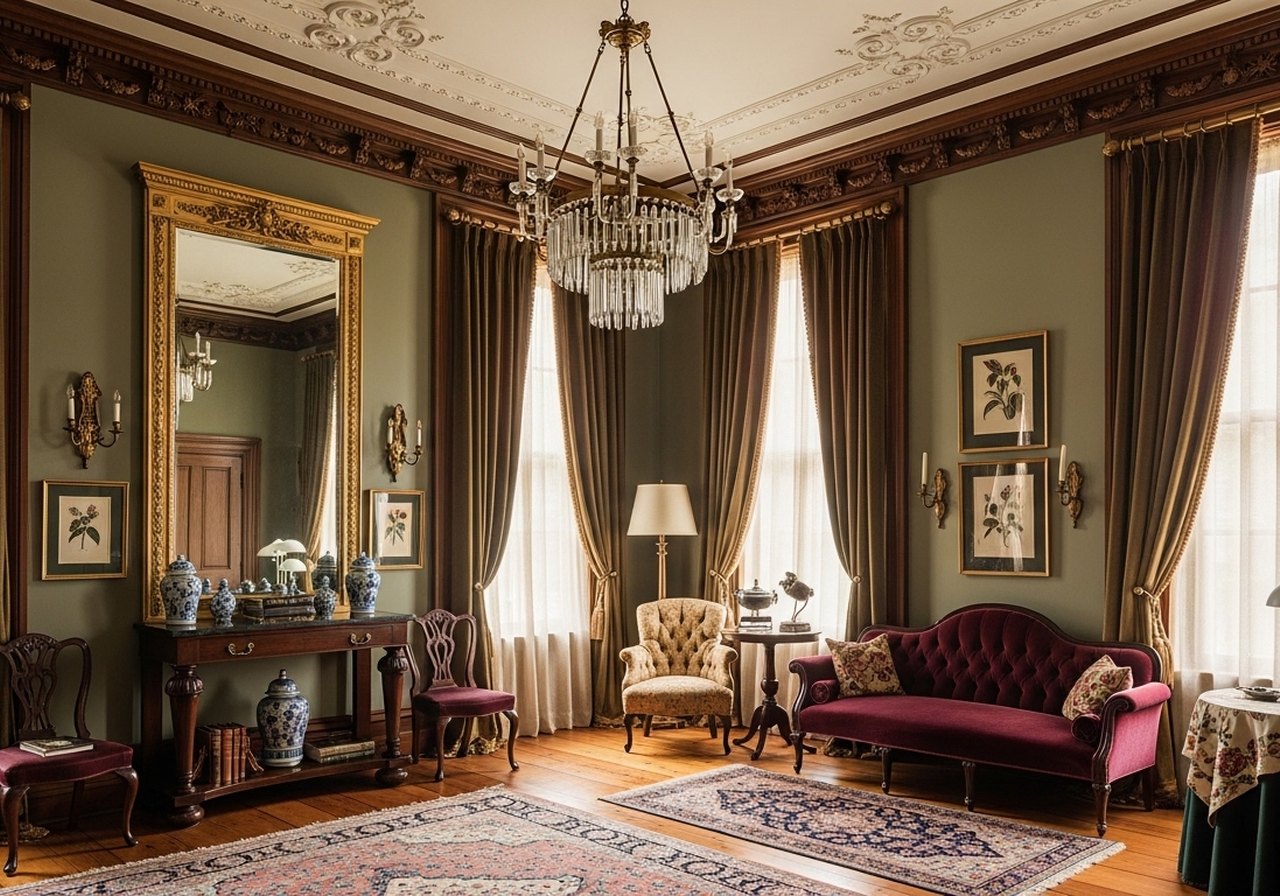
Our parlour has three oils on one long wall and one painting over the mantel. Working through this list, the plan that fits is the plug-in Advent in antique brass in two sizes matched to the frames, cords painted into the wall colour and a sideboard covering the outlet, and the rechargeable version over the mantel, where there is no outlet within reach and any cord would cut the chimney breast in half. If you are planning lamps and accent lights for a room like ours, start with the living room lamp placement guide and add picture lights last, once you see where the dark corners really are.
The Short Version
Buy a brass House of Troy Advent about half the width of the frame. Choose plug-in if an outlet is near and you can paint or hide the cord, and rechargeable if it is over a mantel or anywhere a cord would show. Mount to the wall, not the antique frame. Use 2700K LED. For a statement portrait with a budget to match, look at the Hudson Valley Vernon.