Home library ideas for a room that had exactly zero bookshelves when we bought it: floor-to-ceiling shelves on three walls detailed to the room's own trim, a rolling ladder on the longest wall, a built-in bench in the window alcove at 18 inches with storage below, and a pair of swing-arm sconces flanking the window positioned so the light falls over the shoulder and onto the page. The room is about 12 by 14 with a single east-facing window and original plaster on all four walls; when we moved in it held a pullout sofa and a television, and it is now the most intentional room in the house and the one visitors spend the most time in. This post is the shelves and why floor to ceiling, matching the trim so they read as original, the ladder that made the shelves make sense, the reading nook in the alcove and its 18-inch height, the two swing-arm sconces hardwired into the bookcase framing, the shelf lights that keep the books from disappearing, the floor lamp and the overhead on a dimmer, 2700K for long reading, what goes on the shelves and the face-out rule, the desk that did not happen, the carpenter and the upholsterer, the rug, the door that closes, what the room is used for now, the mistakes, and the cost.
Floor to ceiling, three walls
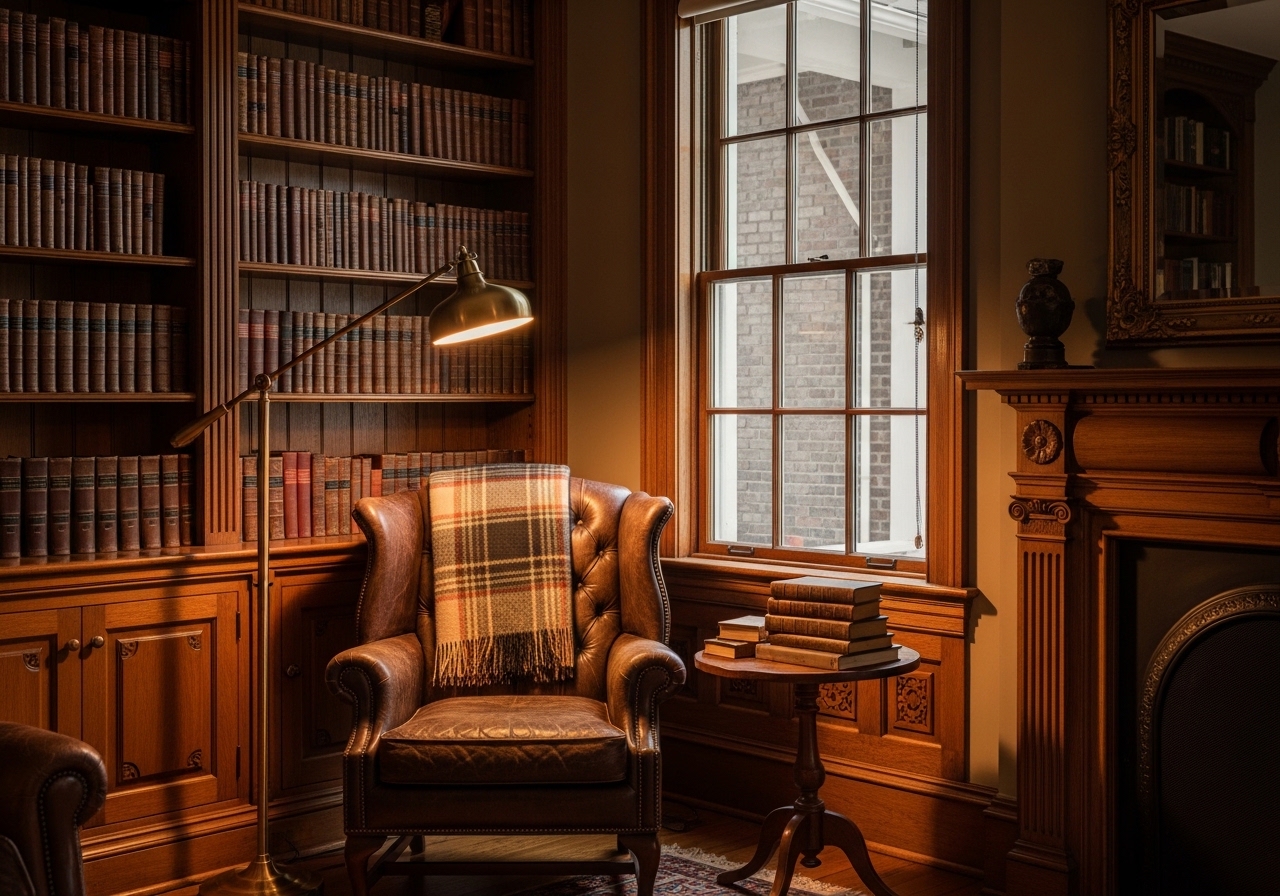
Shelves from the baseboard to 6 inches below the crown on the two long walls and the wall opposite the window, leaving the window wall for the alcove and the door wall's return; 10-foot ceilings mean the top two shelves are reached by the ladder and hold the books read least, which is the library's version of the pantry's top shelf. Anything less than floor to ceiling in a tall room reads as a bookcase in a room, and floor to ceiling reads as a room made of books, which is what a library is.
Matching the trim
The shelves' base matches the room's 9-inch baseboard, the face frames are the width of the door casing, the crown at the top dies into the plaster crown at each corner, and the shelf edges have the same quarter-round as the window stool; the carpenter had a knife ground to the baseboard's profile, as with the dining room's built-ins, and the shelves are painted the wall's warm off-white so they read as part of the original house rather than a modern add-on. Done that way, new built-ins are architecture; done any other way, they are furniture that cannot leave.
The ladder
A rolling library ladder on a brass rail along the longest wall, 9 feet of travel, which was the detail that made the rest of the shelving make sense: it gave the room a function and a character at the same time, and it is the object every guest touches. Brass to match the sconces, with a hook to park it at the wall's end so it is not across the door. It was $900 with the rail, and it is the most expensive single thing in the room after the shelves and the one I would not remove.
The nook
A built-in bench in the window alcove, 60 inches wide and 24 deep, cushioned in a tufted linen, with two cabinet doors below for the blankets and the board games; it sits about 18 inches off the floor, lower than a standard chair and exactly right for reading with your legs stretched out, and the alcove's depth means a reader is inside the window and not in front of it. It took a local carpenter two days to build and an upholsterer one more to finish the cushion, and it is the seat the room is for.
The two swing-arm sconces
A pair of wall-mounted swing-arm sconces flanking the window at 48 inches to the arm's pivot, hardwired directly into the bookcase framing so no plaster was opened, positioned so the light falls over the shoulder rather than into the eyes of a reader on the bench; each arm reaches 20 inches and swings out over the cushion and back against the shelf. The reading light was the most important decision in the whole project and hardwiring the pair into the framing was the best thing we did, because the framing is new wood and takes a box the way plaster never will.
The shelf lights
Small warm LED strips under the front edge of every third shelf, source hidden behind the shelf's lip, on a driver in the lower cabinet and a dimmer by the door, at 20 percent in the evening; without them the books above 6 feet disappear into shadow at night and the room reads as a dark box with a lit window seat. With them the shelves glow, the spines are readable to the crown, and the room is a library after dark. They were $220 for three walls and the lip is the detail that keeps them from reading as a shop's.
The floor lamp and the overhead
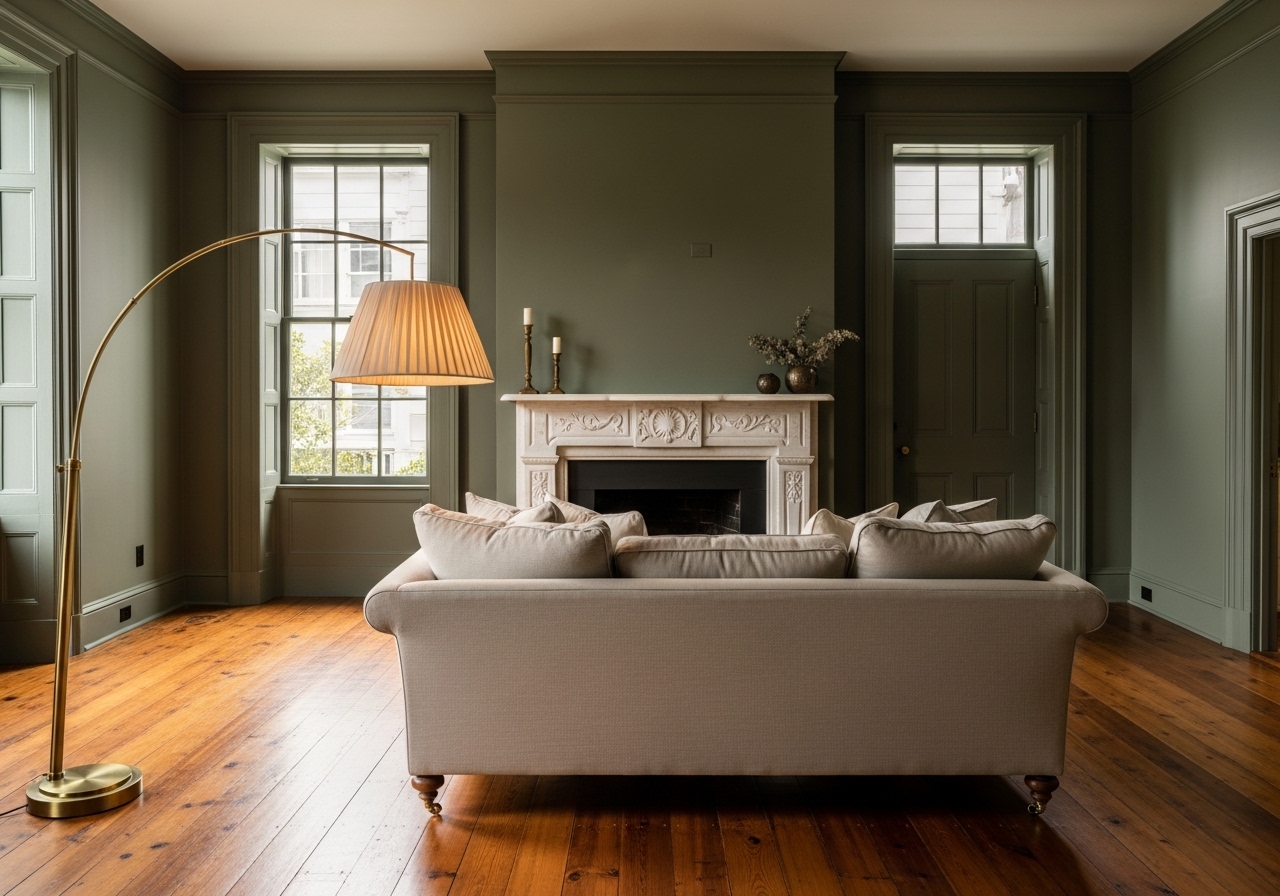
A floor lamp in the corner opposite the window, a brass arc with a linen shade, for the chair that is the room's second seat and for the evenings when more ambient light is needed; and the overhead, a 26-inch drum on a dimmer, for the rare occasions the room needs full light, a search or a clean. The overhead is at 20 percent most evenings and off most others, and the room is lit by the sconces, the shelf strips and the lamp, which is three layers at three heights. The layering post is the same three in the back parlor.
2700K, for long reading
A warm 2700K bulb in every fixture for comfort over hours of reading, with a warm-dimming bulb in the sconces so the last chapter is amber; a library is the room where a bulb's temperature is felt longest, and a 3000K reading light is a light that ends a book early. The sconces' bulbs are 450 lumens each and the two together on the bench are 900 on a page, which is enough for small type and not enough to wake the reader up.
What goes on the shelves
Books, mostly, about 1,400 of them, arranged by subject and within subject by whatever order we read them in, with a shelf per wall left half empty for the next year's; a few objects, a clock, two photographs, a bowl, at eye height where the eye rests. Face-out matters: a book picked by its cover is a book read, and the bottom shelf on the window wall holds the children's books face-out on a ledge for the guests' children, who find them without being shown. A shelf of spines is a wall; a shelf with a face-out row is an invitation.
The desk that did not happen
The plan had a desk under the window, and the bench replaced it, because a desk in a library makes it an office and a bench makes it a library, and the house has a desk elsewhere. A room's one job is the thing to protect, and the library's is reading, and a desk would have been the room's second job and its first excuse not to read. The bench's cabinets hold the laptop when it visits.
The carpenter and the upholsterer
The same millworker as the dining room's built-ins, five weeks in the shop and four days on site for the shelves and the bench, with three site visits for the measurements that an 1892 room requires; an upholsterer on Spring Street for the cushion, a day, in a tufted oatmeal linen with a zip cover that has been washed twice. The ladder came from a specialist and the carpenter fitted its rail. Two trades and a supplier, and the room took eight weeks from drawing to first book.
The rug
A flat-weave wool in a faded red, 9 by 12, the one colored thing in a room of cream shelves and oatmeal linen, because a library wants one warm thing on the floor and the heart pine under it is the second; it is the rug that makes the room read as old, and it was $600 at auction. Nothing else in the room has a color, and the rug is the reason nothing needs to.
The door that closes
The library's door is the only interior door on the ground floor that is closed in the evening, because a library is a room for being alone in a house that is otherwise open; its lock works, its hinges were oiled, and the room behind it is quiet in a way plaster and 1,400 books make it. The high ceilings post is why plaster is quiet; the books are the rest.
What the room is used for now
Reading, by the two of us and by every guest who discovers the bench; the children of guests, who take the face-out row to the rug; and the ladder, which is used more for the pleasure of it than for the top shelves. It is the room visitors spend the most time in, unsurprisingly, and the room that had a pullout sofa and a television is the room that has neither and is fuller.
Mistakes
The desk in the plan. Shelf lights on every shelf in the first estimate, which would have been a store; every third is right. The sconces' pivots at 54 inches in the drawing, lowered to 48 for a reader at 18 inches. And leaving the room as a television room for three years because it worked, which is the sentence that appears in every one of these posts and is the reason for all of them.
What it cost
The shelves, three walls, $9,800. The bench and its cabinets, $1,600, and the cushion, $420. The ladder and rail, $900. Two swing-arm sconces, $280, and the wiring into the framing, $220. Shelf strips and driver, $220, and dimmers, $44. The floor lamp, $380. The rug, $600. About $14,500 for the most intentional room in the house, and the $500 of sconces and wiring is the line that decided whether anyone would read in it.
The window by day
East, and the bench in its alcove is the brightest seat in the house until 11 am, with no curtain because the garden is the view and the light is the reason the bench is there; after noon the sconces do the alcove and the room turns from a morning room into an evening one. A library with one window is a library whose reading light changes at midday, and the two swing arms are the afternoon's window.
What I would tell someone with a room and no shelves
Shelves to the ceiling, in the room's own trim, on every wall the door and the window leave; a seat in the window if there is an alcove and a chair by it if there is not; two swing-arm sconces where the seat is, wired into the shelves' framing; a strip every third shelf; and no desk. The ladder is the luxury and the sconces are the necessity, and the shelves are the room. It is the most expensive room in this house per square foot and the one that has earned it most per hour.
A room with no shelves is a room waiting, and this one waited three years for the eight weeks that made it.
In one paragraph
Shelves floor to ceiling on three walls, detailed to the room's trim and painted its color; a brass rolling ladder; a built-in bench in the window alcove at 18 inches with storage below; two swing-arm sconces hardwired into the bookcase framing so the light falls over the shoulder; shelf strips every third shelf at 20 percent; a lamp for the chair and a drum overhead on a dimmer for rare full light; 2700K throughout; one red rug; a face-out row for the children; and no desk.
Shop this post: wall sconces with a swing arm, and brass sconces to match a ladder's rail